
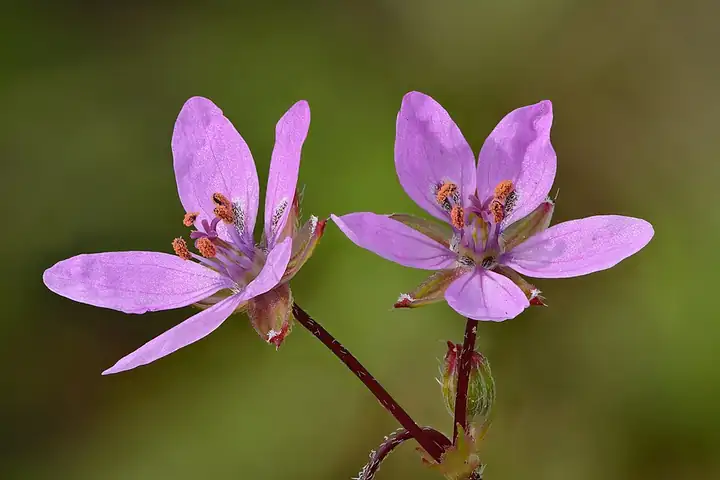
Redstem filaree
Erodium cicutarium
| Type | Broadleaf |
|---|---|
| Life cycle | Winter annual |
| Family | Geranium family (Geraniaceae) |
| Origin | Introduced from elsewhere |
| Most common in | Mountain West, Southwest, California |
About
Redstem filaree is a Mediterranean relative of garden geraniums that probably arrived with Spanish explorers in the 1700s. It's a common cool-season weed of dry lawns and beds, especially in the West, but it's also good forage for wildlife.
Also called filaree, storksbill, redstem stork's bill, cranesbill, heronsbill
How to identify it
Look for
It starts as a flat rosette of hairy, fern-like leaves cut into many small segments. Stems are often reddish. Small pink-purple flowers with five petals give way to long, pointed 'stork's bill' pods up to 2 inches long.
Look-alikes
Broadleaf filaree has less deeply cut leaves, and whitestem filaree has pale stems.
Where it grows
Dry, sunny lawns, planting beds, roadsides, pastures, orchards and rangeland.
When
Seeds sprout with fall and winter rains, rosettes overwinter, and plants flower from mid-spring into summer.
How it spreads
By seed: each seed has a corkscrew tail that twists with moisture and drills it into the soil, and seeds stay alive for years.
Most common in
| Northeast | Occasional here |
|---|---|
| Southeast | Occasional here |
| South Central | Common here |
| Midwest | Occasional here |
| Great Plains | Common here |
| Mountain West | Very common here |
| Southwest | Very common here |
| Pacific Northwest | Common here |
| California | Very common here |
| Alaska | Occasional here |
| Hawaii | Occasional here |
What to do, gentlest first
Start at the top. Weed killers are a last step; always read and follow the label.
Shade it out Prevent
Taller, thicker plantings cut the light it needs.
Pull or hoe rosettes before seed pods form By hand
Pull young rosettes or hoe them in winter and early spring, before the stork's-bill pods ripen.
Don't compost plants with pods.
Mulch beds Barrier
USU suggests about 3 inches of mulch in planting beds to cut down sprouting.
Broadleaf lawn herbicide on young plants Conventional spray
WSU lists 2,4-D, MCPP, dicamba and triclopyr products for lawns, glufosinate or triclopyr in landscapes, and glyphosate or glufosinate on bare ground.
Read and follow the label. Many lawn weed killers also kill garden plants, so keep spray and drift off beds and vegetables.
Uses, wildlife and pets
For wildlife
Rodents, desert tortoises, deer and livestock graze it, and birds eat the seeds (USDA Forest Service).
Pets
Not listed by the ASPCA.
Sources
Photo: Photo: Ivar Leidus / Wikimedia Commons, CC BY-SA 4.0 (CC BY-SA 4.0). Photo resized for the web.

Planting dates and advice are general guidance; check with your local Cooperative Extension office for your area.