
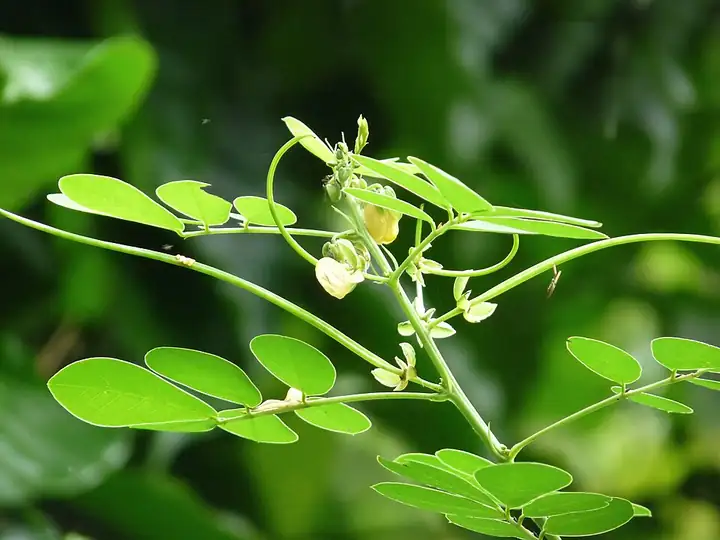
Sicklepod
Senna obtusifolia
| Type | Broadleaf |
|---|---|
| Life cycle | Summer annual |
| Family | Pea family (Fabaceae) |
| Origin | Native to the US |
| Most common in | Southeast, South Central |
About
A bad-smelling summer annual in the pea family, named for its long, sickle-curved pods, and one of the toughest weeds of Southern fields and gardens. Its hard seeds last for years, and they are toxic to livestock and poultry when they get into feed.
Also called coffeeweed, coffeebean, java-bean, American sicklepod
How to identify it
Look for
Seedlings have large, round seed leaves. Plants grow 1-6 feet with smooth, angled stems and leaves made of 3-4 pairs of oval leaflets that smell unpleasant when crushed. Yellow five-petal flowers sit in the leaf joints, followed by slender, four-sided pods 3-8 inches long that curve downward.
Look-alikes
Coffee senna has more (3-7 pairs) pointed leaflets and pods that curve upward; partridge pea has many more, much smaller leaflets.
Where it grows
Crop fields, gardens, pastures and disturbed sandy ground, mainly in the Southeast; it tolerates compacted soil.
When
Comes up from late spring through summer in warm soil, blooms 6-12 weeks after emergence, and flowers into late summer and fall.
How it spreads
By seed; plants make about 1,500-16,000 seeds with hard, waxy coats that keep many dormant in the soil for years.
Most common in
| Northeast | Occasional here |
|---|---|
| Southeast | Very common here |
| South Central | Very common here |
| Midwest | Occasional here |
| Great Plains | Occasional here |
| Mountain West | Occasional here |
| Southwest | Occasional here |
| Pacific Northwest | Occasional here |
| California | Occasional here |
| Alaska | Not found here |
| Hawaii | Occasional here |
Where it is regulated
Alabama lists sicklepod as a restricted noxious weed seed under its seed law.
What to do, gentlest first
Start at the top. Weed killers are a last step; always read and follow the label.
Plant densely and mow before bloom Prevent
Close spacing and quick canopy cover suppress it. In grassy areas, mowing just before it flowers stops or greatly cuts seed production.
Shallow hoe while young By hand
Hoe or pull young plants; shallow cultivation beats deep digging, which buries seeds that come back up in later years.
Use landscape fabric or plastic mulch Barrier
Synthetic mulches are effective against sicklepod.
Uses, wildlife and pets
For wildlife
Sulphur butterfly caterpillars feed on it.
Pets
Not listed by the ASPCA. Livestock usually avoid it but can be poisoned, and the seeds are a serious risk to chickens and pigs when mixed into feed.
Sources
Photo: Photo: Jeevan Jose, Kerala, India / Wikimedia Commons, CC BY-SA 4.0 (CC BY-SA 4.0). Photo resized for the web.

Planting dates and advice are general guidance; check with your local Cooperative Extension office for your area.