
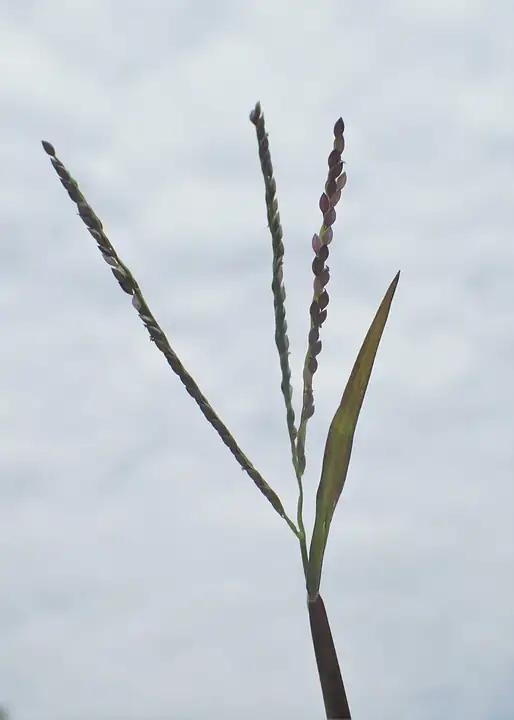
Smooth crabgrass
Digitaria ischaemum
| Type | Grass |
|---|---|
| Life cycle | Summer annual |
| Family | Grass family (Poaceae) |
| Origin | Introduced from elsewhere |
| Most common in | Northeast, Southeast, Midwest |
About
A low-growing summer annual grass that shows up in thin lawns alongside large crabgrass. It sets seed even when mowed short, then dies at frost and leaves gaps.
Also called crabgrass
How to identify it
Look for
Smaller than large crabgrass and often lies flat. Leaves are smooth, about 1/4 inch wide, with just a few long hairs near the base, and older leaves and sheaths turn reddish purple. Seedheads have 2 to 6 finger-like spikes at the stem tip.
Look-alikes
Large crabgrass is hairy on the leaves and sheaths. Goosegrass also grows flat, but it has a silvery-white center and its stems don't root at the joints.
Where it grows
Thin, sunny lawns, lawn edges, garden beds, cracks in paving and other bare soil.
When
Sprouts from spring into early summer when soil reaches the mid-50s F, flowers and seeds from late summer into fall, and dies at the first frost.
How it spreads
Spreads by seed, even from plants mowed as low as 1/2 inch, and now and then by low stems rooting at the joints.
Most common in
| Northeast | Very common here |
|---|---|
| Southeast | Very common here |
| South Central | Common here |
| Midwest | Very common here |
| Great Plains | Common here |
| Mountain West | Common here |
| Southwest | Occasional here |
| Pacific Northwest | Common here |
| California | Common here |
| Alaska | Not found here |
| Hawaii | Not found here |
What to do, gentlest first
Start at the top. Weed killers are a last step; always read and follow the label.
Mow high and keep the lawn thick Prevent
Mow at the right height for your grass (about 3 inches for cool-season lawns), water deeply and less often, and fertilize properly so turf shades out seedlings.
Pull young plants before they seed By hand
Hand-pull or hoe small plants in beds and lawns before seedheads form.
Bag plants with seedheads instead of composting them.
Mulch garden beds Barrier
Keep 2 to 6 inches of wood chips or compost, or fabric under mulch, on bed soil to block the light seeds need.
Corn gluten meal before seeds sprout Organic spray
Spread corn gluten meal in early spring, 3 to 5 weeks before crabgrass sprouts, and water it in lightly. It won't kill plants that are already up.
Don't use it where you plan to sow seed.
Spring pre-emergent, or spot-treat young plants Conventional spray
Apply prodiamine, dithiopyr or pendimethalin before soil reaches about 55 degrees F and water it in. Young plants in lawns can be spot-treated with quinclorac or mesotrione.
Read and follow the label. Many lawn herbicides kill garden plants, so keep spray and drift off beds and vegetables. Most pre-emergents also stop grass seed you sow.
Uses, wildlife and pets
Pets
Not listed as toxic to dogs, cats or horses by the ASPCA.
Sources
- ipm.ucanr.edu
- ipm.ucanr.edu
- content.ces.ncsu.edu
- extension.psu.edu
- extension.umn.edu
- yardandgarden.extension.iastate.edu
- plantsservices.sc.egov.usda.gov
- aspca.org
- aspca.org
- aspca.org
Photo: Photo: Krzysztof Ziarnek, Kenraiz / Wikimedia Commons, CC BY-SA 4.0 (CC BY-SA 4.0). Photo resized for the web.

Planting dates and advice are general guidance; check with your local Cooperative Extension office for your area.