
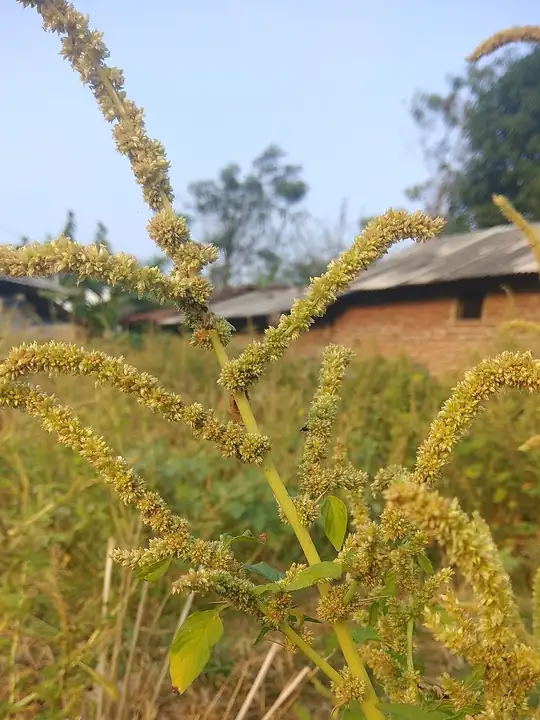
Spiny amaranth
Amaranthus spinosus
| Type | Broadleaf |
|---|---|
| Life cycle | Summer annual |
| Family | Amaranth family (Amaranthaceae) |
| Origin | Native to the US |
| Most common in | Southeast, South Central |
About
A pigweed armed with a pair of sharp spines where each leaf meets the stem, common in pastures, gardens and fields, especially in the Southeast. It makes enormous numbers of seeds, the spines hurt bare hands, and it can build up nitrates that sicken livestock.
Also called spiny pigweed, spiny carelessweed, stickerweed, hogweed
How to identify it
Look for
An upright to bushy plant 1-4 feet tall (sometimes 5) with smooth, hairless stems that are often red. Leaves are alternate and oval to egg-shaped, about 1-2.5 inches long. Look for two stiff spines, up to about 1/2 inch, at each leaf joint; male flowers form slender spikes at the tips and female flowers cluster along the stem.
Look-alikes
Other pigweeds, such as redroot, smooth and Palmer amaranth, have no spines at the leaf joints.
Where it grows
Overgrazed or bare spots in pastures (such as around hay feeders), gardens, crop fields and waste areas.
When
Seedlings come up in late spring and early summer and grow through the hot months; seeds sprout best in warm soil at or near the surface.
How it spreads
By seed; plants make roughly 110,000-235,000 seeds, most of which sprout from the soil surface.
Most common in
| Northeast | Occasional here |
|---|---|
| Southeast | Very common here |
| South Central | Very common here |
| Midwest | Common here |
| Great Plains | Common here |
| Mountain West | Occasional here |
| Southwest | Occasional here |
| Pacific Northwest | Occasional here |
| California | Occasional here |
| Alaska | Not found here |
| Hawaii | Occasional here |
What to do, gentlest first
Start at the top. Weed killers are a last step; always read and follow the label.
Keep grass thick Prevent
A dense, healthy lawn or pasture (right pH, enough fertility, no overgrazing) leaves little bare soil for it. Move hay feeders or other heavy-use spots around.
Hoe small plants, dig bigger ones before they flower By hand
Hoe seedlings while they are under about an inch tall. Dig out larger plants with a spade or dandelion fork before flower spikes appear; mowed plants can still make some seed.
Wear sturdy gloves; the spines are sharp.
Mulch thickly Barrier
A 3-4 inch layer of straw or hay cuts pigweed emergence by about 90 percent.
Treat seedlings in lawns or pasture Conventional spray
Dicamba or 2,4-D, applied while plants are small seedlings, controls it in grass areas.
Read and follow the label. Many lawn weed killers also kill vegetables and flowers, and glyphosate harms any plant it touches.
Uses, wildlife and pets
Pets
Not listed by the ASPCA. It can store high levels of nitrate, and cattle, goats, sheep and pigs that eat it (usually only when other forage is short) risk nitrate poisoning and heart or kidney damage. The spines can also hurt animals.
Sources
- utia.tennessee.edu
- extension.purdue.edu
- eorganic.org
- cals.cornell.edu
- plantsservices.sc.egov.usda.gov
- aspca.org
Photo: Photo: Aris riyanto / Wikimedia Commons, CC BY-SA 4.0 (CC BY-SA 4.0). Photo resized for the web.

Planting dates and advice are general guidance; check with your local Cooperative Extension office for your area.