
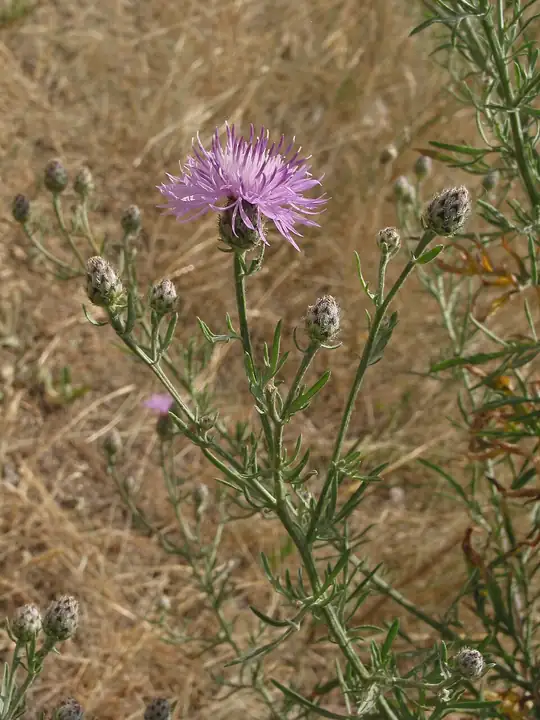
Spotted knapweed
Centaurea stoebe
| Type | Broadleaf |
|---|---|
| Life cycle | Perennial |
| Family | Aster family (Asteraceae) |
| Origin | Introduced from elsewhere |
| Most common in | Midwest, Mountain West, Pacific Northwest |
About
Spotted knapweed is a European biennial or short-lived perennial with thistle-like pink flowers that has spread across dry, open ground in much of the country. It crowds out other plants, livestock avoid it, and handling it can irritate the skin.
Also called knapweed
How to identify it
Look for
The first year it makes a low rosette of grayish-green, deeply divided leaves. Later it sends up 1 to 20 wiry, branched stems 2 to 4 feet tall with small, deeply cut leaves. The pink to purple flower heads sit on stiff bracts tipped with black, fringed hairs that look like spots.
Look-alikes
Canada thistle has prickly leaves; spotted knapweed doesn't. Other knapweeds (diffuse, meadow, brown, Russian) look similar, and the bracts under the flower are the main key; the black-tipped fringe marks spotted knapweed.
Where it grows
Dry, sandy or gravelly open ground: roadsides, field edges, gravel pits, pastures, prairies and dunes.
When
It grows from spring, flowers from about late June to September, and drops seed from late summer on; rosettes can wait 1 to 4 years before bolting.
How it spreads
By seed: a plant makes about 1,000 seeds and a big one up to 25,000, which last in soil up to 7 years and hitch rides on vehicles, hay, livestock and rodents.
Most common in
| Northeast | Common here |
|---|---|
| Southeast | Occasional here |
| South Central | Occasional here |
| Midwest | Very common here |
| Great Plains | Common here |
| Mountain West | Very common here |
| Southwest | Occasional here |
| Pacific Northwest | Very common here |
| California | Occasional here |
| Alaska | Not found here |
| Hawaii | Occasional here |
Where it is regulated
Listed as a noxious weed in many states, including Washington (Class B), California and Minnesota (prohibited).
What to do, gentlest first
Protect yourself first. Weed killers are a last step; always read and follow the label.
Don't give seeds a ride Prevent
Avoid driving through patches, wash vehicle undercarriages after being in infested areas, and use weed-free hay. Report new patches to your county weed office or EDDMapS.
Dig or pull the taproot before seed By hand
Pull or dig plants when the soil is wet, getting as much taproot as you can, before seeds form. Mowing from about May into July, before flowering, cuts seed production.
Wear gloves and long sleeves. Don't mow once seeds are present, and bag flowering plants instead of composting them.
Knapweed weevils Natural enemies
Seedhead weevils (Larinus minutus and L. obtusus) and a root-boring weevil (Cyphocleonus achates) are established biocontrols. Ask your state department of agriculture or Extension about them.
Systemic herbicide on rosettes or bolting plants Conventional spray
Minnesota DNR lists aminopyralid, clopyralid, glyphosate, imazapyr, aminocyclopyrachlor and picloram. Treat rosettes in fall or plants starting to bolt in spring, and expect to repeat for several years.
Read and follow the label. Many lawn weed killers also kill garden plants, so keep spray and drift off beds and vegetables. Picloram is restricted-use, for certified applicators only.
Uses, wildlife and pets
Pets
Not listed by the ASPCA.
Sources
- dnr.state.mn.us
- dnr.wisconsin.gov
- extension.unr.edu
- invasivespeciesinfo.gov
- plantsservices.sc.egov.usda.gov
- aspca.org
Photo: Photo: Robert Flogaus-Faust / Wikimedia Commons, CC BY 4.0 (CC BY 4.0). Photo resized for the web.

Planting dates and advice are general guidance; check with your local Cooperative Extension office for your area.