
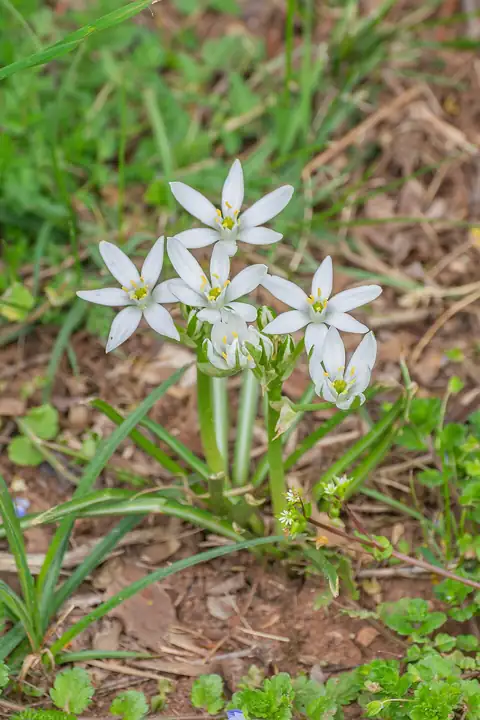
Star-of-Bethlehem
Ornithogalum umbellatum
| Type | Broadleaf |
|---|---|
| Life cycle | Perennial |
| Family | Lily family (Liliaceae) |
| Origin | Introduced from elsewhere |
About
A spring-blooming bulb from Europe that escapes gardens and forms dense patches in lawns. It's pretty in flower, but every part is poisonous, especially the bulbs.
Also called star of Bethlehem, dove's dung, sleepydick
How to identify it
Look for
Narrow, glossy, dark green leaves with a light green to white stripe down the middle, folded into a U shape rather than a hollow tube. In spring, clusters of white, six-petaled star flowers with green stripes on the back open around midday and close in the evening or on cloudy days. It grows from small bulbs just under the soil surface.
Look-alikes
Often mistaken for wild onion or wild garlic, but it has no onion or garlic smell, its leaves carry a white midstripe, and it stays about half as tall. Never eat an onion look-alike that doesn't smell of onion.
Where it grows
Lawns, garden beds, roadsides, pastures and woodland edges.
When
Leaves come up in early spring and flowers open in late April or May; after that it blends into the lawn until next spring.
How it spreads
Spreads by underground bulbs and offsets that build dense colonies, plus some self-sown seed; digging or tilling scatters the bulbs.
Most common in
| Northeast | Common here |
|---|---|
| Southeast | Common here |
| South Central | Occasional here |
| Midwest | Common here |
| Great Plains | Occasional here |
| Mountain West | Occasional here |
| Southwest | Not found here |
| Pacific Northwest | Occasional here |
| California | Occasional here |
| Alaska | Not found here |
| Hawaii | Not found here |
Where it is regulated
Alabama lists it as a Class C noxious weed.
What to do, gentlest first
Protect yourself first. Weed killers are a last step; always read and follow the label.
Don't plant it Prevent
It naturalizes quickly and escapes into lawns and wild areas, so choose a different spring bulb.
Dig out the bulbs By hand
Dig up clumps and every bulb with a trowel. For patches in the lawn, mowing more often in spring keeps the leaves down until they fade.
Wear gloves, and bag the bulbs so kids and animals can't reach them.
Sulfentrazone or carfentrazone for partial control Conventional spray
Most herbicides do little. Lawn products with sulfentrazone or carfentrazone give some control when sprayed on actively growing leaves in spring.
Read and follow the label. Many lawn herbicides kill garden plants, so keep spray and drift off beds and vegetables.
Uses, wildlife and pets
For wildlife
Its flowers attract bees.
Pets
Listed by the ASPCA as toxic to dogs, cats and horses (vomiting, diarrhea, belly pain and heart rhythm problems). Purdue University says all parts, especially the bulbs, poison cattle, sheep and horses and should not be eaten by people or animals.
Sources
- plants.ces.ncsu.edu
- ag.purdue.edu
- turf.purdue.edu
- ag.purdue.edu
- ag.purdue.edu
- poison.org
- plantsservices.sc.egov.usda.gov
- aspca.org
Photo: Photo: Krzysztof Golik / Wikimedia Commons, CC BY-SA 4.0 (CC BY-SA 4.0). Photo resized for the web.

Planting dates and advice are general guidance; check with your local Cooperative Extension office for your area.