
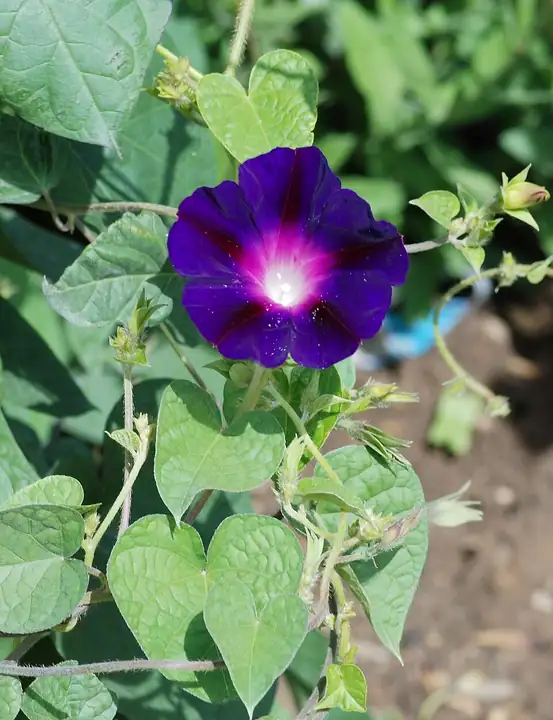
Tall morningglory
Ipomoea purpurea
| Type | Vine |
|---|---|
| Life cycle | Summer annual |
| Family | Morning glory family (Convolvulaceae) |
| Origin | Introduced from elsewhere |
| Most common in | Southeast, South Central, Midwest |
About
A vigorous twining vine from Mexico and Central America, sometimes grown for its purple, pink, blue or white trumpet flowers. It reseeds heavily and climbs over crops, fences and shrubs, and its hard seeds last for years in the soil.
Also called common morning glory, purple morning glory, tall morning-glory
How to identify it
Look for
Seedlings have butterfly-shaped seed leaves. Leaves are heart-shaped, 1-3 inches, with fine hairs that lie flat against the surface, on hairy, often purplish stems. Flowers are about 1.75-2.75 inches long, in clusters of three or more, and open in the morning and close by afternoon.
Look-alikes
Ivyleaf morningglory has three-lobed leaves with hairs that stand straight up, and pitted morningglory is hairless.
Where it grows
Vegetable gardens, crop fields, fences and garden edges, and it is worst in warm, humid areas.
When
Sprouts from late spring into summer with a peak in early summer, begins blooming 6-8 weeks after emergence, and keeps flowering and setting seed until frost.
How it spreads
By seed; a plant can make about 26,000 seeds with no competition, and the hard seed coats let seeds persist in the soil for years.
Most common in
| Northeast | Common here |
|---|---|
| Southeast | Very common here |
| South Central | Very common here |
| Midwest | Very common here |
| Great Plains | Common here |
| Mountain West | Occasional here |
| Southwest | Occasional here |
| Pacific Northwest | Occasional here |
| California | Occasional here |
| Alaska | Not found here |
| Hawaii | Occasional here |
Where it is regulated
Morningglory seeds (Ipomoea species) are noxious weed seeds under state seed laws in states including Arizona (prohibited) and Arkansas, Hawaii and Kansas (restricted).
What to do, gentlest first
Protect yourself first. Weed killers are a last step; always read and follow the label.
Deadhead garden plantings and clean up edges Prevent
If you grow it on purpose, remove spent flowers before the capsules ripen, and pull volunteer vines along fences and edges before they seed. A stale seedbed (water, let seeds sprout, then shallowly cultivate) knocks out a flush before planting.
Pull seedlings before 5 inches By hand
Hand-pull or hoe seedlings before they are about 5 inches long and start twining around your plants.
Use plastic mulch or solarize Barrier
Plastic mulch blocks seedlings, but straw does not. Solarizing moist soil under clear plastic in hot weather kills many seeds near the surface.
Uses, wildlife and pets
For wildlife
Bumblebees, specialist morning-glory bees, butterflies and hummingbirds visit the flowers.
Pets
Morning glories (Ipomoea species) are listed by the ASPCA as toxic to dogs, cats and horses; eating the seeds can cause vomiting, and large amounts may cause hallucinations.
Sources
- cals.cornell.edu
- plants.ces.ncsu.edu
- vegcropshotline.org
- plantsservices.sc.egov.usda.gov
- aspca.org
- poison.org
- ams.usda.gov
Photo: Photo: Alvesgaspar / Wikimedia Commons, CC BY-SA 3.0 (CC BY-SA 3.0). Photo resized for the web.

Planting dates and advice are general guidance; check with your local Cooperative Extension office for your area.