
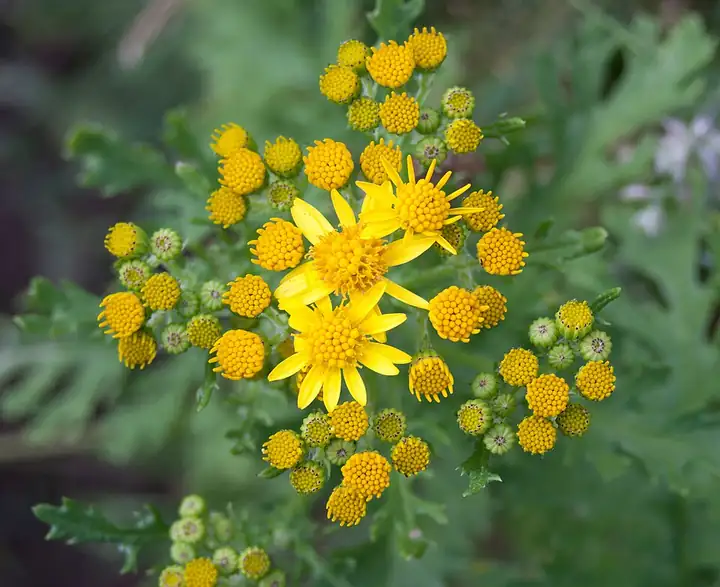
Tansy ragwort
Senecio jacobaea
| Type | Broadleaf |
|---|---|
| Life cycle | Biennial |
| Family | Aster family (Asteraceae) |
| Origin | Introduced from elsewhere |
| Most common in | Pacific Northwest |
About
A yellow-flowered European weed of pastures and roadsides in the coastal Northwest, northern California and New England. It slowly destroys the liver of horses and cattle that eat it, fresh or dried in hay.
Also called stinking willie, ragwort
How to identify it
Look for
First-year plants form a rosette of dark green, deeply lobed, ruffled leaves. Flowering stems grow 1½ to 4 feet tall with flat-topped clusters of yellow daisy-like heads, usually with about 13 petals, and black-tipped bracts underneath.
Look-alikes
Common tansy has fern-like leaves and button flowers with no petals; St. Johnswort flowers have only 5 petals. Tall butterweed has fewer petals (5 to 8) and toothed leaves.
Where it grows
Pastures, roadsides, fields, logged or cleared forest land and other open, disturbed ground with plenty of rain.
When
Grows as a rosette the first year and flowers from midsummer into fall the second year; mowed plants can come back for years.
How it spreads
Spreads mostly by seed, which can live up to 15 years in the soil, and can regrow from root pieces.
Most common in
| Northeast | Occasional here |
|---|---|
| Southeast | Not found here |
| South Central | Not found here |
| Midwest | Not found here |
| Great Plains | Not found here |
| Mountain West | Occasional here |
| Southwest | Not found here |
| Pacific Northwest | Very common here |
| California | Common here |
| Alaska | Not found here |
| Hawaii | Not found here |
Where it is regulated
Washington lists it as a Class B noxious weed, and Oregon as a Class B and target (T) weed.
What to do, gentlest first
Protect yourself first. Weed killers are a last step; always read and follow the label.
Keep pastures thick and hay clean Prevent
Good pasture care and reseeding bare spots crowd out rosettes. Check and don't feed hay that contains ragwort.
Dried plants in hay are still toxic.
Pull or dig the whole plant By hand
Pull or dig out the entire plant, roots included, ideally before it flowers. Hoeing or tilling also works in gardens.
Wear gloves. Seal flowering plants in a plastic bag for the trash. Mowing alone won't kill it.
Cinnabar moth, flea beetle and seed-head fly Natural enemies
Three released insects, the cinnabar moth, the ragwort flea beetle and a seed-head fly, have knocked it down across much of western Oregon. Sheep and goats can also graze it.
Treat rosettes with 2,4-D, dicamba or glyphosate Conventional spray
Spray rosettes in spring or after fall rains; in landscape beds use glyphosate only as a spot treatment.
Read and follow the label. Many lawn and brush herbicides also kill garden plants, so keep spray and drift off anything you want to keep.
Uses, wildlife and pets
Pets
Ragworts (Senecio species) are toxic to dogs, cats and horses (ASPCA), causing liver damage that can show up suddenly.
Sources
Photo: Photo: Julie Anne Workman / Wikimedia Commons, CC BY-SA 3.0 (CC BY-SA 3.0). Photo resized for the web.

Planting dates and advice are general guidance; check with your local Cooperative Extension office for your area.