
Torpedograss
Panicum repens
| Type | Grass |
|---|---|
| Life cycle | Perennial |
| Family | Grass family (Poaceae) |
| Origin | Introduced from elsewhere |
| Most common in | Southeast |
About
Torpedograss is an aggressive perennial grass from the Old World tropics, once planted for cattle pasture, that now invades Southern lawns, beds and waterways. Its tough rhizomes regrow after most treatments, and there is no selective fix in St. Augustinegrass lawns.
Also called torpedo grass
How to identify it
Look for
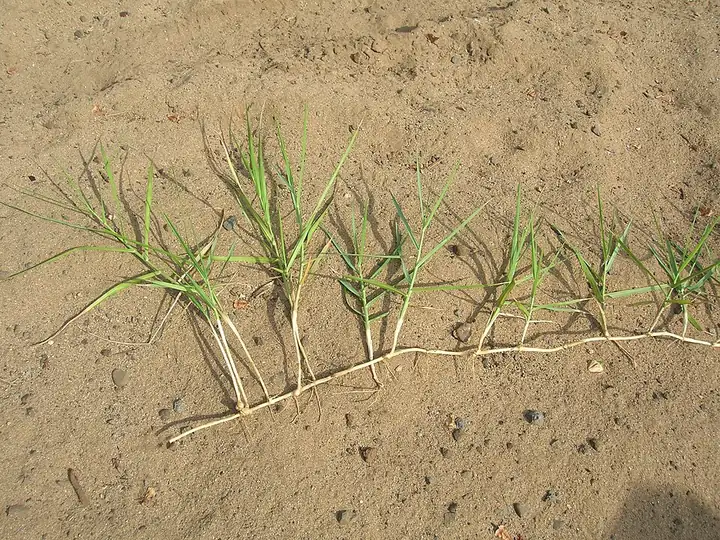
Dig it up to find thick rhizomes with sharp, pointed tips shaped like a torpedo. Stiff, upright stems carry waxy, silvery-green leaves that are flat or folded, with hairs on the sheath. Seedheads are open, 3 to 9 inch panicles.
Where it grows
Wet soil and shallow water, plus lawns, gardens, landscape beds and old fields in the Deep South.
When
It is a warm-season grass that grows actively through the warm months.
How it spreads
Almost entirely by rhizomes and stem pieces, often moved on mowers and equipment or in fill soil; in Florida its seed is rarely viable.
Most common in
| Northeast | Not found here |
|---|---|
| Southeast | Very common here |
| South Central | Common here |
| Midwest | Not found here |
| Great Plains | Not found here |
| Mountain West | Not found here |
| Southwest | Not found here |
| Pacific Northwest | Not found here |
| California | Not found here |
| Alaska | Not found here |
| Hawaii | Occasional here |
What to do, gentlest first
Start at the top. Weed killers are a last step; always read and follow the label.
Keep it from moving in Prevent
Make sure fill soil, mulch and plants come from clean sources, and clean mowers and tools after working in an infested area.
Digging is hard to finish By hand
UF/IFAS notes hand removal has limited success, and tilling just chops the rhizomes into new plants.
Don't till an infested bed before treating it.
Spot treat or repeat selective sprays Conventional spray
In bermudagrass and zoysiagrass lawns, LSU lists repeated quinclorac sprays. In centipedegrass, sethoxydim only suppresses it. In beds or St. Augustinegrass, spot-spray glyphosate, then replant or resod.
Read and follow the label. Many lawn weed killers also kill garden plants, so keep spray and drift off beds and vegetables. Glyphosate kills any plant it touches.
Uses, wildlife and pets
Pets
Not listed by the ASPCA.
Sources
- lsuagcenter.com
- plants.ifas.ufl.edu
- journals.flvc.org
- extension.msstate.edu
- plantsservices.sc.egov.usda.gov
- aspca.org
Photo: Photo: Forest & Kim Starr / Wikimedia Commons, CC BY 3.0 (CC BY 3.0). Photo resized for the web.

Planting dates and advice are general guidance; check with your local Cooperative Extension office for your area.