
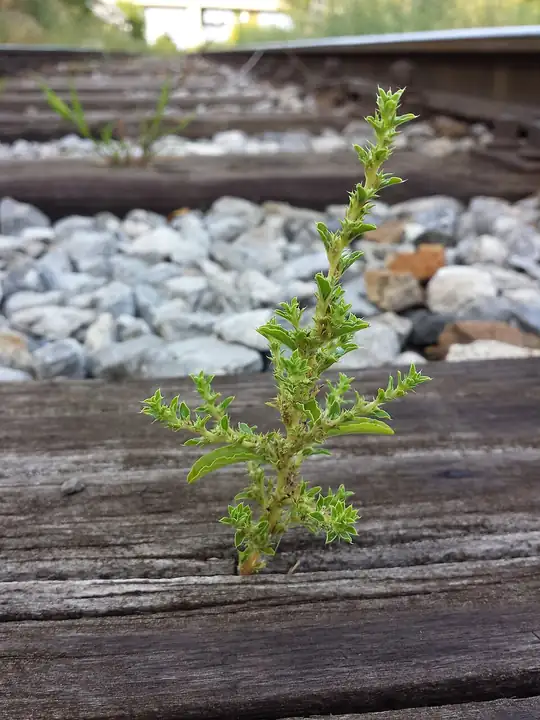
Tumble pigweed
Amaranthus albus
| Type | Broadleaf |
|---|---|
| Life cycle | Summer annual |
| Family | Amaranth family (Amaranthaceae) |
| Origin | Introduced from elsewhere |
| Most common in | Great Plains, Mountain West, Southwest |
About
A bushy, pale-stemmed pigweed that grows into a round clump, then snaps off at the base when dry and rolls in the wind like a tumbleweed, dropping seed as it goes. It turns up in gardens, fields, pastures and roadsides across the country.
Also called prostrate pigweed
How to identify it
Look for
A much-branched, globe-shaped plant 1/2-3 feet tall with smooth, pale green to whitish stems. Leaves are small, light green (often reddish underneath), spoon-shaped and wavy-edged. Tiny greenish flowers with spiny bracts sit in tight clusters in the leaf joints rather than in spikes at the tips, and seeds are tiny, round and glossy black.
Look-alikes
Redroot, smooth and Palmer amaranth grow upright with dense flower spikes at the stem tips; tumble pigweed's flowers sit only in the leaf joints.
Where it grows
Cultivated fields, gardens, pastures, roadsides and other disturbed ground.
When
Sprouts from late winter through summer as the soil warms and grows through the hot months; plants dry out in fall and break loose to tumble.
How it spreads
By seed; dried plants break off at ground level and roll across open ground, scattering seeds as they go.
Most common in
| Northeast | Occasional here |
|---|---|
| Southeast | Occasional here |
| South Central | Common here |
| Midwest | Common here |
| Great Plains | Very common here |
| Mountain West | Very common here |
| Southwest | Very common here |
| Pacific Northwest | Common here |
| California | Common here |
| Alaska | Occasional here |
| Hawaii | Not found here |
What to do, gentlest first
Start at the top. Weed killers are a last step; always read and follow the label.
Use a stale seedbed Prevent
Before planting, prepare and water the bed so pigweed seeds sprout, then kill the seedlings with shallow cultivation before sowing your crop.
Hoe tiny seedlings, pull before it flowers By hand
Hoe while seedlings are under about an inch tall. Pull bigger plants before the flower clusters form, and get them out before they dry and break loose.
Even pulled plants in flower can ripen seed, so bag them.
Mulch thickly Barrier
A 3-4 inch layer of straw or hay cuts pigweed emergence by about 90 percent; seeds sprout only from the top inch of soil.
Summer cover crops Natural enemies
A summer cover of cowpeas or soybeans mixed with tall grasses shades out pigweed seedlings.
Uses, wildlife and pets
Pets
Not listed by the ASPCA.
Sources
- weedid.missouri.edu
- cals.cornell.edu
- ipm.ucanr.edu
- eorganic.org
- plantsservices.sc.egov.usda.gov
- aspca.org
Photo: Photo: Stefan.lefnaer / Wikimedia Commons, CC BY-SA 4.0 (CC BY-SA 4.0). Photo resized for the web.

Planting dates and advice are general guidance; check with your local Cooperative Extension office for your area.