
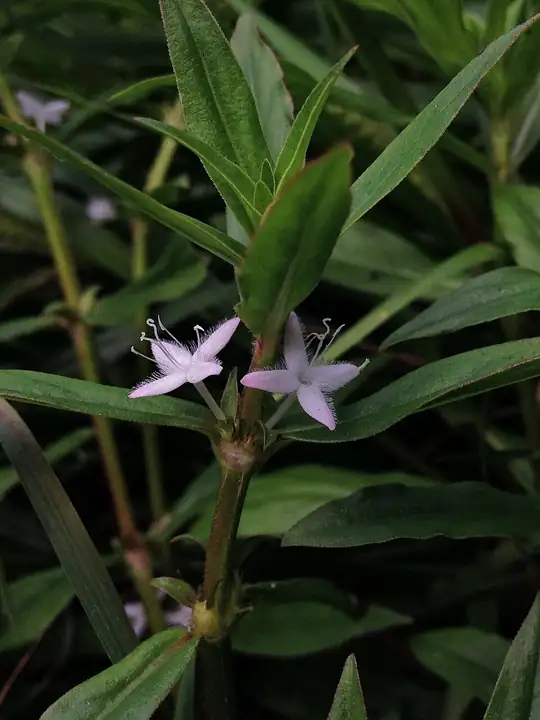
Virginia buttonweed
Diodia virginiana
| Type | Broadleaf |
|---|---|
| Life cycle | Perennial |
| Family | Madder family (Rubiaceae) |
| Origin | Native to the US |
| Most common in | Southeast |
About
Virginia buttonweed is a native wetland plant that becomes a tough, mat-forming lawn weed in damp Southern yards. Its deep roots and rooting stem pieces make it one of the harder lawn weeds to get rid of.
Also called buttonweed, large buttonweed, poor Joe
How to identify it
Look for
Stems creep low and are often reddish and square. Shiny, dark green, lance-shaped leaves sit in opposite pairs with no leaf stalks. Summer flowers are small white stars with four petals, and by late summer leaves may look mottled yellow-green from a virus.
Where it grows
Poorly drained or overwatered lawns and other wet spots; in the wild, swamps, wet meadows and pond edges.
When
It is a problem from spring through late summer and flowers from about June to November.
How it spreads
By seed, by rhizomes, and by stem pieces that root easily in moist soil after mowing or string trimming.
Most common in
| Northeast | Occasional here |
|---|---|
| Southeast | Very common here |
| South Central | Common here |
| Midwest | Occasional here |
| Great Plains | Occasional here |
| Mountain West | Not found here |
| Southwest | Not found here |
| Pacific Northwest | Not found here |
| California | Not found here |
| Alaska | Not found here |
| Hawaii | Not found here |
What to do, gentlest first
Start at the top. Weed killers are a last step; always read and follow the label.
Dry out wet spots and keep turf dense Prevent
Water deeply but less often, core aerate, fix drainage, and mow at the right height for your grass. Bag clippings from patches so stem pieces don't spread.
Pulling rarely works By hand
Clemson notes hand pulling is not effective because the deep roots and leftover pieces resprout. If you pull small plants in beds, dig deep and bag everything.
Treat in spring while plants are tender Conventional spray
Clemson lists metsulfuron, or 2,4-D, dicamba and mecoprop (MCPP) products, applied in spring and repeated as the label allows; fall sprays work less well. For large patches with little grass left, glyphosate and then resodding.
Read and follow the label. Many lawn weed killers also kill garden plants, so keep spray and drift off beds and vegetables. Don't use metsulfuron on tall fescue, on turf under a year old, or under the drip line of trees and shrubs.
Uses, wildlife and pets
For wildlife
Its flowers draw bees (NC State Extension).
Pets
Not listed by the ASPCA.
Sources
Photo: Photo: Fritzflohrreynolds / Wikimedia Commons, CC BY-SA 3.0 (CC BY-SA 3.0). Photo resized for the web.

Planting dates and advice are general guidance; check with your local Cooperative Extension office for your area.