
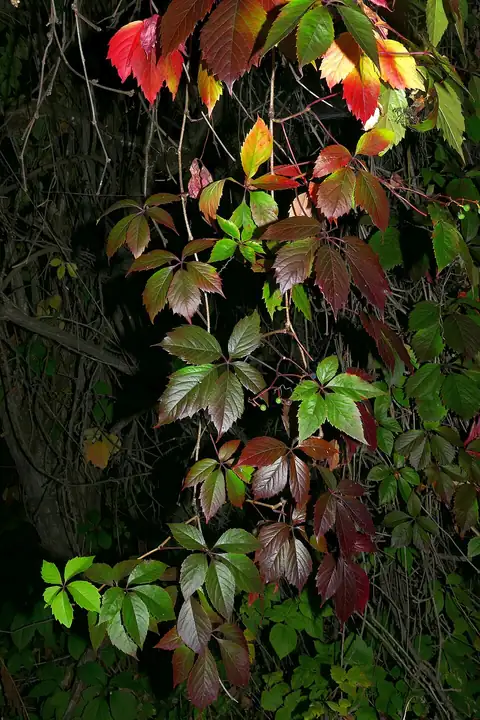
Virginia creeper
Parthenocissus quinquefolia
| Type | Vine |
|---|---|
| Life cycle | Perennial |
| Family | Grape family (Vitaceae) |
| Origin | Native to the US |
| Most common in | Northeast, Southeast, South Central, Midwest |
About
A native woody vine of eastern and central North America with brilliant red fall color and blue berries birds love. It's only weedy when it runs through beds, climbs walls or trees you'd rather keep clear, and its berries are poisonous to people.
Also called woodbine
How to identify it
Look for
Each leaf has five toothed leaflets that all start from one point, like fingers on a hand. It climbs with branched tendrils that end in small sticky disks, and it can grow 30 to 50 feet long. Small greenish flowers in late spring become dark blue berries by late summer, and the leaves turn red to purple in fall.
Look-alikes
Poison ivy has three leaflets, not five ('leaves of three, let it be; leaves of five, let it thrive'), and it carries the rash-causing oil urushiol, which Virginia creeper lacks. The two often grow together, so if you're unsure, treat it as poison ivy.
Where it grows
Woods, fence rows, walls, tree trunks, hedges and shady or sunny beds; it tolerates drought and salt.
When
Flowers from about May to July, berries ripen from July to August, and leaves color up in fall.
How it spreads
Birds spread the seeds from the berries, and trailing stems root where they touch the ground.
Most common in
| Northeast | Very common here |
|---|---|
| Southeast | Very common here |
| South Central | Very common here |
| Midwest | Very common here |
| Great Plains | Common here |
| Mountain West | Occasional here |
| Southwest | Occasional here |
| Pacific Northwest | Not found here |
| California | Not found here |
| Alaska | Not found here |
| Hawaii | Not found here |
What to do, gentlest first
Protect yourself first. Weed killers are a last step; always read and follow the label.
Prune it back each spring Prevent
Where you want to keep some, prune, mow or trim it in spring to hold it in bounds, and keep it off wood siding and stucco.
Pulling clinging vines off wood or stucco can mar the surface.
Pull runners and dig rooted stems By hand
Pull trailing stems and dig out the rooted parts. Pulling alone rarely finishes it, so plan to follow up.
Glyphosate in late summer Conventional spray
Spot-spray a 1% glyphosate solution from mid to late summer, after it flowers and before fall color, or cut the vine and treat the stump in late summer or early fall. It usually takes more than one treatment.
Read and follow the label. Many lawn and brush killers also harm garden plants, so keep spray and drift off anything you want to keep. Keep spray off nearby shrubs; glyphosate can move through grafted roots of plants growing together.
Uses, wildlife and pets
For wildlife
Songbirds, squirrels, opossums and raccoons eat the berries, and bees visit the flowers.
Pets
Not listed as toxic by the ASPCA; Clemson Extension notes the berries are moderately toxic to dogs.
Sources
- hgic.clemson.edu
- hgic.clemson.edu
- extension.psu.edu
- plants.ces.ncsu.edu
- plant-pest-advisory.rutgers.edu
- aspca.org
Photo: Photo: Bff / Wikimedia Commons, CC BY-SA 4.0 (CC BY-SA 4.0). Photo resized for the web.

Planting dates and advice are general guidance; check with your local Cooperative Extension office for your area.