
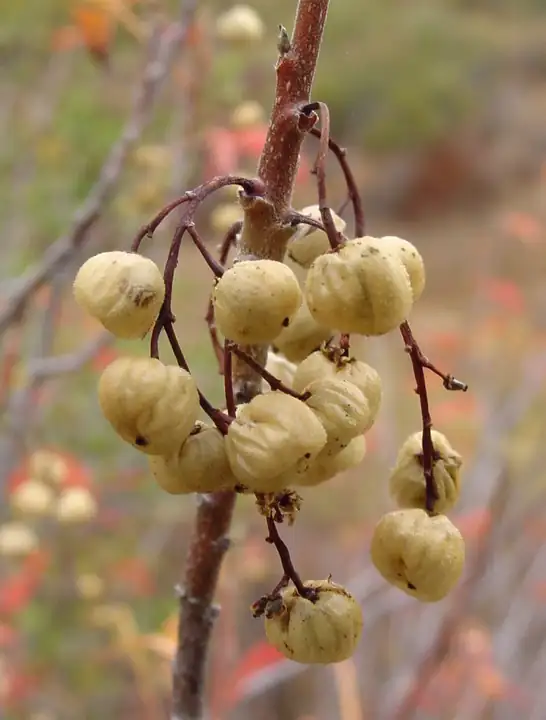
Western poison oak
Toxicodendron diversilobum
| Type | Shrub or tree |
|---|---|
| Life cycle | Perennial |
| Family | Sumac family (Anacardiaceae) |
| Origin | Native to the US |
| Most common in | California |
About
A native West Coast shrub or climbing vine that carries the same rash-causing oil as poison ivy. It is common in California and western Oregon and Washington, including yards and parks next to wild land.
Also called Pacific poison oak, poison oak, Pacific poison-oak
How to identify it
Look for
Leaves usually have three leaflets with toothed or slightly lobed edges, and the middle leaflet has the longest stalk. In sun it forms a dense shrub about 1 to 6 feet tall; in shade it climbs trees with aerial roots. It has no thorns, bears small white-green flowers and whitish berries, and its leaves often turn red or orange by summer's end.
Look-alikes
Skunkbush sumac also has three leaflets, but its berries are red and hairy and its middle leaflet has no stalk. Blackberries have thorns; poison oak never does.
Where it grows
Oak woodlands, brushy hillsides, stream sides, forest edges, parks and gardens next to wild areas.
When
Flowers from March to June; whitish berries form in late summer and fall, and leaves often color red or orange by late summer.
How it spreads
Suckers from underground stems, roots where vines touch the soil, and spreads by bird-carried seeds that can wait in the soil for years.
Most common in
| Northeast | Not found here |
|---|---|
| Southeast | Not found here |
| South Central | Not found here |
| Midwest | Not found here |
| Great Plains | Not found here |
| Mountain West | Not found here |
| Southwest | Not found here |
| Pacific Northwest | Common here |
| California | Very common here |
| Alaska | Not found here |
| Hawaii | Not found here |
What to do, gentlest first
Protect yourself first. Weed killers are a last step; always read and follow the label.
Gear up and keep it out of play areas Prevent
Wear washable cotton gloves over plastic gloves, long sleeves, long pants and eye protection. Afterward, wash tools, shoes and all clothing.
Don't mow it: mowing throws oil into the air, much like burning.
Dig out plants, roots and all By hand
Pull or grub out plants with a shovel in early spring or late fall, when moist soil lets the roots come out. Get the whole root system, or it resprouts.
Dried, dead brush still causes a rash. Bag it for the trash and never burn it. Hire a professional for large stands.
Goats or sheep for small areas Natural enemies
Goats and sheep will eat poison oak and can knock back small patches when grazed there repeatedly.
Their coats can carry the oil to people.
Spot-treat with triclopyr or glyphosate Conventional spray
Spray leaves in late spring or early summer while it is actively growing, or paint a freshly cut stump right away. Re-treat when sprouts regrow.
Read and follow the label. Many lawn and brush herbicides also kill garden plants, so keep spray and drift off anything you want to keep. Near streams, only certain aquatic formulations are allowed.
Uses, wildlife and pets
For wildlife
Birds eat the berries, and deer browse the leaves.
Pets
The ASPCA lists poison oak as non-toxic to dogs, cats and horses, but pets can carry the oil on their fur to people. Bathe a pet that brushed through it while wearing gloves.
Sources
Photo: Photo: Noah Elhardt / Wikimedia Commons, CC BY-SA 2.5 (CC BY-SA 2.5). Photo resized for the web.

Planting dates and advice are general guidance; check with your local Cooperative Extension office for your area.