
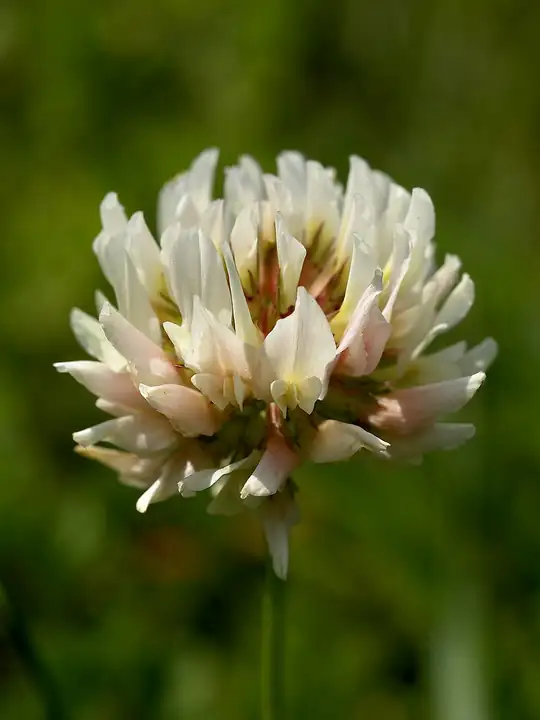
White Clover
Trifolium repens
| Type | Broadleaf |
|---|---|
| Life cycle | Perennial |
| Family | Pea family (Fabaceae) |
| Origin | Introduced from elsewhere |
| Most common in | Northeast, Southeast, Midwest, Pacific Northwest, California |
About
White clover is a low, creeping perennial with three-part leaves and round white flower heads. Some people welcome it because it feeds bees and adds nitrogen to soil; others dislike the patches and the bee stings on bare feet.
Also called Dutch clover, white Dutch clover, ladino clover, clover
How to identify it
Look for
Each leaf has three oval, finely toothed, hairless leaflets, often marked with a pale crescent or V. Stems creep along the ground and root where they touch. White to pinkish, ball-shaped flower heads stand on stalks above the leaves, and the roots carry small round nitrogen-fixing nodules.
Look-alikes
Black medic has yellow flowers and hairy leaves; yellow woodsorrel has heart-shaped leaflets; strawberry clover lacks the pale leaf mark.
Where it grows
Lawns that are mowed short and short on nitrogen, plus garden beds, fields and roadsides.
When
Seeds sprout in fall when soil cools to the 50s °F; it flowers from spring into fall and dies back to the ground in cold winters.
How it spreads
Creeping stems that root at the nodes, plus hard-coated seeds that can sprout over many years.
Most common in
| Northeast | Very common here |
|---|---|
| Southeast | Very common here |
| South Central | Common here |
| Midwest | Very common here |
| Great Plains | Common here |
| Mountain West | Common here |
| Southwest | Occasional here |
| Pacific Northwest | Very common here |
| California | Very common here |
| Alaska | Common here |
| Hawaii | Occasional here |
What to do, gentlest first
Start at the top. Weed killers are a last step; always read and follow the label.
Feed the lawn and mow a little higher Prevent
Clover thrives where grass is short on nitrogen. Keep nitrogen at the level your grass needs and adjust your mowing height so grass can outcompete it.
Mowing alone won't remove an established patch.
Dig out patches By hand
Pull or dig young plants and small patches when the soil is moist, getting the rooted runners.
Thick mulch in beds Barrier
In planting beds, about 4 inches of organic mulch keeps seedlings from coming up; renew it each year.
Vinegar on seedlings only Organic spray
Horticultural vinegar can kill very young clover seedlings, but established plants regrow from their stems and roots.
Strong vinegar (over about 11% acetic acid) can burn skin and eyes, so wear gloves and eye protection. It browns any leaves it touches, grass included.
Broadleaf lawn herbicide Conventional spray
Spot-treat actively growing clover with a lawn product containing MCPP (mecoprop), dicamba or triclopyr, often sold in three-way mixes with 2,4-D. UC IPM notes 2,4-D alone does little on clover.
Read and follow the label. Many lawn weed killers also harm vegetables, flowers and shrubs, so don't let spray drift into beds, and keep dicamba products off the root zones of trees and shrubs.
Uses, wildlife and pets
Edible?
NC State notes young leaves and flowers are eaten raw or cooked, and dried flowers are used for tea. Only harvest from unsprayed lawns, and don't mix it up with other trifoliate plants.
Not 100% sure? Don't eat it. Never pick from ground that may have been sprayed, or along roads and railways.
For wildlife
Honeybees and native bees visit the flowers, and it feeds clouded sulphur butterfly caterpillars.
Pets
Not listed by the ASPCA. The ASPCA does list a different clover, alsike clover, as toxic to horses.
Sources
- turffiles.ncsu.edu
- ipm.ucanr.edu
- ipm.ucanr.edu
- extension.umd.edu
- plants.ces.ncsu.edu
- ipm.ucanr.edu
- extension.umd.edu
- npgsweb.ars-grin.gov
- plantsservices.sc.egov.usda.gov
- aspca.org
Photo: Photo: Hans Hillewaert / Wikimedia Commons, CC BY-SA 3.0 (CC BY-SA 3.0). Photo resized for the web.

Planting dates and advice are general guidance; check with your local Cooperative Extension office for your area.