
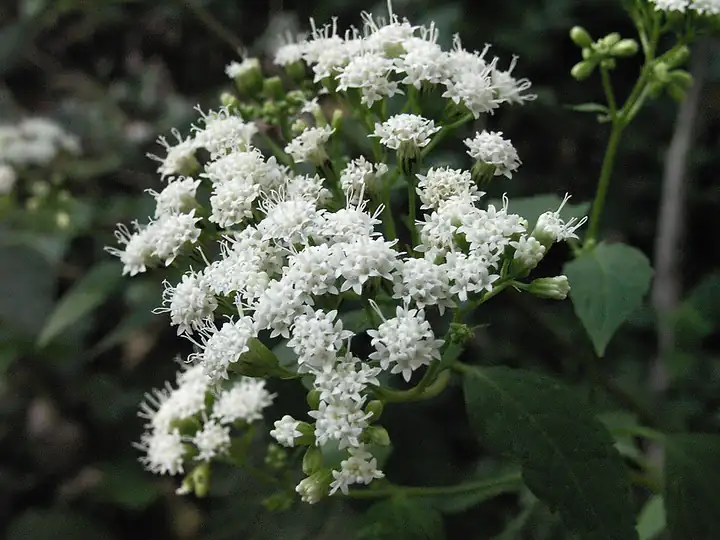
White snakeroot
Ageratina altissima
| Type | Broadleaf |
|---|---|
| Life cycle | Perennial |
| Family | Aster family (Asteraceae) |
| Origin | Native to the US |
| Most common in | Northeast, Southeast, Midwest |
About
A native woodland wildflower that is poisonous to livestock, and through their milk, to people. In pioneer days it caused 'milk sickness' in people, which reportedly killed Abraham Lincoln's mother.
Also called richweed, white sanicle, fall poison, tremetol
How to identify it
Look for
Plants grow 2 to 5 feet tall with smooth stems and toothed, pointed-oval leaves in opposite pairs. From midsummer into fall, it carries flat, loosely branched clusters of tiny white flowers.
Where it grows
Shady woods, woodland edges, shaded pastures and shady garden beds.
When
Leafs out in spring and flowers from midsummer through fall (about July to October).
How it spreads
Spreads by seed and comes back each year from its perennial roots.
Most common in
| Northeast | Very common here |
|---|---|
| Southeast | Very common here |
| South Central | Common here |
| Midwest | Very common here |
| Great Plains | Occasional here |
| Mountain West | Not found here |
| Southwest | Not found here |
| Pacific Northwest | Not found here |
| California | Not found here |
| Alaska | Not found here |
| Hawaii | Not found here |
What to do, gentlest first
Protect yourself first. Weed killers are a last step; always read and follow the label.
Keep animals out of shady pastures Prevent
Move livestock and horses out of wooded or shaded pastures where it grows by midsummer. In gardens, wear gloves when working with it.
Pull after a rain By hand
Pull plants when the soil is moist so the roots come out whole, ideally before seeds form in fall.
Wear gloves and bag plants for the trash in grazing areas.
Spot-treat with dicamba or glyphosate Conventional spray
In pastures and non-crop areas, dicamba-based products or a glyphosate spot spray can control it.
Read and follow the label. Many lawn and brush herbicides also kill garden plants, so keep spray and drift off anything you want to keep. Follow grazing restrictions on the label.
Uses, wildlife and pets
For wildlife
Butterflies and bees use its late nectar and pollen, and songbirds eat the seeds.
Pets
Toxic to horses (ASPCA), with weakness, tremors, heart damage and trouble swallowing; the ASPCA does not list it as toxic to dogs or cats.
Sources
Photo: Photo: Cbaile19 / Wikimedia Commons, CC0 (CC0). Photo resized for the web.

Planting dates and advice are general guidance; check with your local Cooperative Extension office for your area.