
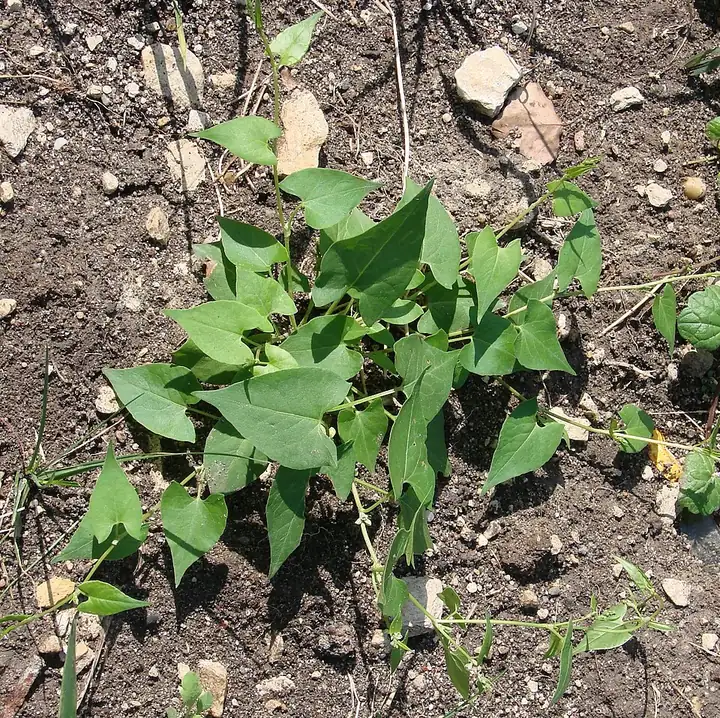
Wild buckwheat
Polygonum convolvulus
| Type | Vine |
|---|---|
| Life cycle | Summer annual |
| Family | Buckwheat family (Polygonaceae) |
| Origin | Introduced from elsewhere |
| Most common in | Northeast, Midwest, Great Plains, Mountain West, Pacific Northwest |
About
A twining annual vine from Europe with arrow-shaped leaves that looks like bindweed but comes back from seed each year. It wraps around crops and garden plants, and its seeds can hide in grain and cover-crop seed.
Also called black bindweed
How to identify it
Look for
Seedlings have long, oval seed leaves with a gritty, powdery surface, and the first true leaves are arrow-shaped. Smooth stems twine or trail up to about 6 feet. Leaves are alternate, hairless and arrow-shaped with a long point and backward lobes, with a thin papery sheath (ocrea) around the stem at each leaf; tiny greenish flowers cluster at the leaf bases and make dull black, three-sided seeds.
Look-alikes
Field and hedge bindweed are perennials with large white or pink trumpet flowers borne one at a time, less pointed leaves, and no papery sheath at the leaf base.
Where it grows
Gardens, grain and vegetable fields, landscapes and roadsides; it does best in heavier soil that holds moisture.
When
Sprouts mostly in early spring while soil is cool, with a few more into summer; it blooms 6-8 weeks after sprouting (about May-September) and keeps setting seed until a hard frost.
How it spreads
By seed; big plants make 12,000-30,000 seeds, and a few can survive for decades buried in cool, moist soil.
Most common in
| Northeast | Very common here |
|---|---|
| Southeast | Occasional here |
| South Central | Occasional here |
| Midwest | Very common here |
| Great Plains | Very common here |
| Mountain West | Very common here |
| Southwest | Occasional here |
| Pacific Northwest | Very common here |
| California | Common here |
| Alaska | Occasional here |
| Hawaii | Occasional here |
Where it is regulated
Alaska lists wild buckwheat as a restricted noxious weed seed under its seed law.
What to do, gentlest first
Start at the top. Weed killers are a last step; always read and follow the label.
Check seed before you sow Prevent
Look over uncertified grain and cover-crop seed for its three-sided black seeds before planting.
Cut or pull the first flush By hand
Weed soon after the first spring flush comes up, while plants are small and before they start twining (about a month after emergence). Cutting tools like a sharp hoe work better than digging.
Crowd it with a dense planting Natural enemies
A vigorous, densely sown winter grain or cover crop that shades the soil quickly suppresses the seedlings.
Uses, wildlife and pets
Pets
Not listed by the ASPCA (its buckwheat entry is for crop buckwheat, Fagopyrum).
Sources
Photo: Photo: Aung / Wikimedia Commons, Public domain. Photo resized for the web.

Planting dates and advice are general guidance; check with your local Cooperative Extension office for your area.