
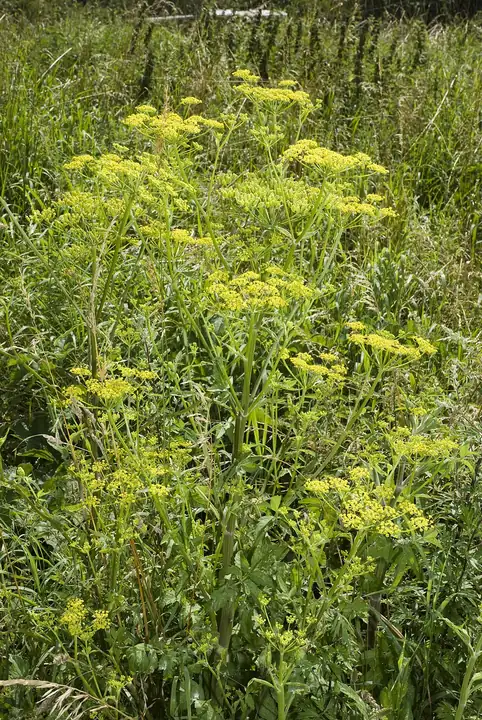
Wild parsnip
Pastinaca sativa
| Type | Broadleaf |
|---|---|
| Life cycle | Biennial |
| Family | Carrot family (Apiaceae) |
| Origin | Introduced from elsewhere |
| Most common in | Northeast, Midwest |
About
The same species as garden parsnip, gone wild along roadsides and field edges. Its sap, with sunlight, causes painful burns and blisters, and it spreads fast once it gets going.
How to identify it
Look for
First-year plants are low rosettes of shiny leaves divided into 5 to 15 toothed leaflets. Second-year plants grow 2 to 6 feet tall on stout, grooved, hollow stems with flat, 2- to 6-inch clusters of small yellow flowers. The long taproot looks and smells like a garden parsnip.
Look-alikes
Its yellow flower heads set it apart from white-flowered giant hogweed, cow parsnip and poison hemlock, and its stems lack giant hogweed's coarse hairs. Don't assume a wild 'parsnip' is safe to eat or handle; water hemlock is also mistaken for it.
Where it grows
Roadsides and rail lines, trails, pastures, old fields and woodland edges in full sun.
When
Rosettes grow the first year; flowers bloom from late spring through late summer (about June to August) in the second year, then the plant sets seed and dies.
How it spreads
Spreads only by seed, which can survive several years in the soil; mowers can carry seed to new places.
Most common in
| Northeast | Very common here |
|---|---|
| Southeast | Common here |
| South Central | Occasional here |
| Midwest | Very common here |
| Great Plains | Common here |
| Mountain West | Common here |
| Southwest | Occasional here |
| Pacific Northwest | Common here |
| California | Occasional here |
| Alaska | Occasional here |
| Hawaii | Not found here |
Where it is regulated
Minnesota lists wild parsnip as a Prohibited Control noxious weed.
What to do, gentlest first
Protect yourself first. Weed killers are a last step; always read and follow the label.
Suit up and stop the seed Prevent
Always wear gloves, long sleeves and long pants near it. Keep desirable plants thick so rosettes can't move in, and wash mowers after use in infested areas.
Never let plants go to seed.
Mow before it flowers Prevent
Mowing in early June, before flowers open, kills many mature plants and cuts seed production.
Mowing and trimming can spray sap; cover up fully and clean equipment afterward.
Cut the root below the crown By hand
With a sharp spade, cut the taproot 1 to 2 inches below the soil, or pull small plants, before flowering. Check again for weeks, since plants bloom at different times.
Wear gloves and eye protection, and bag flowering plants and seed heads for the trash.
Spot-treat rosettes with 2,4-D Conventional spray
Treat rosettes and newly bolting plants with 2,4-D or a spot spray in early spring or in late summer to fall. Expect several years of work.
Read and follow the label. Many lawn and brush herbicides also kill garden plants, so keep spray and drift off anything you want to keep.
Uses, wildlife and pets
Pets
Not listed by the ASPCA.
Sources
- extension.umn.edu
- mda.state.mn.us
- yardandgarden.extension.iastate.edu
- dec.ny.gov
- ars.usda.gov
- plantsservices.sc.egov.usda.gov
- aspca.org
Photo: Photo: Olivier Pichard / Wikimedia Commons, CC BY-SA 3.0 (CC BY-SA 3.0). Photo resized for the web.

Planting dates and advice are general guidance; check with your local Cooperative Extension office for your area.