
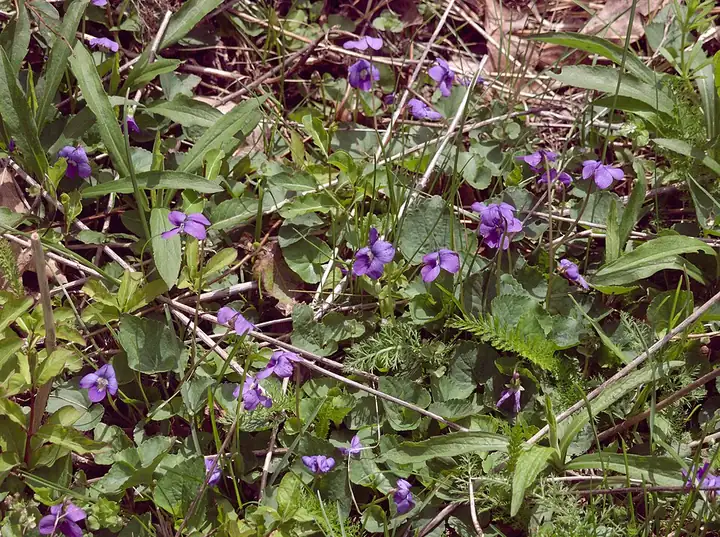
Wild Violet
Viola sororia
| Type | Broadleaf |
|---|---|
| Life cycle | Perennial |
| Family | Violet family (Violaceae) |
| Origin | Native to the US |
| Most common in | Northeast, Southeast, Midwest |
About
Wild violet is a native wildflower with heart-shaped leaves and purple spring flowers that spreads into shady lawns. It is valuable to butterflies and bees, but thick rhizomes and waxy leaves make it one of the toughest lawn weeds to remove.
Also called common blue violet, dooryard violet, woolly blue violet, violet, meadow violet
How to identify it
Look for
Leaves grow in low clumps and are heart-shaped with rounded teeth and a glossy, waxy top. Five-petaled flowers are usually blue-purple (sometimes white) with darker veins. Dig one up and you'll find thick, branching underground stems (rhizomes).
Look-alikes
Lesser celandine, a poisonous invasive, has similar heart-shaped leaves but glossy yellow flowers; foragers should pick only violet flowers, not leaves, to avoid mistakes.
Where it grows
Moist, shady lawns and bed edges with rich soil, though it also persists in sun.
When
New leaves come from the rhizomes in early spring and it blooms in April and May, and small hidden flowers that never open also make seed.
How it spreads
Rhizomes that form spreading colonies, plus seeds that pop out of the pods and get carried off by ants.
Most common in
| Northeast | Very common here |
|---|---|
| Southeast | Very common here |
| South Central | Common here |
| Midwest | Very common here |
| Great Plains | Common here |
| Mountain West | Occasional here |
| Southwest | Occasional here |
| Pacific Northwest | Occasional here |
| California | Occasional here |
| Alaska | Not found here |
| Hawaii | Not found here |
What to do, gentlest first
Start at the top. Weed killers are a last step; always read and follow the label.
Consider living with it, or thicken the turf Prevent
Many gardeners keep violets for the butterflies. Dense, well-fed turf slows their spread, though it won't stop an established patch.
Dig out every rhizome By hand
On small patches, dig out the whole plant and all its rhizomes; pieces left behind resprout, so expect to repeat.
Mulch beds Barrier
In beds, a thick mulch layer after digging helps smother regrowth and seedlings.
Vinegar is not much help Organic spray
Vinegar only burns the leaves, and the rhizomes regrow; pre-emergent products don't work on violets either.
Strong vinegar (over about 11% acetic acid) can burn skin and eyes, so wear gloves and eye protection. It browns any leaves it touches, grass included.
Triclopyr, repeated Conventional spray
Triclopyr is the most effective lawn option; spray actively growing plants in early spring or late summer, and plan on repeat treatments over more than one season.
Read and follow the label. Many lawn weed killers also harm vegetables, flowers and shrubs, so don't let spray drift into beds, and keep dicamba products off the root zones of trees and shrubs.
Uses, wildlife and pets
Edible?
UMN and NC State say the flowers and young leaves are edible in salads, syrups and cooked greens. Because the leaves look like toxic lesser celandine, harvest only the flowers, and only from unsprayed ground away from roads.
Not 100% sure? Don't eat it. Never pick from ground that may have been sprayed, or along roads and railways.
For wildlife
It is a key caterpillar host for fritillary butterflies and gives native bees early nectar and pollen.
Pets
Not listed by the ASPCA (its violet entry is African violet, a different plant).
Sources
- turffiles.ncsu.edu
- extension.umn.edu
- extension.psu.edu
- plants.ces.ncsu.edu
- extension.umd.edu
- npgsweb.ars-grin.gov
- plantsservices.sc.egov.usda.gov
Photo: Photo: Cbaile19 / Wikimedia Commons, CC0 (CC0). Photo resized for the web.

Planting dates and advice are general guidance; check with your local Cooperative Extension office for your area.