
Wineberry
Rubus phoenicolasius
| Type | Shrub or tree |
|---|---|
| Life cycle | Perennial |
| Family | Rose family (Rosaceae) |
| Origin | Introduced from elsewhere |
| Most common in | Northeast |
About
An East Asian raspberry with bristly red canes that forms dense thickets in eastern woods and yard edges. It shades out native plants, but the berries are edible, and because it lacks a big underground storage system, digging it out works well.
Also called wine raspberry
How to identify it
Look for
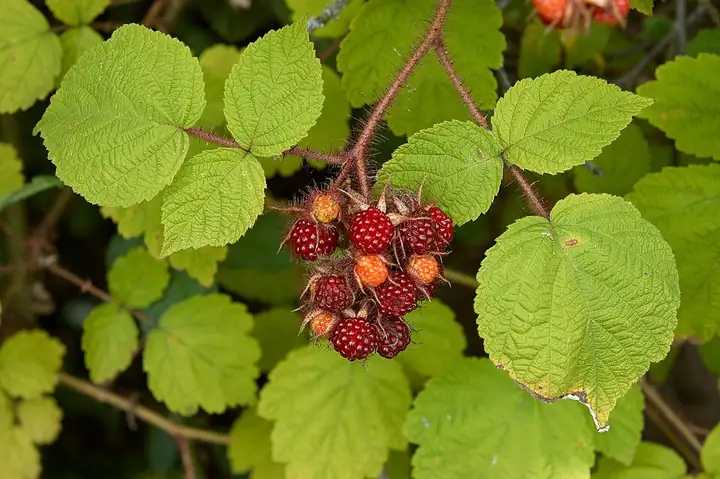
Arching canes 3 to 10 feet long are covered in dense reddish-purple glandular hairs with small prickles, so they look red from a distance. Leaves have 3 (sometimes 5) broad, coarsely toothed leaflets that are bright white and woolly underneath. Small white flowers with red-bristly sepals bloom in late spring, and bright red raspberries ripen in midsummer.
Look-alikes
Native raspberries and blackberries have green to grayish leaf undersides and lack the dense red hairs on their canes.
Where it grows
Woodland edges, canopy gaps, old fields, stream edges, trails and shady yard borders.
When
Flowers in late spring to early summer, and berries ripen in midsummer.
How it spreads
Cane tips root where they touch the ground, roots send up sprouts, and birds and mammals spread the seeds.
Most common in
| Northeast | Very common here |
|---|---|
| Southeast | Common here |
| South Central | Not found here |
| Midwest | Occasional here |
| Great Plains | Not found here |
| Mountain West | Not found here |
| Southwest | Not found here |
| Pacific Northwest | Not found here |
| California | Not found here |
| Alaska | Not found here |
| Hawaii | Not found here |
Where it is regulated
Connecticut, Massachusetts, New York and Wisconsin regulate or restrict it; Wisconsin lists it as prohibited.
What to do, gentlest first
Start at the top. Weed killers are a last step; always read and follow the label.
Keep canes from rooting Prevent
Pull seedlings while small and cut canes before they arch over and root at the tips.
Dig it out By hand
Dig out plants, roots and all; the roots are fibrous without a big storage system, so digging works well. Or cut all canes to the ground and keep removing regrowth.
Gloves and long sleeves help with the bristles and prickles.
Triclopyr or glyphosate Conventional spray
Spray resprouts with triclopyr or glyphosate, or treat cut stumps with either in fall.
Read and follow the label. Many lawn and brush killers also harm garden plants, so keep spray and drift off anything you want to keep. Replant bare areas with native plants and watch for resprouts.
Uses, wildlife and pets
Edible?
The ripe red berries are edible and sweet (University of Maryland Extension). Be sure of the plant, and don't pick where it may have been sprayed.
Not 100% sure? Don't eat it. Never pick from ground that may have been sprayed, or along roads and railways.
For wildlife
Birds and mammals eat the berries, which spreads the seeds.
Pets
Not listed as toxic by the ASPCA
Sources
- extension.umd.edu
- extension.umd.edu
- extension.illinois.edu
- dnr.wisconsin.gov
- nps.gov
- extension.psu.edu
- aspca.org
Photo: Photo: Wouter Hagens / Wikimedia Commons, CC BY-SA 3.0 (CC BY-SA 3.0). Photo resized for the web.

Planting dates and advice are general guidance; check with your local Cooperative Extension office for your area.