
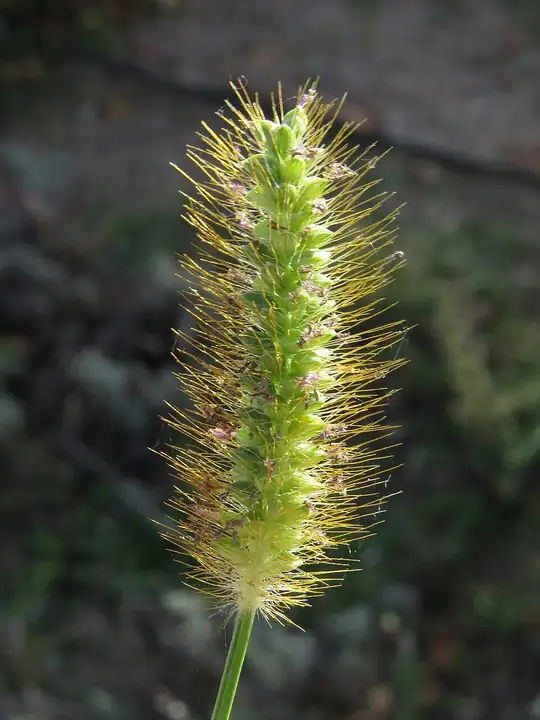
Yellow foxtail
Setaria pumila
| Type | Grass |
|---|---|
| Life cycle | Summer annual |
| Family | Grass family (Poaceae) |
| Origin | Introduced from elsewhere |
| Most common in | Northeast, Midwest, Great Plains |
About
A summer annual grass with bristly, yellowish seedheads. It fills thin lawns, gardens and bare ground in summer and dies at frost.
Also called pigeon grass, yellow bristlegrass, foxtail
How to identify it
Look for
Leaves are twisted and smooth except for several long, whitish hairs near the base of the upper surface; the sheaths are hairless, and the ligule is a fringe of short hairs. Stems are flattened with reddish-purple bases. The dense, spike-like seedhead turns yellow-green to orange-green with bristly awns.
Look-alikes
Green foxtail has no long hairs at the leaf base, hairy sheath edges and a greener seedhead. Crabgrass seedheads are finger-like, not a single bottlebrush spike.
Where it grows
Gardens, thin lawns, pastures, roadsides and other disturbed ground, especially moist soil.
When
Sprouts from spring into midsummer once soil reaches about 65 degrees F, heads out from summer into fall, and dies after frost.
How it spreads
Spreads by seed, and each plant can make thousands of seeds.
Most common in
| Northeast | Very common here |
|---|---|
| Southeast | Common here |
| South Central | Common here |
| Midwest | Very common here |
| Great Plains | Very common here |
| Mountain West | Common here |
| Southwest | Occasional here |
| Pacific Northwest | Common here |
| California | Common here |
| Alaska | Not found here |
| Hawaii | Occasional here |
What to do, gentlest first
Start at the top. Weed killers are a last step; always read and follow the label.
Keep lawns thick and beds covered Prevent
Foxtail mostly takes hold in new or thin lawns and bare soil. Fertilize and water to keep turf dense, and avoid bringing in soil from weedy sites.
Pull before seedheads ripen By hand
Hand-pull or use a trowel on single plants, and hoe seedlings in the garden before they flower.
Bag plants with seedheads instead of composting them.
Mulch garden beds Barrier
Almost any mulch helps block foxtail seedlings in vegetable and flower beds.
Corn gluten meal before seeds sprout Organic spray
Corn gluten meal is labeled to stop foxtail seeds from sprouting. Spread it in early spring and water it in lightly; it won't affect plants that are already up.
Don't use it where you plan to sow seed.
Spring pre-emergent; quinclorac for young plants Conventional spray
In lawns, a spring pre-emergent such as prodiamine, pendimethalin or dithiopyr stops seedlings. Quinclorac or fenoxaprop can treat young plants in lawns.
Read and follow the label. Many lawn herbicides kill garden plants, so keep spray and drift off beds and vegetables.
Uses, wildlife and pets
Pets
Not listed as toxic to dogs, cats or horses by the ASPCA.
Sources
- ipm.ucanr.edu
- extension.psu.edu
- extension.umn.edu
- extension.psu.edu
- extension.umn.edu
- yardandgarden.extension.iastate.edu
- plantsservices.sc.egov.usda.gov
- aspca.org
- aspca.org
- aspca.org
Photo: Photo: Adrián Pablo Rodríguez Quiroga / Wikimedia Commons, CC0 (CC0). Photo resized for the web.

Planting dates and advice are general guidance; check with your local Cooperative Extension office for your area.