
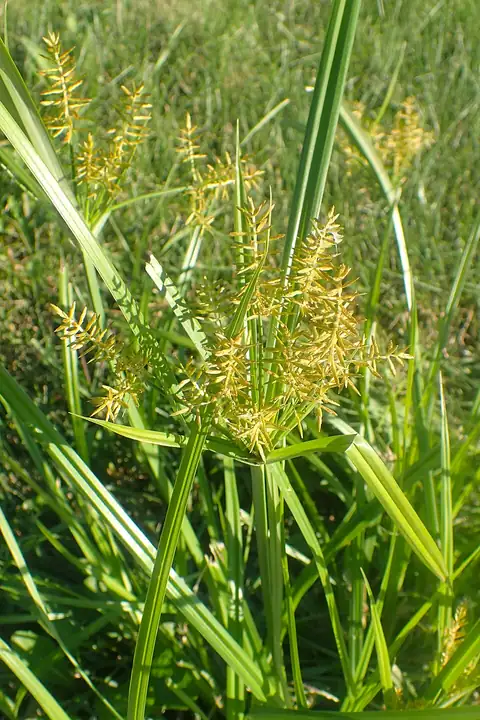
Yellow nutsedge
Cyperus esculentus
| Type | Sedge |
|---|---|
| Life cycle | Perennial |
| Family | Sedge family (Cyperaceae) |
| Origin | Native and introduced forms |
| Most common in | Northeast, Southeast, South Central, Midwest, California |
About
A grass-like perennial sedge that shoots up faster than the lawn and stands out lime green in summer. It spreads by underground tubers, which makes it one of the hardest weeds to clear from lawns and beds.
Also called nutgrass, yellow nutgrass, chufa, chufa flatsedge, tiger nut
How to identify it
Look for
Roll a stem between your fingers: it is triangular, not round. Light green, glossy leaves grow in sets of three from the base, taper to a sharp point and have no ligule or collar. Summer flower heads are straw-colored to golden brown, and single round tubers form at the ends of underground runners.
Look-alikes
Purple nutsedge has darker, blunter leaves, purplish seedheads and tubers in chains. Green kyllinga is shorter with small round green flower heads and no tubers. True grasses have round, hollow stems.
Where it grows
Wet or overwatered spots in sunny lawns, garden beds, vegetable plots and irrigated landscapes.
When
Tubers sprout in spring once soil tops about 43 degrees F, plants flower in summer and fall, and the tops die at frost while tubers wait underground.
How it spreads
Spreads mainly by tubers on underground runners in the top foot of soil; tubers live 1 to 3 years and can resprout several times, and tilling scatters them.
Most common in
| Northeast | Very common here |
|---|---|
| Southeast | Very common here |
| South Central | Very common here |
| Midwest | Very common here |
| Great Plains | Common here |
| Mountain West | Occasional here |
| Southwest | Common here |
| Pacific Northwest | Common here |
| California | Very common here |
| Alaska | Not found here |
| Hawaii | Common here |
Where it is regulated
Listed as a noxious weed in California, Colorado, Hawaii, Oregon and Washington.
What to do, gentlest first
Start at the top. Weed killers are a last step; always read and follow the label.
Fix wet spots and ease off the water Prevent
Nutsedge loves soggy soil, so correct drainage and avoid overwatering. It grows poorly in shade.
Pull young plants often By hand
Pull or hoe out plants with fewer than 5 leaves every 2 to 3 weeks in summer, before new tubers form. For older plants, dig 8 to 14 inches deep to get the tubers.
Don't rototill infested ground; it spreads the tubers.
Woven landscape fabric under mulch Barrier
Heavy woven landscape fabric topped with bark or gravel holds it back. Pull any shoots that sneak through.
Black or clear plastic mulch won't work; the sharp shoots poke through.
Halosulfuron or sulfentrazone on young plants Conventional spray
In lawns, spray halosulfuron or sulfentrazone while plants are young, before about the fifth leaf, and repeat as the label allows. Later sprays mostly kill only the tops.
Read and follow the label. Many lawn herbicides kill garden plants, so keep spray and drift off beds and vegetables.
Uses, wildlife and pets
Edible?
The tubers (chufa or tiger nuts) are edible raw, cooked or dried and taste like almonds, though they are chewy. Only eat plants you are sure of, from ground that hasn't been sprayed.
Not 100% sure? Don't eat it. Never pick from ground that may have been sprayed, or along roads and railways.
For wildlife
A caterpillar host plant for the dun skipper butterfly.
Pets
Not listed as toxic to dogs, cats or horses by the ASPCA.
Sources
- ipm.ucanr.edu
- ipm.ucanr.edu
- aggieturf.tamu.edu
- plants.ces.ncsu.edu
- plantsservices.sc.egov.usda.gov
- aspca.org
- aspca.org
- aspca.org
Photo: Photo: Krzysztof Ziarnek, Kenraiz / Wikimedia Commons, CC BY-SA 4.0 (CC BY-SA 4.0). Photo resized for the web.

Planting dates and advice are general guidance; check with your local Cooperative Extension office for your area.