
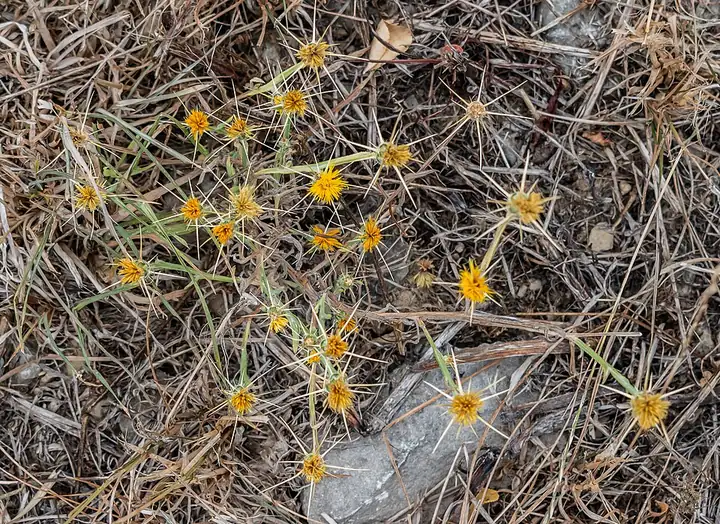
Yellow starthistle
Centaurea solstitialis
| Type | Broadleaf |
|---|---|
| Life cycle | Winter annual |
| Family | Aster family (Asteraceae) |
| Origin | Introduced from elsewhere |
| Most common in | Mountain West, Pacific Northwest, California |
About
A spiny Eurasian weed that covers millions of acres in the West, especially California, Oregon, Washington and Idaho. It crowds out pasture and wildflowers, and it causes a deadly brain disease in horses.
Also called yellow star-thistle, St. Barnaby's thistle, Barnaby's thistle
How to identify it
Look for
Grayish, cottony plants from 6 inches to over 6 feet tall, with stiff stems that look winged where the leaf bases run down them. Rosette leaves are deeply lobed. Bright yellow flower heads sit on a ring of long, stiff, sharp spines.
Look-alikes
Malta starthistle and Sicilian starthistle look similar and are also weedy; the long spines under bright yellow flower heads are the key clue.
Where it grows
Dry, sunny grasslands, pastures, roadsides, vacant lots, parks and open hillsides.
When
Sprouts after the first fall rains, grows as a rosette over winter, bolts in late spring and flowers from about June into fall.
How it spreads
Spreads only by seed, often huge numbers, carried on vehicles, boots, animals, hay and soil; most seeds sprout within a year, but some last up to 10.
Most common in
| Northeast | Occasional here |
|---|---|
| Southeast | Occasional here |
| South Central | Occasional here |
| Midwest | Occasional here |
| Great Plains | Occasional here |
| Mountain West | Very common here |
| Southwest | Common here |
| Pacific Northwest | Very common here |
| California | Very common here |
| Alaska | Not found here |
| Hawaii | Not found here |
What to do, gentlest first
Protect yourself first. Weed killers are a last step; always read and follow the label.
Stop seed from coming in Prevent
Clean boots, tires and equipment after visiting infested areas, and buy weed-free hay. Keep horses off infested ground.
Mow at first bloom Prevent
Mow just as the first yellow flowers open; repeat if plants regrow and rebloom.
Wear eye protection and long sleeves.
Hoe seedlings and pull bolting plants By hand
Hoe seedlings, or pull plants when they bolt in late spring while the soil is still moist.
Wear heavy gloves against the spines, and bag flowering plants.
Solarize small patches Barrier
Covering moist soil with clear plastic during hot summer weather kills seeds and seedlings.
Seed-feeding insects, grazing and competitive plants Natural enemies
Released insects such as the hairy weevil and false peacock fly cut seed production. Sheep, goats and cattle graze it before spines form, and dense lawns, groundcovers or perennial grasses crowd it out.
Never let horses graze it.
Pre-emergent before fall rains Conventional spray
A prodiamine or dithiopyr pre-emergent, applied just before the rainy season, stops seedlings in landscaped areas.
Read and follow the label. Many lawn and brush herbicides also kill garden plants, so keep spray and drift off anything you want to keep.
Clopyralid, aminopyralid, triclopyr or glyphosate Conventional spray
Treat seedlings and rosettes from about December to March with a selective product like aminopyralid or clopyralid; glyphosate works through early flowering. Expect three or more years of work.
Read and follow the label. Many lawn and brush herbicides also kill garden plants, so keep spray and drift off anything you want to keep.
Uses, wildlife and pets
Pets
Toxic to horses (ASPCA), causing 'chewing disease'; the ASPCA lists it as non-toxic to dogs and cats.
Sources
Photo: Photo: Tournasol7 / Wikimedia Commons, CC BY 4.0 (CC BY 4.0). Photo resized for the web.

Planting dates and advice are general guidance; check with your local Cooperative Extension office for your area.