
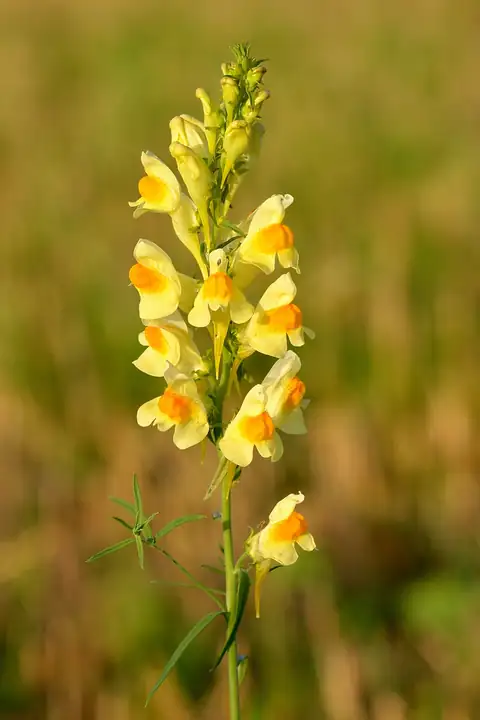
Yellow toadflax
Linaria vulgaris
| Type | Broadleaf |
|---|---|
| Life cycle | Perennial |
| Family | Plantain family (Plantaginaceae) |
| Origin | Introduced from elsewhere |
| Most common in | Mountain West |
About
Yellow toadflax is a European perennial with cheerful snapdragon-like flowers that is still sold as 'butter and eggs.' Its creeping roots form dense patches that crowd out other plants, and Colorado and Washington list it as a noxious weed.
Also called butter and eggs, common toadflax, wild snapdragon
How to identify it
Look for
Stems are 1 to 3 feet tall and packed with narrow, grass-like leaves up to about 3 inches long. Flowers look like small snapdragons, yellow with an orange throat and a long spur at the back, in clusters at the stem tips. The roots creep sideways and send up new shoots.
Look-alikes
Dalmatian toadflax (Linaria dalmatica) has similar snapdragon-like yellow flowers; ask your county weed coordinator to confirm which one you have.
Where it grows
Roadsides, trails, rail lines, field edges, rangeland, meadows and gardens, especially in Colorado, the Mountain West and northern border states.
When
Seedlings come up in April and May; plants flower from about June to September.
How it spreads
By creeping roots that can spread up to 3 feet a year (pieces under half an inch can regrow) and by seed, about 15,000 to 30,000 per plant, lasting ten years or more.
Most common in
| Northeast | Common here |
|---|---|
| Southeast | Occasional here |
| South Central | Occasional here |
| Midwest | Common here |
| Great Plains | Common here |
| Mountain West | Very common here |
| Southwest | Occasional here |
| Pacific Northwest | Common here |
| California | Occasional here |
| Alaska | Occasional here |
| Hawaii | Not found here |
Where it is regulated
Listed as a noxious weed in Colorado (List B) and Washington (Class C).
What to do, gentlest first
Start at the top. Weed killers are a last step; always read and follow the label.
Don't plant 'butter and eggs' Prevent
Avoid buying or sharing it, clean tools and boots after working in infested areas, and plant competitive perennials or native plants.
Pull or dig for several years By hand
For small patches, cut off and bag seed heads first, then pull or dig as much root as possible; follow up for several years. Repeated cultivation every week or two for two years also works in open ground.
Mowing does not control it because it spreads by roots.
Toadflax insects for big stands Natural enemies
Several approved insects, including a flower-feeding beetle (Brachypterolus pulicarius) and a seed capsule weevil (Rhinusa antirrhini), are released on large infestations by weed programs.
Herbicide at bloom or in fall Conventional spray
Spray when plants begin to flower in late spring or in fall; the waxy leaves need an oil or silicone surfactant added. Products with glyphosate or dicamba are among those used.
Read and follow the label; many lawn and brush herbicides also kill garden plants.
Uses, wildlife and pets
Pets
Not listed by the ASPCA. Occasional mild poisoning has been reported in cattle, though livestock usually avoid it.
Sources
- nwcb.wa.gov
- agsci.colostate.edu
- kingcounty.gov
- library.nd.gov
- ag.colorado.gov
- plantsservices.sc.egov.usda.gov
- aspca.org
- aspca.org
- aspca.org
Photo: Photo: Ivar Leidus / Wikimedia Commons, CC BY-SA 3.0 (CC BY-SA 3.0). Photo resized for the web.

Planting dates and advice are general guidance; check with your local Cooperative Extension office for your area.