
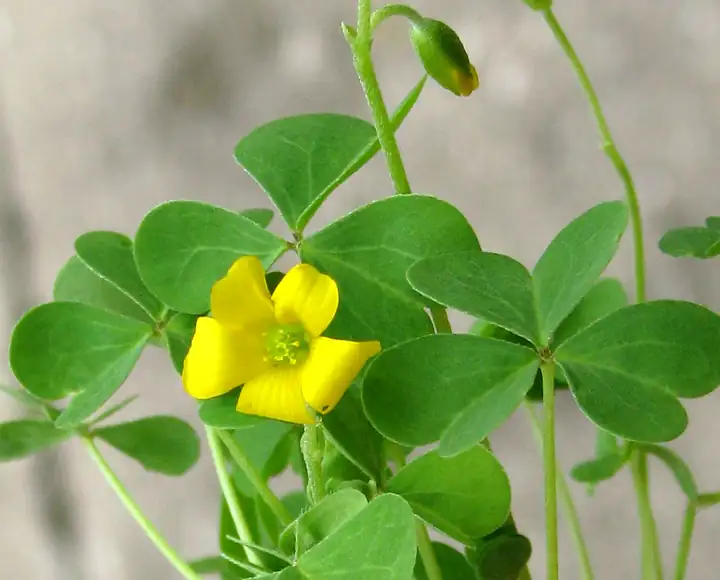
Yellow Woodsorrel
Oxalis stricta
| Type | Broadleaf |
|---|---|
| Life cycle | Perennial |
| Family | Wood-sorrel family (Oxalidaceae) |
| Origin | Native to the US |
| Most common in | Northeast, Southeast, Midwest |
About
Yellow woodsorrel is a small, shamrock-leaved native with little yellow flowers that pops up in lawns, beds and containers. Its seed pods fling seeds several feet, so one plant quickly becomes many.
Also called common yellow oxalis, oxalis, wood sorrel, sourgrass, lemon clover
How to identify it
Look for
Each leaf has three heart-shaped leaflets that are often partly folded along the middle. Upright, sometimes hairy stems are green to purplish, and the flowers are bright yellow with five petals. Slim, upright seed capsules about half an inch to an inch long split open and shoot out seeds.
Look-alikes
White clover and black medic have rounded, not heart-shaped, leaflets.
Where it grows
Lawns, garden beds and moist, fertile soil, though it tolerates many conditions.
When
It flowers from spring through summer, roughly March or May through September depending on the area.
How it spreads
Exploding seed pods that throw seeds up to about 12 feet, plus slender underground stems.
Most common in
| Northeast | Very common here |
|---|---|
| Southeast | Very common here |
| South Central | Common here |
| Midwest | Very common here |
| Great Plains | Common here |
| Mountain West | Occasional here |
| Southwest | Occasional here |
| Pacific Northwest | Occasional here |
| California | Occasional here |
| Alaska | Not found here |
| Hawaii | Not found here |
What to do, gentlest first
Start at the top. Weed killers are a last step; always read and follow the label.
Stop it before it seeds Prevent
Keep turf thick and remove plants before they have a chance to spread seed.
Pull early and often By hand
Pull or dig plants when the soil is moist, getting the underground stems, and do it before the pods ripen.
Pulling after pods form can scatter seed.
Mulch beds Barrier
A 2- to 3-inch mulch layer in beds keeps flung seeds from rooting.
Vinegar on young plants Organic spray
Horticultural vinegar kills small seedlings; bigger plants often regrow.
Strong vinegar (over about 11% acetic acid) can burn skin and eyes, so wear gloves and eye protection. It browns any leaves it touches, grass included.
Pre-emergent plus spot sprays Conventional spray
In lawns, a dithiopyr or isoxaben pre-emergent stops new seedlings, and triclopyr or a 2,4-D/MCPP/dicamba product can be spot-sprayed on actively growing plants.
Read and follow the label. Many lawn weed killers also harm vegetables, flowers and shrubs, so don't let spray drift into beds, and keep dicamba products off the root zones of trees and shrubs.
Uses, wildlife and pets
Edible?
UMN and NC State say the leaves, flowers and pods are edible with a sour, lemony taste, but eat only small amounts because of oxalic acid. Pick only from unsprayed ground.
Not 100% sure? Don't eat it. Never pick from ground that may have been sprayed, or along roads and railways.
Pets
Toxic to dogs, cats and horses (ASPCA, listed as Oxalis spp.): it contains soluble oxalates, and serious problems usually need a large amount eaten.
Sources
- turffiles.ncsu.edu
- extension.umd.edu
- plants.ces.ncsu.edu
- extension.umn.edu
- ipm.ucanr.edu
- extension.umd.edu
- plantsservices.sc.egov.usda.gov
- aspca.org
Photo: Photo: 6th Happiness / Wikimedia Commons, CC BY-SA 3.0 (CC BY-SA 3.0). Photo resized for the web.

Planting dates and advice are general guidance; check with your local Cooperative Extension office for your area.