
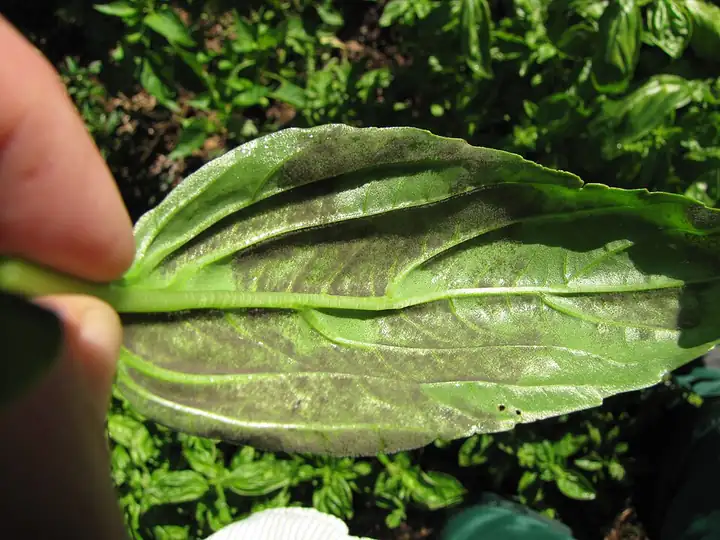
Basil downy mildew
Water mold (Peronospora belbahrii)
| Type | Water mold |
|---|---|
| Cause | Water mold (Peronospora belbahrii) |
| When | Mid to late summer; UMN says the worst damage often comes in late summer. |
About
Basil downy mildew was first found in the U.S. in Florida in 2007 and spread across the East within a year; it can ruin a sweet basil planting. Rutgers University bred downy-mildew-resistant sweet basils, which are now the best defense for home gardeners.
Also called basil downy mildew
How to recognize it
Symptoms
Leaves yellow between the veins, starting on the lower leaves and moving up, while dark gray to purplish fuzz forms on the undersides (easiest to see in early morning). Leaves may cup downward, turn brown or black and drop.
Often confused with
Nutrient shortages, sunburn and thrips damage can yellow basil, but they lack the vein-bounded yellow patches and fuzzy gray growth underneath.
Worse when
Warm, humid weather with wet leaves; it can infect at temperatures as low as 59°F.
How it spreads
Spores blow long distances on the wind, and the disease also arrives on seed, transplants and fresh leaves; in cold-winter states like Minnesota it cannot survive the winter and blows in each year.
When
Mid to late summer; UMN says the worst damage often comes in late summer.
What to do, gentlest first
Prevention works best; most sprays only protect healthy leaves and can't cure infected ones. Always read and follow the product label.
Plant resistant basil Prevent
Rutgers' DMR series ('Rutgers Devotion DMR', 'Obsession DMR', 'Passion DMR' and 'Thunderstruck DMR') and the Prospera and Amazel types resist the disease well. Thai, lemon and red basils are less susceptible; Genovese types are very susceptible.
Rutgers stresses that none of these are fully immune, and new strains could overcome resistance.
Sun, airflow and morning watering Prevent
Grow basil in full sun with good airflow, water at soil level in the morning, and buy healthy transplants or seed.
Report sightings Prevent
Cornell asks growers to report cases on the basil downy mildew monitoring map at basil.agpestmonitor.org to track spread.
Harvest early and remove infected plants By hand
Harvest generously before the disease arrives, and bag and remove infected plants promptly.
Copper or phosphorous acid products Organic spray
Cornell lists some copper and phosphorous acid fungicides for this disease. UMN stresses that most common fungicides do not work on this water mold and any product must go on before infection.
Copper only protects leaves it coats before infection; it will not heal spots already there. It can burn young leaves, especially in weather above 85°F, and some plants are sensitive (Purdue lists celery, strawberry, apple, pear and plum among them). PNW 591 rates copper hydroxide toxic to bees, so spray when bees are not foraging. Follow the label, including the days to wait before harvest.
Plants it affects
Sources
- vegetables.cornell.edu
- extension.umn.edu
- plant-pest-advisory.rutgers.edu
- hort.extension.wisc.edu
- extension.purdue.edu
- s3.wp.wsu.edu
Photo: Photo: Forest & Kim Starr, CC BY 3.0 US, via Wikimedia Commons (CC BY 3.0 US). Photo resized for the web.

Planting dates and advice are general guidance; check with your local Cooperative Extension office for your area.