
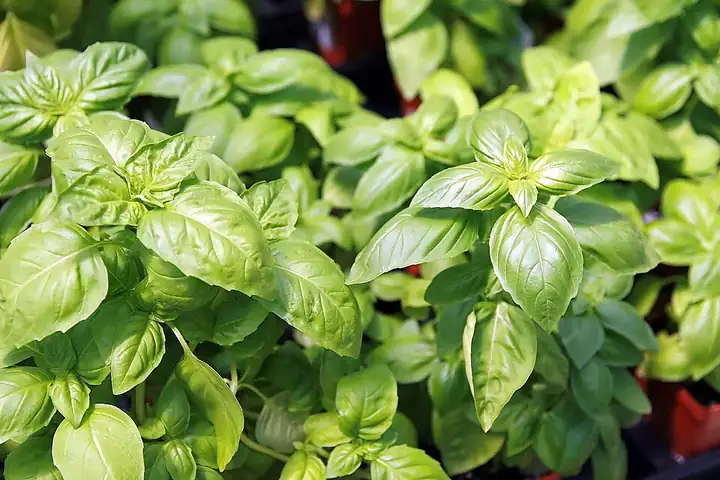
Basil
Ocimum basilicum · Mint family (Lamiaceae)
| Hardiness zones | 2 to 11 |
|---|---|
| Sun | full sun |
| Water | moderate |
| Life cycle | annual |
| Frost | Tender: killed by frost |
| Soil pH | 6.0–7.5 |
| Spacing | 6 to 12 inches |
| Soil temperature to plant | at least 60°F |
About Basil
Sweet basil is a fast-growing, warm-season herb grown for its fragrant leaves. It is one of the easiest herbs to raise from seed, and pinching the tips keeps it bushy and productive all summer.
Grown as a summer annual in every zone; NC State lists it as winter-hardy only in zones 10-11, and frost kills it.
When to plant
Timing is counted from your average last spring frost (and first fall frost). Sow & Tell works out the actual dates for your ZIP code.
- Start seeds indoors: 6 to 8 weeks before the last frost
- Set out plants: 1 to 2 weeks after the last frost
- Sow seeds outdoors: 1 to 2 weeks after the last frost
Wait until well after the last frost, when soil is near 60-70 F; seed sprouts in 10-14 days. Start picking once plants have 6 to 8 leaves, and sow again every 2-3 weeks for a steady supply.
Soil
Well-drained soil that stays evenly moist; Utah State suggests about 1 1/2 inches of water a week.
Follow a soil test; work in no more than 1 inch of well-rotted compost per 100 sq ft, and aim for a soil pH of 6.0 to 7.5.
Feeding
- once plants are big enough to start picking, then every 2-3 weeks: all-purpose liquid fertilizer or another nitrogen source. Use 1-2 Tbsp of fertilizer per 10 ft of row every 2-3 weeks and water it in.
- alternative: once or twice during the season: complete fertilizer such as 5-10-5. Scatter about 3 oz per 10 ft of row beside the plants and water it in. Basil in outdoor pots can get half-strength liquid fertilizer every 3-4 weeks.
Harvest
Snip young leaves any time once the plant has 6 to 8 leaves, cutting whole stems just above a pair of leaves. Pinch off flower buds to keep new leaves coming.
Snip leaves or cut stems just above a pair of leaves, and new growth appears at the cut within about a week. Pinch off flowers, since plants that set seed turn woody and yield much less; it keeps going until cold weather.
Varieties (46)
| Variety | Type | Days | Notes |
|---|---|---|---|
| Aromatto | Bicolor leaf | Leaves blend green and purple. | |
| Greek Dwarf | Bush (dwarf) basil | Spicy, with a slight anise note. Very compact, about 6 inches tall. | |
| Spicy Globe | Bush (dwarf) basil | Small, rounded plant 8-10 inches tall; nice for edging and pots, and slower to go to seed than most basils. | |
| Minette | Dwarf, small-leaf | Compact, small-leaved plant for edging, containers and cooking. | |
| African Blue | Hybrid basil (O. kilimandscharicum x 'Dark Opal') | Camphor-like scent; NC State says it is fragrant but not good for eating. Does not set seed; purple-tinted leaves and large purple-lavender flower spikes. | |
| Newton | Italian sweet basil | Italian type with leaves about 4 inches long. Resistant to Fusarium wilt. | |
| Green Ruffles | Large leaf | Milder flavor than standard green basils. Large, wide leaves. | |
| Mrs. Burns' Lemon | Lemon basil | Lemon-scented. A lemon basil for cooking. | |
| Sweet Dani | Lemon basil | Lemon fragrance; dries well. | |
| Lemon basil | Lemon basil (Ocimum x africanum / O. x citriodorum) | Distinct lemon scent; good with fish, in iced tea and in salads. Narrower, serrated leaves and white flowers on a plant 12-18 inches tall. | |
| Lesbos | Lemon basil hybrid (Ocimum x citriodorum) | ||
| Pesto Perpetuo | Lemon basil hybrid (Ocimum x citriodorum) | ||
| Dark Opal | Purple basil | Deep purple leaves and pale pink to lavender flowers; used both as an ornamental and in the kitchen. | |
| Purple Ruffles | Purple basil | Dark purple leaves with ruffled, fringed edges. | |
| Red Rubin | Purple basil | Dark purple leaves that hold their color well. | |
| Amethyst | Purple leaf | Purple-leaved basil used in herb vinegars and as a landscape accent. | |
| Osmin | Purple leaf | Purple-leaved basil used in herb vinegars and as a landscape accent. | |
| Anise | Scented basil | Scent and taste similar to anise. Purple-tinted leaves and ornamental flowers; 2-2.5 feet tall. | |
| Cinnamon | Scented basil | Strong, spicy cinnamon scent and flavor in both leaves and flowers. Purple stems and flowers on a plant 2-2.5 feet tall. | |
| Holy basil (tulsi) | Separate species (Ocimum tenuiflorum) | Spicy bite that mixes clove, mint and basil; usually cooked or brewed as tea rather than eaten raw. Grows fast to about 3 feet; green or purple leaves on hairy stems with purplish flowers. | |
| Blue Spice | Spice basil (Ocimum americanum) | NC State lists it as resistant to basil downy mildew. | |
| Lime | Spice basil (Ocimum americanum) | Listed by NC State among basils resistant to downy mildew. | |
| Sweet basil | Sweet basil | The classic basil flavor used for pesto and tomato dishes. The most widely grown basil type in home gardens. | |
| Elidia | Sweet basil (compact) | Compact plant with Fusarium wilt resistance. | |
| Everleaf | Sweet basil (downy mildew resistant) | Penn State lists it as resistant to basil downy mildew. | |
| PestoBesto | Sweet basil (downy mildew resistant) | Penn State lists it as resistant to basil downy mildew. | |
| Dolce Fresca | Sweet basil (Genovese type) | ||
| Rutgers Devotion DMR | Sweet basil (Genovese type), downy mildew resistant | Uniform, upright plant with dark green, flat to cupped leaves; gets established faster than Obsession. | |
| Cardinal | Sweet basil (ornamental flowers) | Grown as much for its showy dark purple flower heads as for its leaves. Penn State notes the blooms draw pollinators. | |
| Magical Michael | Sweet basil (ornamental flowers) | Very uniform plants with ornamental flowers. | |
| Amazel | Sweet basil, downy mildew resistant | Downy mildew resistant basil grown from cuttings rather than seed. | |
| Prospera DMR | Sweet basil, downy mildew resistant | Seed series carrying a single resistance gene to downy mildew; Penn State also lists it as Fusarium wilt resistant. Includes Italian Large Leaf, Compact and Red forms. | |
| Rutgers Obsession DMR | Sweet basil, downy mildew resistant | Compact, high-yielding plant with thick, glossy dark green leaves and very late flowering; also highly resistant to Fusarium wilt. | |
| Rutgers Passion DMR | Sweet basil, downy mildew resistant | Vigorous plant with a high leaf-to-stem ratio and larger, slightly cupped leaves; looks similar to Devotion. | |
| Rutgers Thunderstruck DMR | Sweet basil, downy mildew resistant | Fast, upright grower with medium-sized, ruffled, bright green leaves; high yielding. | |
| Italian Large Leaf | Sweet basil, large-leaf | Milder flavor than smaller-leaved basils. Large green leaves for cooking. | |
| Lettuce Leaf | Sweet basil, large-leaf | Large leaves with a sweet flavor. Big, crinkled green leaves on a vigorous plant. | |
| Mammoth | Sweet basil, large-leaf | Flavor is less strong than other green basils. Large, wide leaves. | |
| Napoletano | Sweet basil, large-leaf | Milder than most green basils. Very large leaves. | |
| Nufar | Sweet basil, large-leaf | Large-leaved cooking basil resistant to Fusarium wilt. | |
| Genovese | Sweet basil, large-leaf Italian | An Italian strain that Iowa State calls the top choice for pesto and garlic dishes. Upright plant about 2 feet tall with dark green leaves up to 2 inches long; slow to bolt. | |
| Queenette | Thai basil | Thai-style basil listed as resistant to basil downy mildew. | |
| Siam Queen | Thai basil | Spicy licorice-mint flavor. Large leaves with purple stems and flowers. | |
| Thai | Thai basil | Sweet, anise-like scent and flavor with a hint of licorice; a staple of Southeast Asian cooking. Narrow leaves, purple stems and pinkish-purple flowers; upright, well-branched plant 2-3 feet tall. | |
| Batik | Thai-style | Mild Thai-style flavor. Purple-speckled leaves and purple flower bracts. Very uniform and easy to grow. | |
| Queen of Sheba | Compact plant that suits containers. Often grown as an ornamental but also edible. |
Good neighbors
A few studies found basil planted with tomatoes reduced thrips on the tomatoes (University of Minnesota Extension); most other basil pairings you see online are untested.
Pests to watch for
Japanese beetle, Grasshoppers, Slugs, Fungus gnats
Diseases and problems
Basil downy mildew, Root rot, Fusarium wilt, Damping-off
In the kitchen
The leaves flavor sauces, pesto, salads and tomato dishes, and the flowers are edible too.
Keeping it: Basil hates the cold: keep the stems in a glass of water at room temperature, change the water daily, and use within several days.
Pets: Not toxic to dogs or cats (ASPCA)
Sources
- plants.ces.ncsu.edu
- extension.umn.edu
- extension.usu.edu
- mgnv.org
- extension.umn.edu
- aspca.org
- extension.psu.edu
Photo: Photo: David J. Stang, CC BY-SA 4.0, via Wikimedia Commons (CC BY-SA 4.0). Photo resized for the web.

Planting dates and advice are general guidance; check with your local Cooperative Extension office for your area.