
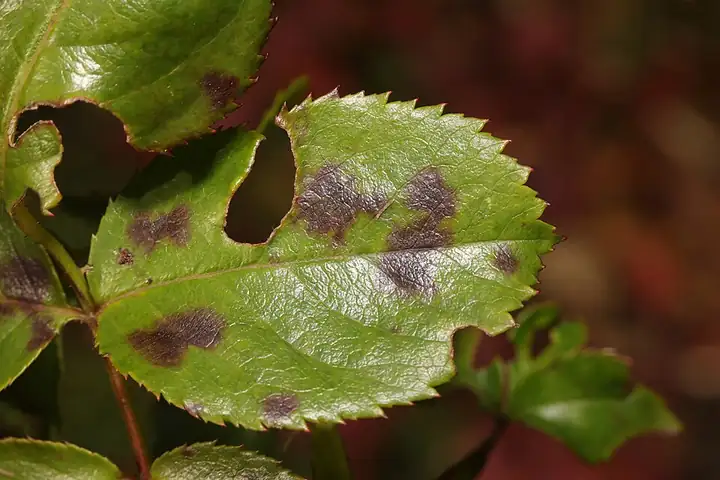
Black spot of rose
Fungus (Diplocarpon rosae)
| Type | Fungus |
|---|---|
| Cause | Fungus (Diplocarpon rosae) |
| When | Starts in wet spring weather as leaves come out and keeps going through summer. |
About
Black spot is a common fungal leaf disease of roses that thrives in wet weather. It does not usually kill roses, but repeated leaf loss leaves them weak, stunted and short on flowers.
Also called black spot, Black spot, rose black spot, blackspot, black spot of rose, Diplocarpon black spot
How to recognize it
Symptoms
Round black to dark brown spots up to about half an inch across show up on the tops of leaves. The spots have feathery, fringed edges and often a yellow halo, and the leaves soon yellow and drop, starting low on the plant. Young canes can get raised purple-red blotches that later blacken and blister.
Often confused with
Rose downy mildew also spots leaves purple, red or brown, but its spots are angular. Black spot's spots have fringed edges with tiny black dots inside and no fuzz on the leaf underside (UC IPM).
Worse when
Long, warm, wet spells, especially in spring; the fungus needs leaves to stay wet for more than about 7 hours to infect.
How it spreads
Spores splash and blow from spotted leaves onto new ones; the fungus spends the winter in fallen rose leaves and infected canes.
When
Starts in wet spring weather as leaves come out and keeps going through summer.
Where
Worst where summers are warm and humid; in California it is mostly a problem in humid coastal areas, not the dry interior (UC IPM).
What to do, gentlest first
Prevention works best; most sprays only protect healthy leaves and can't cure infected ones. Always read and follow the product label.
Plant resistant roses Prevent
Choose roses rated for black spot resistance. Extension lists include shrub rose 'Meipotal' (Carefree Delight), rugosas 'Blanc Double de Coubert' and 'Fru Dagmar Hastrup', 'William Baffin', 'Henry Kelsey', the Knock Out series, and 'Pride N Joy', 'Sexy Rexy' and 'Prima Donna'.
Resistant roses can still get some black spot; only a few roses resist every strain.
Sun, space and dry leaves Prevent
Plant in full sun with room for air to move. Water at the base with drip or a soaker hose, and if you must wet the leaves, do it in the morning so they dry before night.
Clean up and prune out infection By hand
Pick off spotted leaves, rake up fallen ones, and replace old mulch under the roses before spring growth. In late winter or early spring, cut infected canes 6 to 8 inches below the damage, in dry weather.
Wipe or dip pruners in 70% alcohol or 10% bleach between cuts; rinse and oil them after bleach.
Neem or horticultural oil, potassium bicarbonate or sulfur Organic spray
UC IPM says these have been shown to reduce black spot. Start as leaves come out on roses that had black spot before, and repeat every 7 to 14 days while wet weather lasts.
Do not spray oil on water-stressed roses or within two weeks of a sulfur spray, or leaves can burn. Oils can hurt bees they hit, so spray in the evening. Follow the label.
Copper Organic spray
Copper fungicides are listed for black spot by Clemson and Wisconsin. They protect leaves before infection; they do not clear spots already there.
WSU's bee guide rates copper products toxic to bees, so do not spray open flowers and spray in the evening. Follow the label.
Chlorothalonil, myclobutanil or propiconazole Conventional spray
For roses with a history of bad black spot, spray from bud break every 7 to 14 days through wet weather. Switch between at least two active ingredients so the fungus does not become resistant.
These protect new leaves and do not cure spotted ones. UC IPM rates chlorothalonil high in hazard to people and to fish and other water life, so keep it out of water, wear gloves, long sleeves and goggles, and follow the label.
Plants it affects
Sources
Photo: Photo: Stephen James McWilliam / Wikimedia Commons, CC0 (CC0). Photo resized for the web.

Planting dates and advice are general guidance; check with your local Cooperative Extension office for your area.