
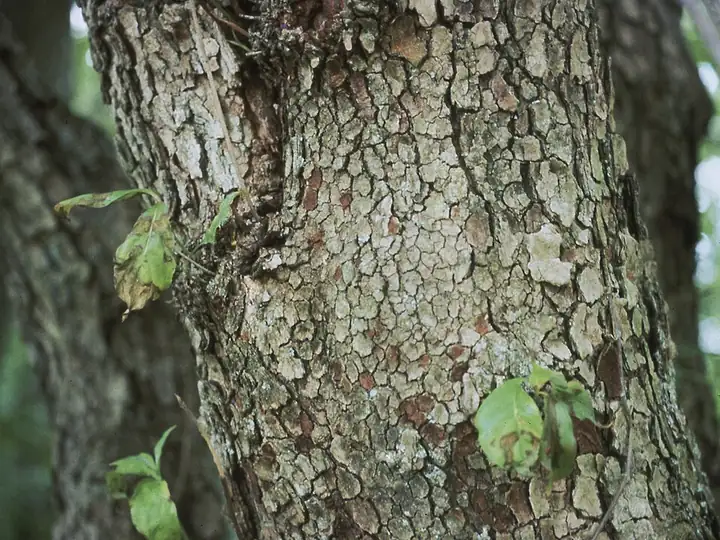
Dogwood anthracnose
Fungus (Discula destructiva)
| Type | Fungus |
|---|---|
| Cause | Fungus (Discula destructiva) |
About
Dogwood anthracnose is a serious fungal disease of flowering dogwood that can kill branches and whole trees, especially in cool, shady, moist spots. Kousa dogwood and several Rutgers hybrid dogwoods resist it much better.
Also called dogwood anthracnose, Dogwood anthracnose, Discula anthracnose, Discula destructiva
How to recognize it
Symptoms
In spring, tan leaf spots with purple borders appear, starting on the lower branches and moving up; they grow into brown blotches along leaf edges and veins. Dead leaves often hang on the twigs into winter. The fungus moves into twigs and branches, causing sunken cankers, lots of water sprouts on the trunk, and dieback that can girdle and kill the tree.
Often confused with
Spot anthracnose (Elsinoe corni) makes much smaller spots with reddish-purple borders, often on the flower bracts, and is mostly cosmetic; it never moves into the branches.
Worse when
Cool, wet, rainy spring weather, long periods of wet leaves, and heavy shade with poor air movement.
How it spreads
Spores splash and blow in rain from infected leaves, twig cankers and fallen leaves, where the fungus spends the winter; it also moves on dogwoods dug from the wild and on infected nursery trees.
When
Leaf spots show in spring; twig and branch dieback builds through the season and over years.
Where
Worst in the cooler, higher mountains of the Southeast (in South Carolina mostly above 2,000 feet) and in shaded, moist sites in the East; in North Carolina it has been found only in the western part of the state.
What to do, gentlest first
Prevention works best; most sprays only protect healthy leaves and can't cure infected ones. Always read and follow the product label.
Plant resistant dogwoods Prevent
Kousa dogwood is generally resistant, as are the Rutgers hybrids 'Aurora', 'Celestial', 'Constellation', 'Galaxy', 'Ruth Ellen', 'Stellar Pink' and 'Star Dust'. Flowering dogwood 'Appalachian Spring' is also listed as resistant.
Do not dig dogwoods from the woods to plant at home; they may carry the fungus.
Good site and care Prevent
Plant where the tree gets morning sun so leaves dry early. Water in dry spells, keep 2 to 4 inches of mulch over the roots, avoid sprinklers on the leaves, avoid heavy nitrogen, and keep mowers and string trimmers off the trunk.
Prune out dead wood and rake leaves By hand
Cut out dead and cankered twigs as you find them, remove water sprouts from the trunk in fall, rake up fallen leaves, and thin crowding plants nearby to let in air and light.
Copper Organic spray
Clemson lists copper fungicides for dogwood anthracnose. Start at bud break and keep new growth covered while the weather stays cool and wet.
It protects new leaves only and will not cure cankers. WSU's bee guide rates copper products toxic to bees, so spray in the evening and not on open flowers. Follow the label.
Chlorothalonil, mancozeb, propiconazole or thiophanate-methyl Conventional spray
For valuable trees or trees near infected dogwoods, spray at bud break and about every two weeks until the weather turns warm and dry. Spraying works best before branch dieback starts.
Fungicides do not cure infected wood. UC IPM rates chlorothalonil high in hazard to people and to fish and other water life: wear gloves, long sleeves and goggles and follow the label.
Plants it affects
Sources
Photo: Photo: NatureServe / Wikimedia Commons, CC BY 2.0 (CC BY 2.0). Photo resized for the web.

Planting dates and advice are general guidance; check with your local Cooperative Extension office for your area.