
Oak wilt
Fungus (Bretziella fagacearum, formerly Ceratocystis fagacearum)
| Type | Fungus |
|---|---|
| Cause | Fungus (Bretziella fagacearum, formerly Ceratocystis fagacearum) |
About
Oak wilt is a fatal fungal disease that plugs the water-conducting wood of oaks. Red, black and pin oaks can die within weeks, while white and bur oaks decline more slowly and sometimes can be saved.
Also called oak wilt, Oak wilt, oak wilt disease
How to recognize it
Symptoms
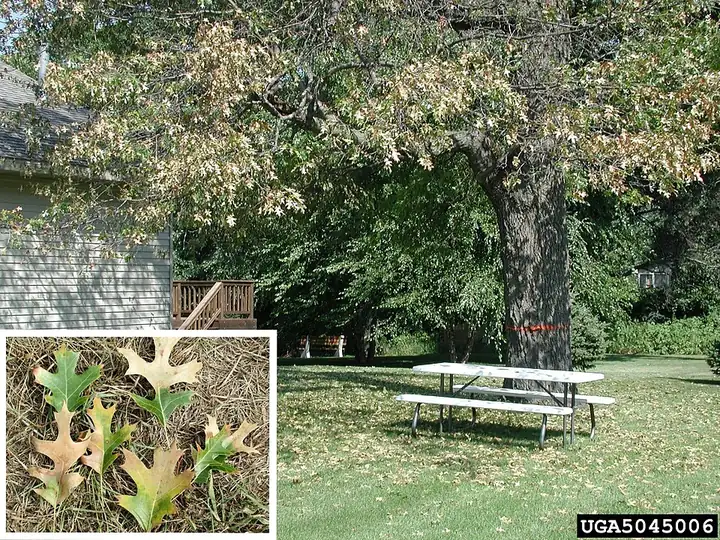
On red oaks, leaves turn dull green, then bronze or red-brown from the edges inward while the base stays green, starting at the top or outer crown; they drop fast and pile up under the tree in summer. White oaks show the same leaf pattern on a few scattered branches and may take years to die. Under the bark of wilted branches the wood may be stained brown, bluish or black.
Often confused with
Several other tree problems look alike, so get a lab test from freshly wilted branches. Bacterial leaf scorch also browns oak leaves from the edges, but it shows up in late summer and creeps through the tree over several years instead of killing a red oak in weeks.
Worse when
Fresh wounds on oaks from pruning, storms or construction in spring and early summer, when sap beetles carrying spores are active; oaks of the same group growing close together, whose roots graft.
How it spreads
Sap beetles carry spores from fungal mats under the bark of recently killed red oaks to fresh wounds on healthy oaks, and the fungus spreads tree to tree through grafted roots (most within about 30 to 50 feet); firewood from infected oaks can carry it long distances.
When
Infection risk is highest from about April through July; wilting shows in summer.
Where
Found from Minnesota east to Pennsylvania, south to South Carolina and Tennessee, and west into central Texas, Kansas and Nebraska.
What to do, gentlest first
Prevention works best; most sprays only protect healthy leaves and can't cure infected ones. Always read and follow the product label.
Do not prune or wound oaks in spring and early summer Prevent
Prune oaks in winter, before about mid-March. If an oak gets wounded from spring through midsummer, cover the wound right away with latex or water-based paint or shellac.
Exact risk dates vary by year and state; check your state's guidance before pruning.
Do not move oak firewood Prevent
Do not bring in or haul away firewood or logs from wilted oaks. Infected wood can be debarked, split and dried, chipped, or tightly covered with thick clear plastic with the edges buried.
Plant diverse trees Prevent
Where oak wilt is common, favor white oaks over red oaks, space red oaks more than 50 feet apart, and mix in other kinds of trees.
Cut root grafts and remove wilted red oaks By hand
Hire a tree professional to cut root connections (often with a vibratory plow about 5 feet deep) between diseased and healthy oaks, then remove wilted red oaks in fall or winter. Mild cases in white oaks may respond to pruning out diseased wood.
Healthy-looking oaks right next to a diseased one may already be infected.
Propiconazole injection (arborist only) Conventional spray
Injected by a qualified arborist, propiconazole can protect healthy high-value oaks for up to about two years and can halt early infections in white oaks with less than about 30% of the crown affected.
It does not stop spread through roots and usually fails on red oaks already wilting. Follow the label.
Plants it affects
Sources
Photo: Photo: Joseph O'Brien, USDA Forest Service, Bugwood.org / Wikimedia Commons, CC BY 3.0 US (CC BY 3.0 US). Photo resized for the web.

Planting dates and advice are general guidance; check with your local Cooperative Extension office for your area.