
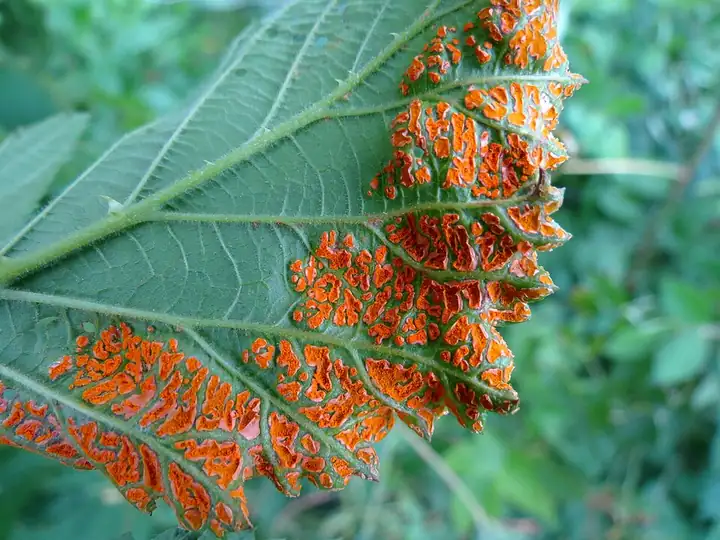
Orange rust
Fungi (Gymnoconia nitens on blackberry and dewberry; Arthuriomyces peckianus on black and purple raspberry)
| Type | Fungus |
|---|---|
| Cause | Fungi (Gymnoconia nitens on blackberry and dewberry; Arthuriomyces peckianus on black and purple raspberry) |
| When | Orange spores show in spring on new shoots, sometimes again in late summer. |
About
A rust disease of blackberries and black and purple raspberries that infects the whole plant, roots and all, for life. Red raspberries do not get it.
Also called orange rust
How to recognize it
Symptoms
In spring, new shoots come up weak and spindly with small, narrow, pale yellow-green leaves. Within 2 to 3 weeks the leaf undersides are covered with waxy blisters that burst into bright orange powder. Infected plants rarely flower and give little or no fruit.
Worse when
Cool, moist weather; leaves must stay wet for many hours for spores to infect.
How it spreads
The fungus lives inside the crown and roots year-round, and wind carries the orange spores to healthy plants, including from wild brambles.
When
Orange spores show in spring on new shoots, sometimes again in late summer.
What to do, gentlest first
Prevention works best; most sprays only protect healthy leaves and can't cure infected ones. Always read and follow the product label.
Start clean and remove wild brambles Prevent
Buy disease-free plants, keep canes thinned and weeds down for airflow, and clear out wild blackberries and black raspberries nearby. Red raspberries are an option where orange rust is common.
Dig out infected plants, roots and all By hand
Check plants in early spring when shoots are under a foot tall and dig up any with weak, pale shoots, including the roots, before the orange spores burst open. Do not wait for them to recover; they never do.
Fungicides do not cure or control orange rust. UC IPM notes glyphosate or triclopyr can be spot-applied to kill infected plants, but these can injure nearby plants you want to keep; follow the label.
Plants it affects
Sources
Photo: Photo: Katja Schulz, CC BY 2.0, via Wikimedia Commons (CC BY 2.0). Photo resized for the web.

Planting dates and advice are general guidance; check with your local Cooperative Extension office for your area.