
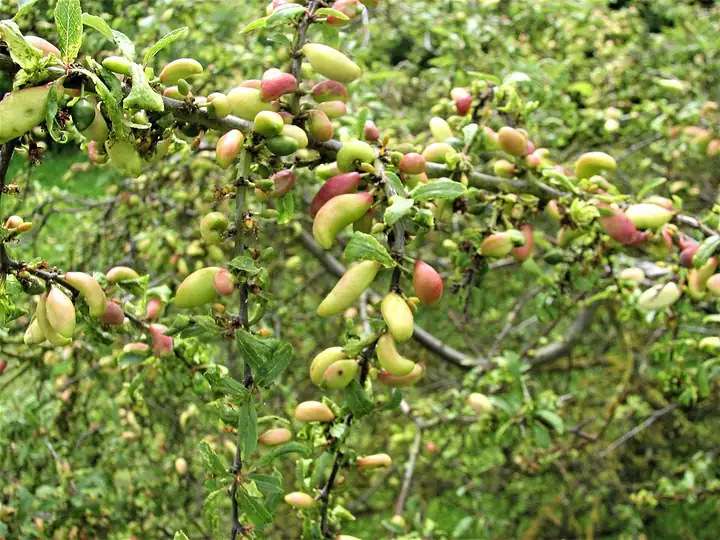
Plum pockets
Fungus (Taphrina communis), a cousin of the peach leaf curl fungus
| Type | Fungus |
|---|---|
| Cause | Fungus (Taphrina communis), a cousin of the peach leaf curl fungus |
| When | Spring; swollen fruit shows 6 to 8 weeks after bud break. |
About
A fungus that turns young plums into big, hollow, spongy bladders. It mostly hits wild and American-type plums and doesn't hurt the tree itself.
Also called plum pocket, plum pockets, bladder plum, pocket plum, mock plums
How to recognize it
Symptoms
A month or two after bloom, a small blister on a young plum spreads until the fruit swells up to ten times normal size. Pocketed fruit is spongy and hollow, with no pit, and turns from yellow or reddish to a velvety gray as spores form, then dries black and drops. Leaves and shoots may thicken, curl and swell like peach leaf curl.
Often confused with
Leaf and shoot symptoms look like peach leaf curl, a related fungus.
Worse when
Cool, wet weather in spring, right around bud break.
How it spreads
The fungus spends the winter on twigs and bud scales, and spores infect young tissue in spring; dried pocketed fruit left on the tree adds more spores.
When
Spring; swollen fruit shows 6 to 8 weeks after bud break.
What to do, gentlest first
Prevention works best; most sprays only protect healthy leaves and can't cure infected ones. Always read and follow the product label.
Resistant kinds Prevent
Most dessert plums are seldom affected; it's mainly a problem on wild and American-type plums.
Pick off pocketed fruit By hand
Remove pocketed plums before they turn gray with spores, rake up fallen fruit and leaves, and prune out swollen twigs. Bury or discard them.
The tree's health isn't at risk, so many years this is all you need.
Dormant copper or lime sulfur Organic spray
Only if the disease has ruined most of the crop several years in a row: one spray just before bud break (or in fall after leaf drop) with a copper product such as Bordeaux mix or copper octanoate, or liquid lime sulfur.
The tree and fruit must be listed on the label, and some products for ornamental plums aren't safe for edible fruit. Homeowners shouldn't spray trees taller than 10 feet; hire a licensed applicator. Follow the label.
Chlorothalonil (dormant) Conventional spray
Chlorothalonil is another option on the same dormant schedule.
Check that the label allows use on fruit you'll eat, and follow the waiting period before harvest.
Plants it affects
Sources
Photo: Photo: Patrick Roper / Wikimedia Commons, CC BY-SA 2.0 (CC BY-SA 2.0). Photo resized for the web.

Planting dates and advice are general guidance; check with your local Cooperative Extension office for your area.