
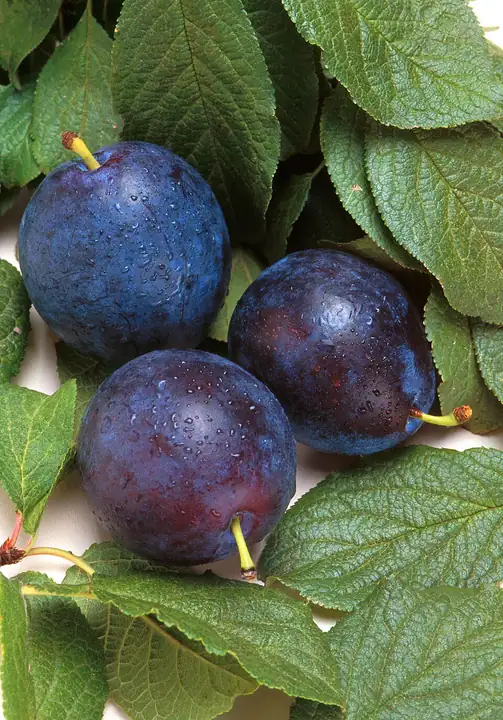
Plum
Prunus domestica (European plum), plus Japanese, American and hybrid plums (Prunus spp.) · Rose family (Rosaceae)
| Hardiness zones | 3 to 9 |
|---|---|
| Sun | full sun |
| Water | moderate |
| Life cycle | perennial |
| Frost | Hardy: takes frost |
| Soil pH | 6.0–7.0 |
| Spacing | 144 to 264 inches |
About Plum
Plums come in several groups: European plums for eating fresh or drying, Japanese plums mainly for fresh eating, and very cold-hardy hybrid plums. Most need a pollination partner, and stone-fruit pests like plum curculio and brown rot take some management.
NC State lists European plum for zones 4-9, and some hybrid plums rate good in zone 3 (University of Minnesota). European plums need about 700-1,100 chill hours below 45 F and Japanese plums 500-900 (UGA).
When to plant
Timing is counted from your average last spring frost (and first fall frost). Sow & Tell works out the actual dates for your ZIP code.
- Set out plants: up to 4 weeks before the last frost
Plant in early spring as soon as the soil is dry enough to work (UNH); in Georgia, plant dormant trees in February or early March (UGA). Hybrid plums bear 2 to 5 years after planting a 1- or 2-year-old tree (University of Minnesota). Thin fruit 30-45 days after bloom to one every 2-4 inches (UGA).
Soil
Deep, well-drained, fertile soil; plums tolerate little wet or heavy soil and may yellow (iron chlorosis) in alkaline soils (Utah State).
Aim for a pH of 6.0 to 7.0; test the soil, work in any nutrients it lacks, and clear perennial weeds before planting.
Feeding
- Each spring (May in New England) from the second year on, only if growth is weak: balanced fertilizer such as 10-10-10, or nitrogen fertilizer such as 20-0-0. Follow a soil test; about 1/2 lb of 10-10-10 for young trees and 1 lb for bearing trees (Utah suggests 1/2-1 cup of 20-0-0 for trees under 5 years, 1-2 cups for older), spread from the drip line to about 16 inches from the trunk.
Skip feeding when young trees already grow 10-20 inches a year (older trees 8-10 inches); too much fertilizer does more harm than too little.
Harvest
Ripe plums soften and turn from green to blue, purple or red depending on variety; green types often get yellow highlights (Utah State).
Plums give one crop a year, ripening in late summer to early fall depending on cultivar, as the fruit softens and colors. When the crop is heavy, thin fruit to 4-6 inches apart once frost danger is past.
Varieties (35)
| Variety | Type | Days | Notes |
|---|---|---|---|
| South Dakota | American plum | Medium fruit with reddish-yellow skin. Hardy, vigorous and productive. | |
| Damson | European | Traditional fruit for cooking and jam; Utah State notes many plums of this type are self-fruitful. | |
| Early Italian | European | Prune-type plum. Hardy in New Hampshire. | |
| Green Gage | European | Very sweet amber flesh; greenish-yellow skin with a red blush. A classic fresh-eating plum. | |
| Italian | European | Prune-type plum. | |
| Mount Royal | European | Yellow flesh and blue skin; good fresh, dried or in preserves. Heavy producer. Rated very good in zone 4 and good in zone 3. | |
| Seneca | European | Listed by Utah State as a good fresh-eating European plum. | |
| Stanley | European | Sweet, fairly dry, pale yellow flesh under blue skin; a prune plum. Good for drying and preserves. Best in southern Minnesota; rated only fair in zone 4. | |
| Alderman | Hybrid (American x Japanese) | Sweet, juicy golden flesh under burgundy skin. Large fruit; thinning helps size. University of Minnesota release (1986). | |
| BlackIce | Hybrid (American x Japanese) | Deep red flesh with blue-black skin; about 2-inch fruit. Naturally small tree with a weeping shape. | |
| LaCrescent | Hybrid (American x Japanese) | Very sweet, juicy yellow fruit with a hint of apricot. Vigorous tree but often a light cropper. | |
| Pembina | Hybrid (American x Japanese) | Sweet, juicy yellow flesh under bright red skin. Large, pointed fruit. Very hardy; may survive zone 2. | |
| Pipestone | Hybrid (American x Japanese) | Sweet, melting golden flesh; thin bright red skin. Very large fruit. Hardy and copes with dry sites. University of Minnesota release (1942). | |
| Superior | Hybrid (American x Japanese) | Very sweet, rich yellow flesh with bright red skin. Large fruit; thinning helps size. University of Minnesota release (1933). Rated good in zone 4, poor in zone 3. | |
| Toka | Hybrid (American x Japanese) | Rich, spicy-sweet golden flesh under deep magenta skin. Rated good in zone 4 and fair in zone 3 in Minnesota. | |
| Underwood | Hybrid (American x Japanese) | Soft yellow flesh with red skin; heart-shaped fruit. One of the oldest University of Minnesota plum releases (1920). | |
| Waneta | Hybrid (American x Japanese) | Sweet, juicy yellow flesh with red skin. Very hardy; developed in South Dakota in 1913. | |
| AU Amber | Japanese | Red-purple skin with amber flesh. Good tree health rating in Georgia. | |
| AU Producer | Japanese | Dark red skin and red flesh. Tolerant of plum leaf scald. | |
| AU Roadside | Japanese | Dark red skin and red flesh. Tolerant of plum leaf scald; rated very good for tree health in Georgia. | |
| AU Rosa | Japanese | Resistant to plum leaf scald. Auburn University release. | |
| Bruce | Japanese | Large red plum. | |
| Byrongold | Japanese | May have leaf scald problems. | |
| Methley | Japanese | Small to medium fruit; juicy, sweet red flesh under mottled purple skin. Prone to black knot. | |
| Morris | Japanese | Large fruit with firm red to purple flesh. | |
| Ozark Premier | Japanese | Large fruit with yellow flesh and reddish skin. | |
| Ruby Queen | Japanese | Excellent flavor; dark red skin and red flesh. Good tree health rating in Georgia. | |
| Rubysweet | Japanese | Red-bronze skin with blood-red flesh. Very good tree health rating in Georgia. | |
| Santa Rosa | Japanese | Large purplish plum with amber flesh. | |
| Satsuma | Japanese | Round, fairly large fresh-eating plum. | |
| Shiro | Japanese | Round, fairly large fresh-eating plum. | |
| Gulfbeauty | Japanese (low-chill) | Sweet, mild dark reddish-purple flesh. Resistant to bacterial canker; some resistance to leaf scald. University of Florida release. | |
| Gulfblaze | Japanese (low-chill) | Sweet, mild flesh; dark red to purple skin. Disease resistance similar to Gulfbeauty. | |
| Gulfrose | Japanese (low-chill) | Sweet, aromatic blood-red flesh. Moderate bacterial canker resistance; less tolerant of leaf scald. | |
| Spring Satin | Plum-apricot hybrid | Red-black skin with yellow-red flesh. Good tree health rating in Georgia. |
Pests to watch for
Plum curculio, Spotted wing drosophila, Peachtree borer, Aphids, Twospotted spider mite, Scale insects, Sawflies (garden sawflies), Eriophyid mites (rust, bud, blister and gall mites), Katydids, Boxelder bugs, Ground squirrels, Granulate ambrosia beetle, Obliquebanded leafroller, Pear sawfly (pearslug, cherry slug), European red mite, Apple maggot, Oriental fruit moth, Cherry fruit fly, Spotted lanternfly, Eastern tent caterpillar, Green June beetle (fig-eater), Leaffooted bugs
Diseases and problems
Brown rot, Black knot, Bacterial spot, Bacterial canker, Powdery mildew, Rust, Iron chlorosis, Mechanical damage (mower, trimmer and tie wounds), Crown gall, Sunscald, Plum pockets, Armillaria root rot, Gray mold (Botrytis)
In the kitchen
Japanese plums are mostly eaten fresh; European plums are eaten fresh or processed, for example dried as prunes (UGA).
Keeping it: Ripen firm plums on the counter in a paper bag, then refrigerate ripe ones and use them within a few days.
Safety: Stems, leaves and seeds contain cyanide-forming compounds (ASPCA), so do not crush or eat the pits.
Pets: Toxic to dogs, cats and horses (ASPCA): stems, leaves and seeds contain cyanogenic glycosides, especially as leaves wilt; signs include brick-red gums, dilated pupils, trouble breathing, panting and shock
Sources
- plants.ces.ncsu.edu
- content.ces.ncsu.edu
- extension.umn.edu
- extension.unh.edu
- fieldreport.caes.uga.edu
- extension.usu.edu
- aspca.org
Photo: Photo: Scott Bauer, USDA ARS, Public domain (USDA ARS), via Wikimedia Commons. Photo resized for the web.

Planting dates and advice are general guidance; check with your local Cooperative Extension office for your area.