
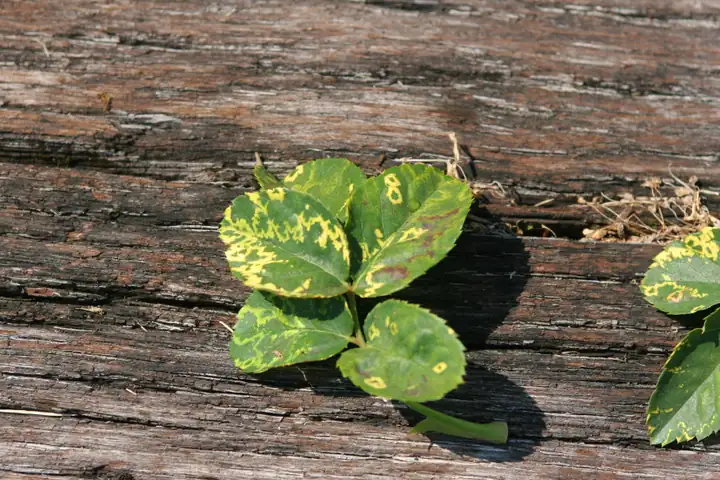
Rose mosaic
Viruses (mainly Prunus necrotic ringspot virus and apple mosaic virus, both ilarviruses, sometimes with others), passed on through budding and grafting
| Type | Virus |
|---|---|
| Cause | Viruses (mainly Prunus necrotic ringspot virus and apple mosaic virus, both ilarviruses, sometimes with others), passed on through budding and grafting |
| When | Leaf patterns show mostly in spring and may fade during summer. |
About
Rose mosaic is caused by a group of viruses that draw yellow lines, rings and mottling on rose leaves. It spreads almost entirely in nursery propagation, through infected buds, rootstocks or cuttings, not through insects or pruning in the garden. Infected roses stay infected for life, but many keep growing and blooming, so you only need to replace the ones that struggle.
Also called rose mosaic virus, rose mosaic disease, RMV, Prunus necrotic ringspot virus, PNRSV, apple mosaic virus, ApMV, arabis mosaic virus, ArMV
How to recognize it
Symptoms
Leaves show yellow, cream or pale green zigzag lines, rings, oak-leaf patterns, mottling, or yellow bands along the veins, sometimes on only part of the plant. Patterns are clearest in spring and may be missing on leaves that grow in summer. Some infected roses never show signs. Over time, plants may grow less, bloom later or less, drop leaves early in fall and suffer more winter injury.
Often confused with
Rose spring dwarf and rose leaf curl can look similar. Symptoms alone are unreliable; a lab test confirms rose mosaic.
Worse when
Buying roses that were not virus-tested and propagating from infected plants. Cool spring weather brings out the leaf patterns.
How it spreads
Spreads when buds or scions from an infected rose are grafted onto a rootstock, when healthy buds are grafted onto an infected rootstock, and in cuttings taken from sick plants. Current research finds no evidence that aphids, thrips, pruning shears or soil spread it. Rare root grafts between tightly packed plants are the only natural spread known, and they have not been seen in gardens.
When
Leaf patterns show mostly in spring and may fade during summer.
What to do, gentlest first
Prevention works best; most sprays only protect healthy leaves and can't cure infected ones. Always read and follow the product label.
Buy virus-tested roses Prevent
Buy roses certified as virus-indexed, meaning tested free of known rose viruses. Check leaves before you buy, especially in spring, and pass on any with line or ring patterns.
Don't propagate from infected roses Prevent
Don't take cuttings or buds from a rose with mosaic patterns, and don't bud onto one.
Clean pruners as a precaution Prevent
Pruning tools have not been shown to spread rose mosaic, but UF suggests cleaning pruners between plants anyway.
Replace roses that struggle By hand
There is no cure, and no spray helps. Pruning off patterned leaves does not remove the virus. Keep an infected rose if it grows and blooms well, or dig it out and replace it with a virus-tested plant if it performs poorly.
An infected rose is not known to infect neighboring roses in a garden, so there is no need to remove healthy-looking plants around it.
Plants it affects
Sources
Photo: Photo: Malcolm Manners, CC BY 2.0, via Wikimedia Commons (CC BY 2.0). Photo resized for the web.

Planting dates and advice are general guidance; check with your local Cooperative Extension office for your area.