
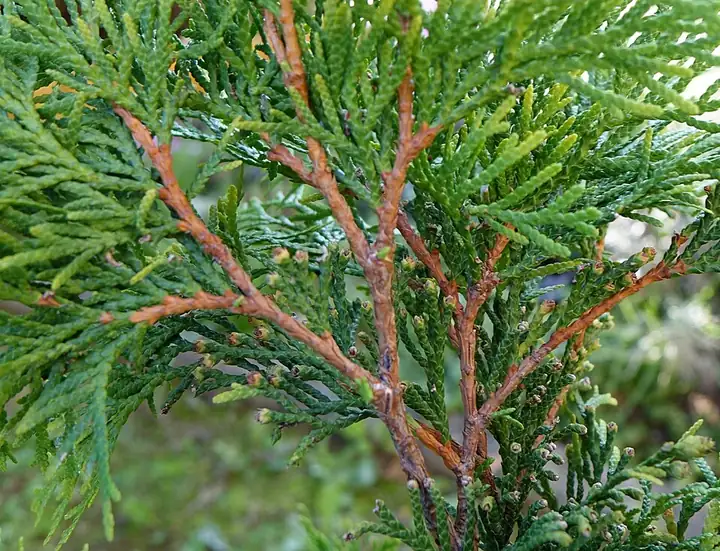
Arborvitae leafminer
Argyresthia thuiella and at least three related leafminers
| Type | Insect |
|---|---|
| When | Larvae inside tips from late summer through spring; moths June to July. |
| Pressure by region | High pressure: Northeast |
About
The larvae of tiny moths that hollow out the scaly leaf tips of American arborvitae (northern white cedar) (UMass). The browning often isn't noticed until January or February, so it gets mistaken for winter injury.
Spotting it
Damage
Infested tips turn brown and are hollow inside, sometimes filled with frass, with entry holes too small to see without a lens. Damage can look bad, but plants can lose up to 80% of their foliage and still survive (UMass).
How to find it early
In spring and fall, check brown tips, starting on the sunny side. Pinch or split one open with a hand lens: hollow tips with frass mean leafminers, while solid brown tips point to winter injury or disease. Shaking the plant in June and July may flush out the tiny moths (UMass).
When
Larvae inside tips from late summer through spring; moths June to July.
Life cycle
Small gray moths lay eggs from mid-June to mid-July. Larvae mine the tips through fall, spend winter inside them, finish feeding in spring and pupate, and adults come out to start again (UMass).
What to do, gentlest first
Start at the top. Sprays are a last step; always read and follow the product label.
Tolerate light damage Prevent
Arborvitae can lose a lot of foliage and recover, so light browning rarely needs action (UMass).
Prune out infested tips By hand
Where it won't hurt the plant's health or look, clip off and destroy brown, mined tips (UMass).
Parasitic wasps Natural enemies
Many tiny parasitic wasps attack the larvae and pupae, though they may be scarce on single landscape plants (UMass).
Labeled leafminer insecticides Conventional spray
UMass lists about 20 active ingredients registered for this leafminer, some applied as soil drenches or injections.
Apply only after bloom and when bees are less active (UMass). Follow the label.
Plants it goes after
Pressure by region
At least four leafminer species attack arborvitae in the Northeast (UMass). Ratings elsewhere are estimates.
| Northeast | High pressure |
|---|---|
| Southeast | Low |
| South Central | Low |
| Midwest | Moderate |
| Great Plains | Low |
| Mountain West | Low |
| Southwest | Low |
| Pacific Northwest | Low |
| California | Low |
| Alaska | Low |
| Hawaii | Low |
Ratings come from extension sources where available; some are estimates, as noted above.
Sources
Photo: Photo: Jerzy Opioła / Wikimedia Commons, CC BY-SA 4.0 (CC BY-SA 4.0). Photo resized for the web.

Planting dates and advice are general guidance; check with your local Cooperative Extension office for your area.