
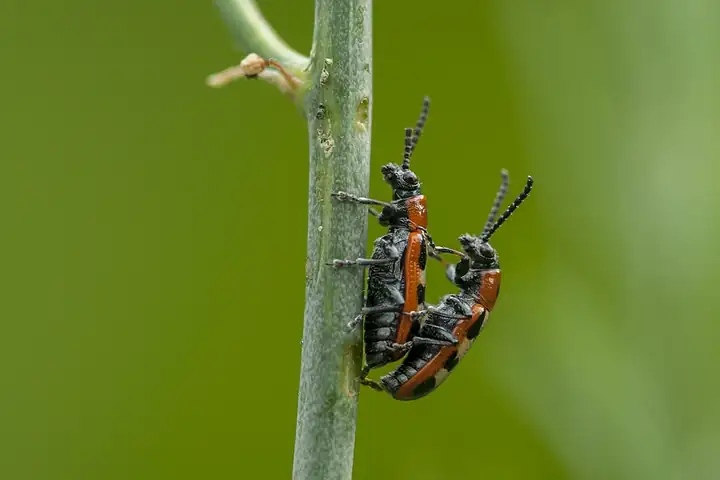
Asparagus beetles
Common asparagus beetle (Crioceris asparagi) and spotted asparagus beetle (Crioceris duodecimpunctata)
| Type | Insect |
|---|---|
| When | Spring through late summer. |
| Pressure by region | Moderate: Northeast, Southeast, South Central, Midwest, Great Plains, Mountain West, Southwest, Pacific Northwest, California |
About
Two quarter-inch beetles: the common one is bluish-black with six cream spots, the spotted one reddish-orange with twelve black spots. Both have slug-like larvae.
Spotting it
Damage
Spears get chewed tips and brown stains and bend over into a hook. Larvae strip the ferns, weakening the plants for next year.
How to find it early
Check spears in spring for dark brown eggs and beetles, and later check the ferns for slug-like larvae.
When
Spring through late summer.
Life cycle
Adults overwinter in plant debris and emerge in early May to lay dark brown eggs on the spears, which hatch within a week. The common asparagus beetle has two to three generations a year in Utah and the spotted beetle two.
What to do, gentlest first
Start at the top. Sprays are a last step; always read and follow the product label.
Clean up ferns and harvest often Prevent
Cut and remove dead ferns in late fall or early spring, pull volunteer asparagus, and pick spears promptly.
Hand-pick and wash off eggs By hand
Drop beetles and larvae into soapy water, and brush or hose eggs and young larvae off the spears.
Egg-parasite wasp Natural enemies
A tiny wasp (Tetrastichus asparagi) can kill up to 70 percent of the eggs, and lady beetles eat eggs and larvae.
Pyrethrins, neem or spinosad Organic spray
Consider only if 10 percent or more of plants have adults, or 50 to 75 percent have larvae. Pyrethrins work on young larvae.
UMN warns these are generally toxic to honey bees, so do not spray when asparagus or nearby plants are flowering. UC IPM notes damage rarely warrants spraying. Follow the label and pre-harvest interval.
Carbaryl or pyrethroids Conventional spray
A last resort for persistent infestations.
Highly toxic to bees and natural enemies; do not spray flowering plants. Carbaryl has been a restricted-use material in California since August 1, 2020 (UC IPM), so home gardeners there cannot buy it. Follow the label and pre-harvest interval.
Plants it goes after
Pressure by region
Found wherever asparagus is grown in the U.S. and Canada (Utah State). No Alaska or Hawaii source was found, so both low ratings are estimates.
| Northeast | Moderate |
|---|---|
| Southeast | Moderate |
| South Central | Moderate |
| Midwest | Moderate |
| Great Plains | Moderate |
| Mountain West | Moderate |
| Southwest | Moderate |
| Pacific Northwest | Moderate |
| California | Moderate |
| Alaska | Low |
| Hawaii | Low |
Ratings come from extension sources where available; some are estimates, as noted above.
Sources
Photo: Photo: Luc hoogenstein, CC BY-SA 4.0, via Wikimedia Commons (CC BY-SA 4.0). Photo resized for the web.

Planting dates and advice are general guidance; check with your local Cooperative Extension office for your area.