
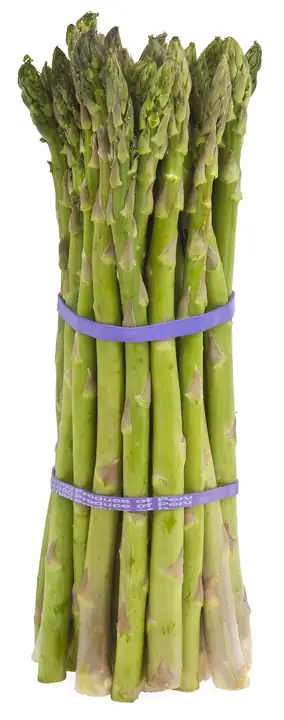
Asparagus
Asparagus officinalis · Asparagus family (Asparagaceae)
| Hardiness zones | 2 to 9 |
|---|---|
| Sun | full sun |
| Water | moderate |
| Life cycle | perennial |
| Frost | Hardy: takes frost |
| Soil pH | 6.5–7.0 |
| Spacing | 9 to 12 inches |
About Asparagus
Asparagus is a long-lived perennial whose spring spears rise from crowns planted deep in the soil. It takes patience, with little or no harvest for the first two years, but a good bed can produce for about 15 years.
A hardy perennial; NC State lists it for zones 2-9. It is planted once as crowns and left in place for many years.
When to plant
Timing is counted from your average last spring frost (and first fall frost). Sow & Tell works out the actual dates for your ZIP code.
- Set out plants: up to 4 weeks before the last frost
Plant 1-year-old crowns in early spring, as soon as the ground can be worked, in furrows 6 to 12 inches deep with rows at least 3 feet apart. Harvest is counted in years, not days: none the first year, about 2 weeks the second, and 6 to 8 weeks once established.
Soil
Fertile, well-drained soil (heavy, medium or sandy) that does not stay waterlogged; avoid very acidic soil.
Clear perennial weeds the year before, aim for soil pH 6.5 to 7.0, and follow a soil test; without one, work in about 1 to 1.5 lb of balanced fertilizer such as 10-10-10 per 100 sq ft before planting.
Feeding
- first year: once the crowns start to send up growth: nitrogen fertilizer. Scatter a light amount along the row and water it in.
- every year after: in early spring before spears come up, or right after the harvest ends (early summer): balanced fertilizer such as 16-16-8 or 10-10-10, or compost. Spread about 1 lb of complete fertilizer per 100 sq ft over the bed and water it in.
Do not over-pick young beds: take no spears the first spring and only about 2 weeks' worth the first harvest year so the roots can build up.
Harvest
Snap or cut spears 5 to 9 inches tall while the tips are tight. Stop for the year when most new spears are thinner than a pencil, and let the ferns grow to feed next year's crop.
Start harvesting 2 years after planting crowns; each spring's harvest lasts about 6 to 8 weeks (until about July 1 in Minnesota), then let the ferns grow to feed next year's crop. A bed can produce for 15 years or more.
Varieties (15)
| Variety | Type | Days | Notes |
|---|---|---|---|
| Jersey Gem | All-male hybrid (Rutgers) | Early producer with medium to large spears. | |
| Jersey Giant | All-male hybrid (Rutgers) | Large, dark green spears; all-male hybrid with good vigor and Fusarium tolerance. | |
| Jersey King | All-male hybrid (Rutgers) | Vigorous and disease resistant, with larger spears but a bit less yield than other Jersey types. | |
| Jersey Knight | All-male hybrid (Rutgers) | Large, dark green, high-quality spears; tolerates rust and Fusarium. | |
| Jersey Supreme | All-male hybrid (Rutgers) | Early, high-yielding all-male hybrid. | |
| Millennium | All-male hybrid (University of Guelph) | Very vigorous and high yielding; tolerates rust and Fusarium. | |
| Walker Deluxe | Hybrid | Tolerates rust and Fusarium. | |
| UC 72 | Hybrid (University of California) | ||
| Atlas | Hybrid, male and female plants (California) | Larger spears than the New Jersey hybrids; tolerates rust, Fusarium, Cercospora blight and heat. | |
| Grande | Hybrid, male and female plants (California) | Excellent spear quality; tolerates rust, Fusarium and heat. | |
| UC 157 | Hybrid, male and female plants (University of California) | Large, pale green spears with good disease resistance. | |
| Viking KB-3 | Open-pollinated | ||
| Martha Washington | Open-pollinated heirloom | ||
| Mary Washington | Open-pollinated heirloom | Very cold hardy with some rust resistance; yields less than the Jersey hybrids. | |
| Purple Passion | Open-pollinated, purple | Sweeter than green types. Thick, burgundy-purple spears that turn green when cooked. Plants are about half female, so beds take longer to mature and yield less. |
Pests to watch for
Asparagus beetles, Aphids, Cutworms, Harlequin bug, Garden symphylan, Beet armyworm, Seedcorn maggot
Diseases and problems
Asparagus rust, Fusarium crown and root rot, Purple spot, Black walnut toxicity
In the kitchen
Steamed, roasted, grilled or sauteed; the spears are one of the first fresh vegetables of spring.
Keeping it: Wrap the cut ends in a wet paper towel, bag the spears, and refrigerate; use within about 4 days for best flavor. Keeping them upright helps.
Safety: Raw young shoots can cause contact dermatitis in some people, and the red berries may cause stomach upset if eaten (NC State).
Pets: Garden asparagus is not listed by the ASPCA; its 'Asparagus fern' entry (the ornamental Asparagus densiflorus, a different species) is toxic to dogs and cats: the berries can cause vomiting, belly pain or diarrhea, and repeated skin contact can cause dermatitis.
Sources
- extension.umn.edu
- extension.usu.edu
- extension.illinois.edu
- plants.ces.ncsu.edu
- extension.umd.edu
- aspca.org
Photo: Photo: Evan-Amos, CC BY-SA 3.0, via Wikimedia Commons (CC BY-SA 3.0). Photo resized for the web.

Planting dates and advice are general guidance; check with your local Cooperative Extension office for your area.