
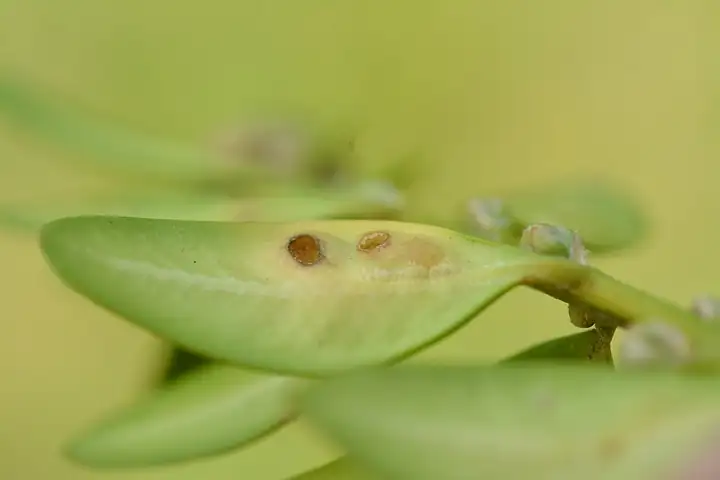
Boxwood leafminer
Monarthropalpus flavus (also listed as M. buxi)
| Type | Insect |
|---|---|
| Pressure by region | High pressure: Northeast, Southeast |
About
A tiny orange-yellow gall midge, about 1/10 inch long, whose maggots live and feed inside boxwood leaves (UC IPM). It came to the US with imported boxwoods before 1910 and now shows up wherever boxwood is grown (UMass).
Spotting it
Damage
Leaves get pale yellow spots on top and puffy, blister-like swellings underneath. Infested leaves are smaller and yellower, and heavy infestations make leaves brown and drop early, thin the shrub and lead to branch dieback and more winter injury (UC IPM, UMass).
How to find it early
In April or May, look for swarms of tiny orange gnats around the shrub and empty pupal skins sticking out of leaves. Any time of year, turn last year's leaves over and look for blisters; mines in this year's leaves may not show until fall (UMass, UC IPM).
When
Larvae inside leaves all year; adults fly for about two weeks in spring (April to May).
Life cycle
One generation a year. Larvae spend winter inside their leaf mines and pupate there; in spring the adults pop out for about two weeks, lay eggs in the new leaves, and the larvae feed inside them through summer (UC IPM, UMass).
What to do, gentlest first
Start at the top. Sprays are a last step; always read and follow the product label.
Plant resistant boxwoods and keep them watered Prevent
Resistant choices include 'Vardar Valley', 'Handsworthiensis', 'Justin Brouwers', 'Pendula', 'Pyramidalis', English boxwood 'Suffruticosa', 'Franklin's Gem', 'Green Pillow' and 'Grace Hendrick Phillips' (UC IPM, UMass). Water during dry spells to keep plants vigorous (UC IPM).
Pick off mined leaves and rake By hand
Clip off lightly mined leaves and rake up fallen leaves in fall and winter, since they can hold the next generation (UC IPM).
Spinosad in spring Organic spray
UC IPM lists a spinosad leaf spray in spring, aimed at the egg-laying adults and young larvae; adding horticultural oil can help it work longer. Larvae deep in their mines are protected from contact sprays (UMass).
Spinosad is toxic to bees (PNW 591). Spray only after boxwoods finish flowering, in the evening when bees are not flying (UC IPM). Follow the label.
Systemic soil drench Conventional spray
UC IPM lists a dinotefuran or imidacloprid soil drench around the base of the shrub.
Both are highly toxic to bees (PNW 591) and move into nectar and pollen, so apply only after boxwoods finish their spring bloom (UC IPM). Follow the label.
Plants it goes after
Pressure by region
UMass says it occurs wherever boxwood is grown in the US; ratings are estimates based on where boxwood is common.
| Northeast | High pressure |
|---|---|
| Southeast | High pressure |
| South Central | Moderate |
| Midwest | Moderate |
| Great Plains | Low |
| Mountain West | Low |
| Southwest | Low |
| Pacific Northwest | Moderate |
| California | Moderate |
| Alaska | Low |
| Hawaii | Low |
Ratings come from extension sources where available; some are estimates, as noted above.
Sources
Photo: Photo: Gilles San Martin / Wikimedia Commons, CC BY-SA 4.0 (CC BY-SA 4.0). Photo resized for the web.

Planting dates and advice are general guidance; check with your local Cooperative Extension office for your area.