
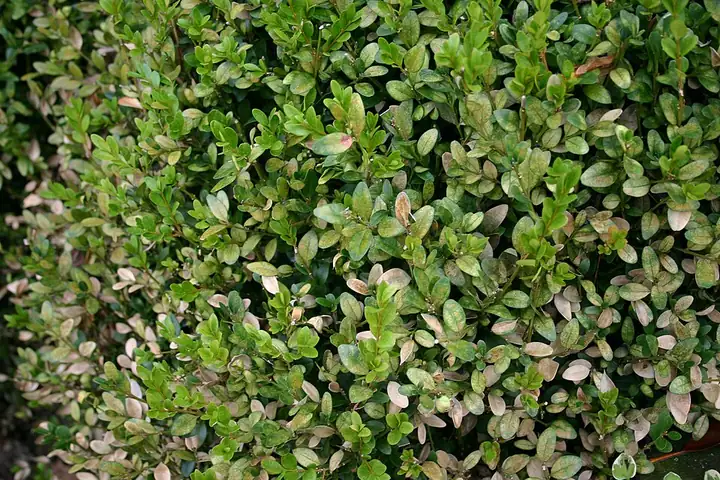
Boxwood mite
Eurytetranychus buxi
| Type | Mite |
|---|---|
| When | Mid-spring through early summer, sometimes again in late summer. |
| Pressure by region | Moderate: Northeast, Southeast, Midwest, Pacific Northwest |
About
A spider mite about the size of a printed period that feeds only on boxwood (NC State). Its damage is often noticed, but the mites themselves are rarely seen.
Spotting it
Damage
Unlike most spider mites, it feeds on both sides of the leaf, leaving tiny pale lines that look like fine scratches, especially on new growth. Leaves can look speckled, yellowish or bronzed and may drop early (NC State, Rutgers).
How to find it early
In spring, look at new leaves with a hand lens for fine, scratch-like pale lines and tiny gray mites (NC State).
When
Mid-spring through early summer, sometimes again in late summer.
Life cycle
Yellowish eggs laid on leaves and twigs in September and October spend winter there and hatch in mid-spring. A generation takes about 18 to 21 days, so there are at least eight a year; mites are busiest in late spring and early summer and may pick up again in late summer (NC State, Rutgers).
What to do, gentlest first
Start at the top. Sprays are a last step; always read and follow the product label.
Go easy on nitrogen Prevent
Keep boxwoods healthy and unstressed and avoid nitrogen fertilizer, which favors mites (Rutgers).
Prune and clean up By hand
Prune off badly infested shoots and remove clippings and fallen leaves (Rutgers).
Natural enemies Natural enemies
Lady beetles, lacewings and predatory mites eat boxwood mites (Rutgers).
Insecticidal soap or horticultural oil Organic spray
In spring when mites are present, spray insecticidal soap or horticultural oil twice, 10 to 14 days apart (NC State). A 2 to 3% dormant oil hits the overwintering eggs; if you find mites later in the year, spray oil then and again the next spring (Rutgers, NC State).
Oil can harm bees it hits (PNW 591); spray when bees are not flying. Follow the label.
Plants it goes after
Pressure by region
Ratings are estimates based on where boxwood is common.
| Northeast | Moderate |
|---|---|
| Southeast | Moderate |
| South Central | Low |
| Midwest | Moderate |
| Great Plains | Low |
| Mountain West | Low |
| Southwest | Low |
| Pacific Northwest | Moderate |
| California | Low |
| Alaska | Low |
| Hawaii | Low |
Ratings come from extension sources where available; some are estimates, as noted above.
Sources
Photo: Photo: SB_Johnny / Wikimedia Commons, CC BY-SA 3.0 (CC BY-SA 3.0). Photo resized for the web.

Planting dates and advice are general guidance; check with your local Cooperative Extension office for your area.