
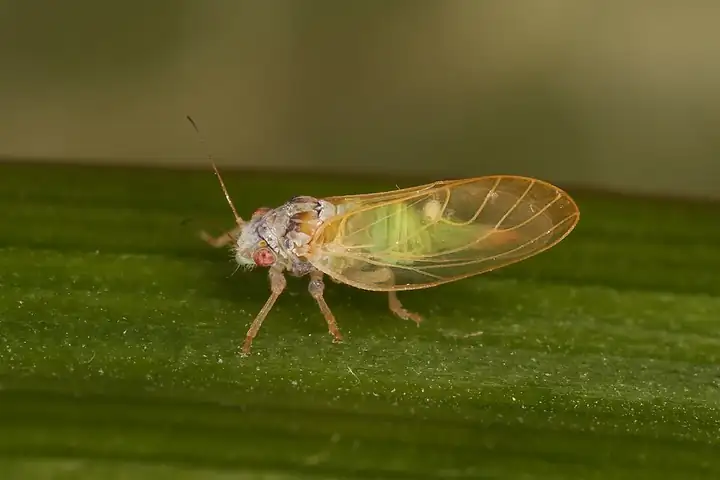
Boxwood psyllid
Psylla buxi
| Type | Insect |
|---|---|
| When | Spring (nymphs) into early summer (adults). |
| Pressure by region | Moderate: Northeast, Southeast, Midwest, Pacific Northwest |
About
A tiny sap-sucking insect common across the temperate US whose nymphs make young boxwood leaves cup upward in spring (UMass). The damage is mostly cosmetic and usually does not need spraying.
Spotting it
Damage
Nymphs feed on opening buds and new leaves, which cup upward like little spoons and may yellow. The cupped leaves can stay on for a few years, but plants usually push new leaves the same season (UMass).
How to find it early
As buds open in spring, look for cupped leaf tips with white, waxy threads inside. Shaking the shrub in June can flush out the tiny adults (UMass).
When
Spring (nymphs) into early summer (adults).
Life cycle
One generation a year. Females tuck orange eggs between bud scales in early summer; the young nymphs spend winter inside the eggs and come out as buds open in spring, feed inside the cupped leaves under white waxy fluff, and become small green winged adults by June (UMass).
What to do, gentlest first
Start at the top. Sprays are a last step; always read and follow the product label.
Tolerate it or plant less-favored boxwoods Prevent
The damage is mostly cosmetic. American boxwood is hit hardest; English boxwood is less affected, and 'Green Mountain', 'Green Velvet', 'Glencoe' ('Chicagoland Green'), 'Fiorii' and 'Arborescens' are partly resistant (UMass).
Horticultural oil in spring Organic spray
If cupping is not acceptable, an oil spray in spring before buds open targets the eggs with the nymphs inside; insecticidal soap works on nymphs if you spray as soon as they appear, before cupped leaves shelter them (UMass).
Oil can harm bees it hits (PNW 591); spray after bloom and when bees are not flying (UMass). Follow the label.
Plants it goes after
Pressure by region
UMass calls it common in the temperate United States; ratings are estimates.
| Northeast | Moderate |
|---|---|
| Southeast | Moderate |
| South Central | Low |
| Midwest | Moderate |
| Great Plains | Low |
| Mountain West | Low |
| Southwest | Low |
| Pacific Northwest | Moderate |
| California | Low |
| Alaska | Low |
| Hawaii | Low |
Ratings come from extension sources where available; some are estimates, as noted above.
Sources
Photo: Photo: thomas_oswald / Wikimedia Commons, CC BY 4.0 (CC BY 4.0). Photo resized for the web.

Planting dates and advice are general guidance; check with your local Cooperative Extension office for your area.