
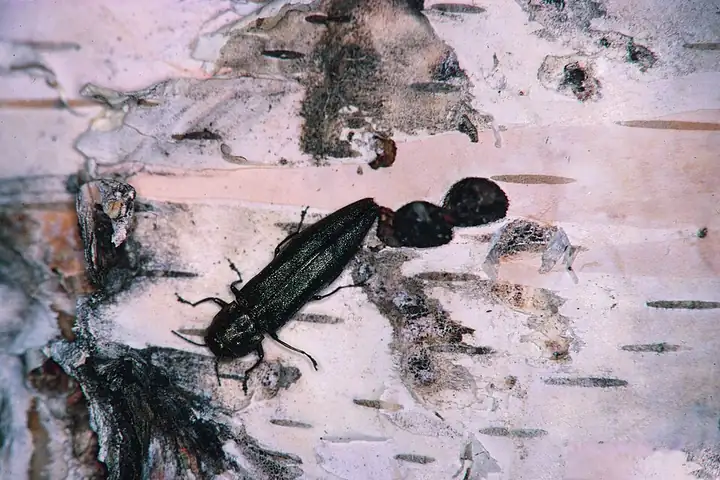
Bronze birch borer
Agrilus anxius
| Type | Insect |
|---|---|
| When | Adults in late May and June; larvae feed under the bark summer into fall. |
| Pressure by region | High pressure: Northeast, Midwest |
About
A native, slender bronze beetle whose larvae tunnel under the bark of stressed birches; it lives throughout the native range of birch in the US and Canada (UMass, Morton Arboretum). White-barked European and Himalayan birches are the most likely to be killed, while river birch is highly resistant and rarely affected.
Spotting it
Damage
The upper crown yellows and thins first, then branches die from the top down over several years, and leaves may brown and drop by late summer. Bark gets bumpy over the larval tunnels and shows D-shaped exit holes, and untreated trees can die in two to three years (Morton Arboretum).
How to find it early
In summer, watch for yellowing and thinning at the very top of birches. Check the trunk and upper branches for bumpy ridges and small D-shaped holes (Morton Arboretum).
When
Adults in late May and June; larvae feed under the bark summer into fall.
Life cycle
One generation a year. Larvae spend winter in cells under the bark, pupate in spring, and adults come out through D-shaped holes in late May and June, feed a little on leaves, and lay eggs in bark cracks that hatch in about 10 days (Morton Arboretum, UMass).
What to do, gentlest first
Start at the top. Sprays are a last step; always read and follow the product label.
Plant a resistant birch in a cool, moist spot Prevent
River birch, including the light-barked 'Heritage', and 'Whitespire' gray birch resist the borer (Morton Arboretum, UMass). Site birches in cool, moist, partly shaded spots, water in dry spells, and mulch 2 to 4 inches deep over the roots, kept off the trunk (Morton Arboretum).
Prune at the right time By hand
Cut out dying branches and remove infested wood, but prune in fall (about mid-September or later), when adults are not drawn to fresh cuts (Morton Arboretum, UMass).
Systemic insecticide for valuable trees Conventional spray
UMass lists imidacloprid as a soil drench and emamectin benzoate as a trunk injection, usually done by an arborist.
Both are highly toxic to bees (PNW 591); keep drenches away from flowering plants. Follow the label.
Plants it goes after
Pressure by region
Found throughout the native range of birch in the US and Canada (UMass). Birches on hot, sunny, dry sites or heavy clay suffer most (Morton Arboretum). Ratings are estimates.
| Northeast | High pressure |
|---|---|
| Southeast | Low |
| South Central | Low |
| Midwest | High pressure |
| Great Plains | Moderate |
| Mountain West | Moderate |
| Southwest | Low |
| Pacific Northwest | Moderate |
| California | Low |
| Alaska | Low |
| Hawaii | Not found here |
Ratings come from extension sources where available; some are estimates, as noted above.
Sources
Photo: Photo: Steven Katovich, USDA Forest Service / Wikimedia Commons, Public domain. Photo resized for the web.

Planting dates and advice are general guidance; check with your local Cooperative Extension office for your area.