
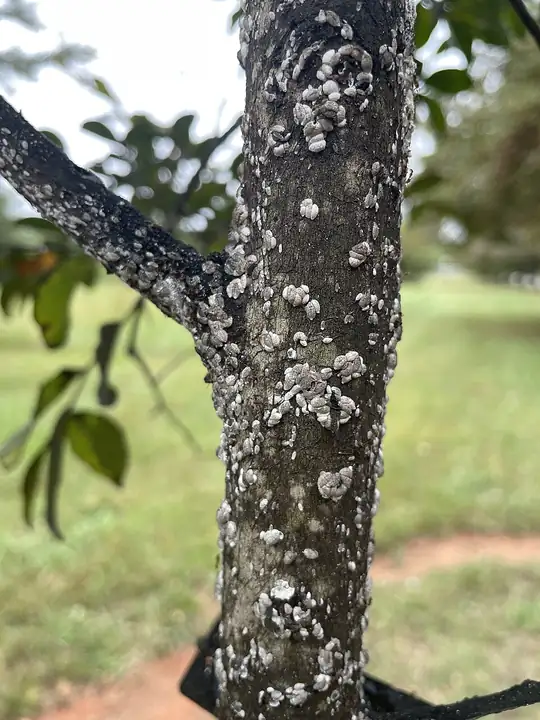
Crapemyrtle bark scale
Acanthococcus lagerstroemiae (formerly Eriococcus lagerstroemiae)
| Type | Insect |
|---|---|
| Pressure by region | High pressure: Southeast, South Central |
About
An invasive felt scale from Asia that attacks crape myrtles; it is one specific newcomer, not the general scale insects record. It shows up as white to gray felty crusts on the bark, and a crushed female leaves a pink smear (Penn State, Clemson).
Spotting it
Damage
Scales suck sap and drip honeydew that turns branches and leaves black with sooty mold. Heavy infestations reduce flowering and growth, delay leaf-out and cause branch dieback, though they rarely kill the plant (Clemson, Penn State).
How to find it early
Look for white or gray waxy crusts in branch crotches, at pruning cuts and on trunks, and for black sooty mold on leaves. A pink or reddish smear when you crush a crust means live scale (Penn State, Clemson). From mid-April, double-sided tape wrapped sticky side out around a few infested twigs shows when the pink crawlers are moving (Clemson).
When
Present all year. Crawlers peak around the start of summer and again in late summer (UF); in central Maryland the first peak is about late May into early June (UMD).
Life cycle
Females lay 100 to 300 pink eggs in white felt sacs, and there are 2 to 4 overlapping generations a year in the South and in Maryland (Penn State, UMD). Any life stage can survive winter, and the pink crawlers peak in early summer and again in late summer (UF).
What to do, gentlest first
Start at the top. Sprays are a last step; always read and follow the product label.
Inspect new plants and plant in sun Prevent
Check crape myrtles closely before you buy, since infested plants spread it (UF). Plant in full sun and keep plants healthy with good watering (Clemson, Penn State). UMD says to avoid heavy pruning and too much nitrogen fertilizer, which favor the scale.
Prune and wash off scales By hand
Cut off heavily infested branches and bag them for the trash rather than leaving them on site (Clemson). Washing the trunk with a hose or pressure washer removes scales (NC State); Penn State also suggests scrubbing with soapy water and a stiff brush.
Clemson cautions that soapy solutions can injure plants and does not encourage them.
Lady beetles Natural enemies
Lady beetles, including the twice-stabbed lady beetle, and mealybug destroyers can control this scale (Clemson, Penn State). Their fuzzy white larvae look like the scales, so leave them be (NC State).
Horticultural oil or insecticidal soap Organic spray
Spray when crawlers are active, aiming at crawlers and young nymphs (Penn State). UMD also lists dormant oil.
Soap and oil work only on contact. Oil can harm bees it hits for up to about 3 hours (PNW 591), so spray when bees are not on the plants. Clemson advises spraying in the very late evening and keeping drift off nearby flowering shrubs. Read and follow the label.
Insect growth regulator (pyriproxyfen) Conventional spray
Clemson lists pyriproxyfen, which disrupts the scale's development and reduces its numbers.
PNW 591 lists no bee precaution for pyriproxyfen but says it may harm bumble bee larvae, so keep it off plants in bloom. Skip pyrethroids, which kill the lady beetles that control this scale (Clemson, UF). Many guides suggest dinotefuran or imidacloprid drenches; these neonicotinoids harm pollinators, so skip them. For a large tree, have a certified arborist do any soil or trunk treatment (UMD). Read and follow the label.
Plants it goes after
Pressure by region
First found in Texas in 2004, it has spread to Oklahoma, Louisiana, Georgia, Tennessee, Alabama, Arkansas, New Mexico, Virginia, Mississippi, North Carolina, Washington, Kansas, South Carolina and Delaware (Clemson), plus Washington, DC (Penn State) and central Maryland (UMD). It spreads mainly on moved plants and is still expanding; models suggest it can live wherever crape myrtles grow (Penn State). Ratings outside the South are estimates. Report finds in new areas to your state department of agriculture.
| Northeast | Low |
|---|---|
| Southeast | High pressure |
| South Central | High pressure |
| Midwest | Low |
| Great Plains | Low |
| Mountain West | Low |
| Southwest | Low |
| Pacific Northwest | Low |
| California | Low |
| Alaska | Low |
| Hawaii | Low |
Ratings come from extension sources where available; some are estimates, as noted above.
Sources
- hgic.clemson.edu
- lgpress.clemson.edu
- content.ces.ncsu.edu
- extension.psu.edu
- extension.umd.edu
- ask.ifas.ufl.edu
- s3.wp.wsu.edu
Photo: Photo: m.borden, CC BY-SA 2.0, via Wikimedia Commons (CC BY-SA 2.0). Photo resized for the web.

Planting dates and advice are general guidance; check with your local Cooperative Extension office for your area.