
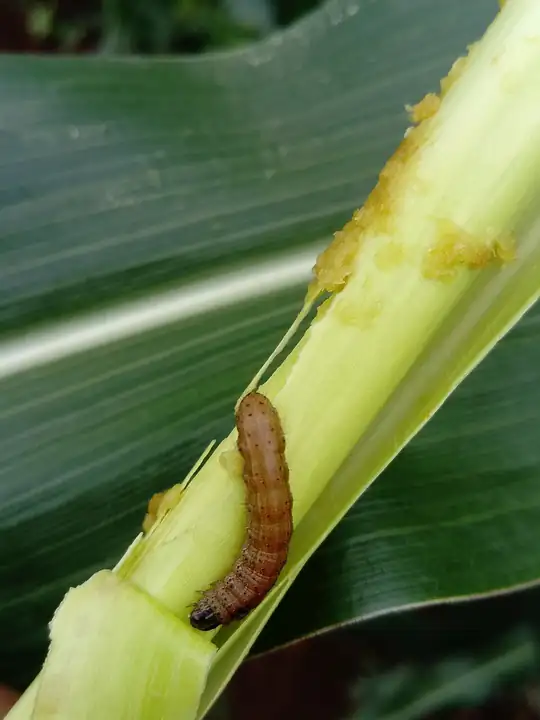
Fall armyworm
Spodoptera frugiperda
| Type | Insect |
|---|---|
| When | Summer into fall; worst on late-planted corn. |
| Pressure by region | Moderate: Southeast, South Central |
About
A striped caterpillar up to about 1 1/2 inches long with a pale, upside-down Y on its dark head. It cannot survive most U.S. winters, so moths fly north from the far South each summer, and late-planted sweet corn takes the worst of it.
Spotting it
Damage
Young caterpillars chew ragged holes and rows of holes in the leaves of the corn whorl. Older ones feed deep in the whorl, in the tassel and in the ear, often leaving a large, messy hole in the side of the ear.
How to find it early
Check whorl-stage corn for ragged feeding and look deep in the whorl and the emerging tassel for caterpillars with the pale inverted Y on the head. If you find damage but no caterpillars, they have probably finished feeding and moved on to pupate.
When
Summer into fall; worst on late-planted corn.
Life cycle
It normally survives winter in the U.S. only in southern Florida and southern Texas, and the strong-flying moths spread north every summer. There is one generation a year in Minnesota and New York, one to two in Kansas, three in South Carolina and four in Louisiana.
What to do, gentlest first
Start at the top. Sprays are a last step; always read and follow the product label.
Plant corn early Prevent
Early plantings usually finish before fall armyworm numbers build up. Mississippi State notes it is mainly a problem on late-planted corn.
Protect natural enemies Natural enemies
Parasitic wasps, ground beetles, earwigs and the spined soldier bug all attack fall armyworm. Broad-spectrum sprays kill them too.
Bt (Bacillus thuringiensis) Natural enemies
Spray Bt (kurstaki or aizawai strains) into the whorl while caterpillars are small. UF/IFAS notes it works only if it is on the leaves when the larvae first appear.
Works only on young caterpillars that eat it. Bt carries no bee warning on its label.
Spinosad Organic spray
Spinosad is the other organic option for whorl-stage corn. Spray when you find caterpillars in the whorl.
Spinosad stays toxic to bees for about 3 hours to a day after spraying (PNW 591), not just while wet; spray in the evening when bees are not foraging, keep it off open flowers, and follow the label and pre-harvest interval.
Permethrin Conventional spray
Mississippi State lists permethrin for armyworms in home gardens when organic options are not enough.
Highly toxic to bees and it also kills the natural enemies. Keep sprays off open flowers, and follow the label and pre-harvest interval.
Garden friends that go after it
Spined soldier bug
Protect these helpers: skip broad sprays when they're around.
Plants it goes after
Pressure by region
It overwinters only in the warmest zones (southern Florida and southern Texas), so northern gardens see it only after moths arrive in mid to late summer; the South, with three or four generations a year, is rated moderate. Western, Alaska and Hawaii ratings are estimates made for lack of a regional source.
| Northeast | Low |
|---|---|
| Southeast | Moderate |
| South Central | Moderate |
| Midwest | Low |
| Great Plains | Low |
| Mountain West | Low |
| Southwest | Low |
| Pacific Northwest | Low |
| California | Low |
| Alaska | Low |
| Hawaii | Low |
Ratings come from extension sources where available; some are estimates, as noted above.
Sources
Photo: Photo: Ernani Zimmermann, CC BY-SA 4.0, via Wikimedia Commons (CC BY-SA 4.0). Photo resized for the web.

Planting dates and advice are general guidance; check with your local Cooperative Extension office for your area.