
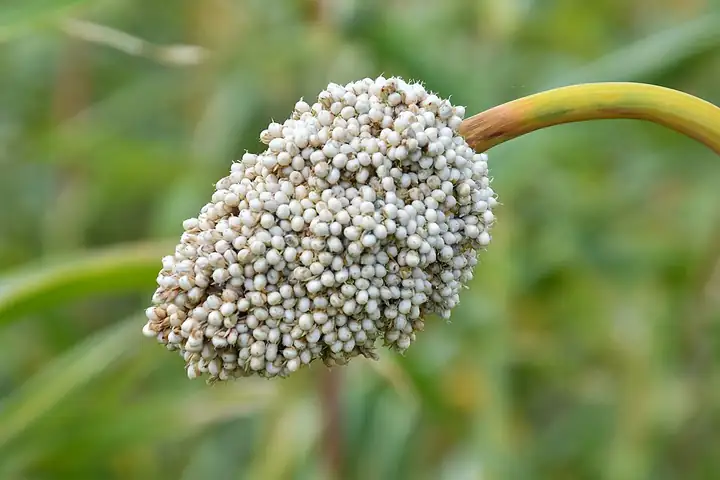
Sorghum (sweet and grain)
Sorghum bicolor · Grass family (Poaceae)
| Hardiness zones | 3 to 11 |
|---|---|
| Sun | full sun |
| Water | low |
| Life cycle | annual |
| Frost | Tender: killed by frost |
| Spacing | 4 to 6 inches |
| Days to harvest | 100 to 200 days |
| Soil temperature to plant | at least 65°F |
About Sorghum (sweet and grain)
Sorghum is a tall, corn-like grass from northeastern Africa. Sweet sorghum grows 10 to 14 feet with juicy stalks that are pressed and boiled down into sorghum syrup (sorghum molasses), an Appalachian and Southern tradition; grain sorghum (milo) is a shorter type grown for flour and feed, and broomcorn and ornamental types give seed heads for brooms and dried arrangements. It handles heat and drought well. Young, frosted or drought-stunted plants can poison grazing livestock: see safety.
Grown as a warm-season annual in most states except the far north; it is perennial in warm climates but winter-kills in the continental U.S. Pick a variety that matures well before your first killing frost. Iowa lists shattercane, the weedy wild form of this species, as a secondary noxious weed but exempts cultivated sorghum.
When to plant
Timing is counted from your average last spring frost (and first fall frost). Sow & Tell works out the actual dates for your ZIP code.
- Start seeds indoors: 2 to 3 weeks before the last frost
- Set out plants: 2 to 5 weeks after the last frost
- Sow seeds outdoors: 2 to 5 weeks after the last frost
Days count from seeding: about 100 to nearly 200 days depending on variety and heat (Purdue), about 120 days in Pennsylvania. Sow 3/4 to 1 1/4 inches deep once soil at 2 inches is 65F (usually May 1-20 in Kentucky), 3-4 seeds per foot in rows 3 feet apart, then thin to 2-3 plants per foot. Kentucky growers also start clumps of 4 seedlings per cell for 2-3 weeks and transplant them 18-24 inches apart into 60F soil, which ripens the crop about 3 weeks sooner.
Soil
Deep, well-drained loam or sandy loam; clay gives poor stands and syrup, very rich high-organic soils can lower syrup quality, and acid soil below about pH 6.0 should be limed.
Follow a soil test and lime soil below pH 6.0; for sweet sorghum on average soil Kentucky suggests about equal parts nitrogen, phosphate and potash (around 40 lb each per acre, about 1 lb each per 1,000 sq ft) broadcast and worked in before planting.
Feeding
Don't side-dress or add heavy manure: extra nitrogen lowers the sugar in the juice and makes stalks fall over, and manure hurts syrup quality.
Harvest
For syrup, cut stalks when most seeds are at the soft- to hard-dough stage, and always before a hard freeze, which ruins the juice. Strip the leaves while stalks stand, cut off the seed heads, and press within 3 to 5 days. For grain or seed heads, let the seed get hard and ripe.
Stalks are cut once, at the soft- to hard-dough seed stage and before a hard freeze; removing seed heads early makes new side branches form in about two weeks, but the crop is still pressed in one go.
Varieties (14)
Kentucky and Texas Extension describe 14 syrup (sweet) sorghum varieties; grain and ornamental sorghums are mostly sold by type, not by documented variety.
| Variety | Type | Days | Notes |
|---|---|---|---|
| Black Amber | Sweet (syrup) | ||
| Brandes | Sweet (syrup) | Not adapted to Kentucky's season. | |
| Dale | Sweet (syrup) | 100 days | Upright, high-yielding cane from the USDA station at Meridian, Miss.; resists leaf anthracnose, red rot and maize dwarf mosaic. |
| Della | Sweet (syrup) | Virginia Tech release (1991) that resists leaf anthracnose and maize dwarf mosaic; less lodging-resistant than Dale; syrup quality similar. | |
| Honey Drip | Sweet (syrup) | An older syrup variety that Kentucky lists as highly susceptible to common diseases. | |
| M81E | Sweet (syrup) | Gives more juice and syrup than Dale; resists leaf anthracnose and red rot but not maize dwarf mosaic; more easily hurt by light frost. | |
| Milsap | Sweet (syrup) | 90 days | A 90-day syrup sorghum named for Milsap, Texas. |
| Orange | Sweet (syrup) | ||
| Simon | Sweet (syrup) | Small stalks with little juice; susceptible to most diseases. | |
| Sugar Drip | Sweet (syrup) | Shorter stalks and less juice; can lodge; very susceptible to red rot and maize dwarf mosaic. | |
| Sumac | Sweet (syrup) | ||
| Texas Ribbon Cane | Sweet (syrup) | 120 days | Texas-seeded syrup cane about 7 to 8 feet tall; said to be the same as Honey Drip. |
| Theis | Sweet (syrup) | Not adapted to Kentucky's season. | |
| Williams | Sweet (syrup) | An older variety; gave the highest syrup yield per ton in a Georgia trial but lower yields in Kentucky. |
Pests to watch for
Aphids, Fall armyworm
Diseases and problems
Anthracnose, Red rot, Maize dwarf mosaic, Bacterial stripe
In the kitchen
Sweet sorghum juice is boiled down into sorghum syrup for biscuits, pancakes and baking (about 8 to 10 gallons of juice make 1 gallon of syrup); grain sorghum is milled into gluten-free flour.
Keeping it: Press stalks within 3 to 5 days of cutting, and use the juice within 3 to 4 hours or it ferments. Store finished syrup in clean, airtight containers.
Safety: Young plants under about 20 inches, new regrowth, frost-killed and drought-stunted sorghum can build up prussic acid (cyanide) and nitrate that poison cattle, sheep and goats; never let livestock graze it at those stages (Wisconsin Extension). The syrup and grain are ordinary foods.
Pets: Not listed by the ASPCA
Sources
- publications.mgcafe.uky.edu
- publications.mgcafe.uky.edu
- extension.psu.edu
- hort.purdue.edu
- oaktrust.library.tamu.edu
- site.extension.uga.edu
- extension.illinois.edu
- cropsandsoils.extension.wisc.edu
- legis.iowa.gov
- aspca.org
Photo: Photo: Shagil Kannur, CC BY-SA 4.0, via Wikimedia Commons (CC BY-SA 4.0). Photo resized for the web.

Planting dates and advice are general guidance; check with your local Cooperative Extension office for your area.