
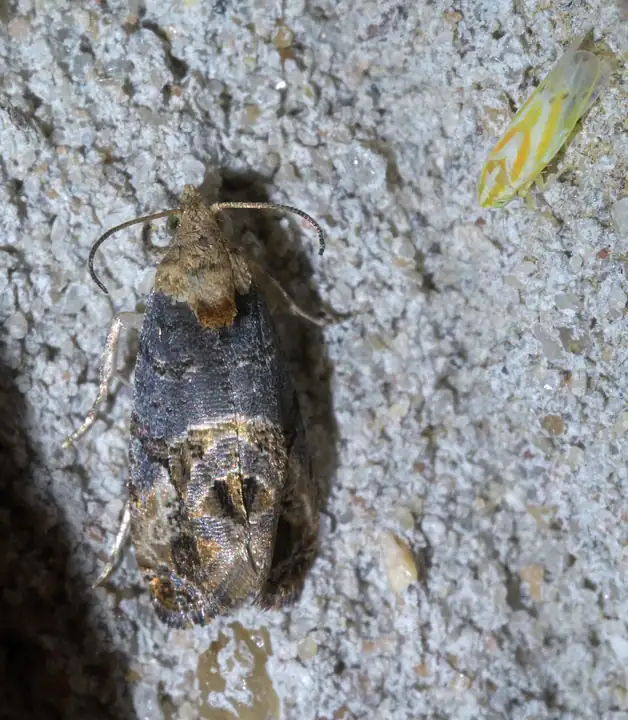
Grape berry moth
Paralobesia viteana
| Type | Insect |
|---|---|
| When | Bloom through harvest. |
| Pressure by region | High pressure: Midwest |
About
A small, mottled brown moth native to eastern North America that lives on wild and cultivated grapes. Its caterpillars, which turn from cream to green to purple, feed inside the berries.
Spotting it
Damage
Early caterpillars web together flower buds and tiny berries. Later ones bore into green berries, leaving a reddish spot at the entry hole; one caterpillar can ruin two to six berries, and damaged clusters split and rot.
How to find it early
Look for webbing in flower clusters in spring and for red or purple 'stung' spots on green berries in summer, especially on vines near woods. Pheromone traps show when moths fly.
When
Bloom through harvest.
Life cycle
It spends winter as a pupa in fallen leaves on the ground. There are two to three generations a year, and up to four in the South; each takes about 810 degree-days above 47°F (Ohio State).
What to do, gentlest first
Start at the top. Sprays are a last step; always read and follow the product label.
Clean up leaf litter Prevent
Burying or destroying fallen grape leaves in fall or early spring removes overwintering pupae (Ohio State).
Pick off damaged berries By hand
For light infestations, remove webbed or stung berries by hand (UMD).
Leave natural enemies alone Natural enemies
General predators and a tiny egg-parasitic wasp attack grape berry moth (Ohio State).
Pheromone mating disruption works best in vineyards over five acres.
Bt or spinosad Organic spray
UMD lists Bacillus thuringiensis and spinosad products. Aim at eggs and newly hatched caterpillars, before they get inside berries.
Bt carries no bee warning; spinosad is toxic to bees for a few hours to a day (PNW 591), so keep it off blooming plants. Follow the label and pre-harvest interval.
Chlorantraniliprole; carbaryl or a pyrethroid for heavy pressure Conventional spray
UMD lists chlorantraniliprole among targeted products and pyrethroids or carbaryl for severe cases. Ohio State suggests acting when more than 5 to 15% of clusters are damaged.
Chlorantraniliprole has no bee warning (PNW 591); carbaryl and pyrethroids are highly toxic to bees. Carbaryl has been a restricted-use pesticide in California since August 1, 2020 (UC IPM), so California home gardeners cannot buy it without an applicator license. Use only products labeled for grapes and follow the pre-harvest interval.
Plants it goes after
Pressure by region
Ohio State calls it a common, destructive pest in Midwest vineyards; UMD covers Maryland. It is native to eastern North America, so the western, Alaska and Hawaii low ratings, and the Southeast, South Central and Great Plains ratings, are estimates.
| Northeast | Moderate |
|---|---|
| Southeast | Moderate |
| South Central | Low |
| Midwest | High pressure |
| Great Plains | Low |
| Mountain West | Low |
| Southwest | Low |
| Pacific Northwest | Low |
| California | Low |
| Alaska | Low |
| Hawaii | Low |
Ratings come from extension sources where available; some are estimates, as noted above.
Sources
Photo: Photo: xpda, CC BY-SA 4.0, via Wikimedia Commons (CC BY-SA 4.0). Photo resized for the web.

Planting dates and advice are general guidance; check with your local Cooperative Extension office for your area.