
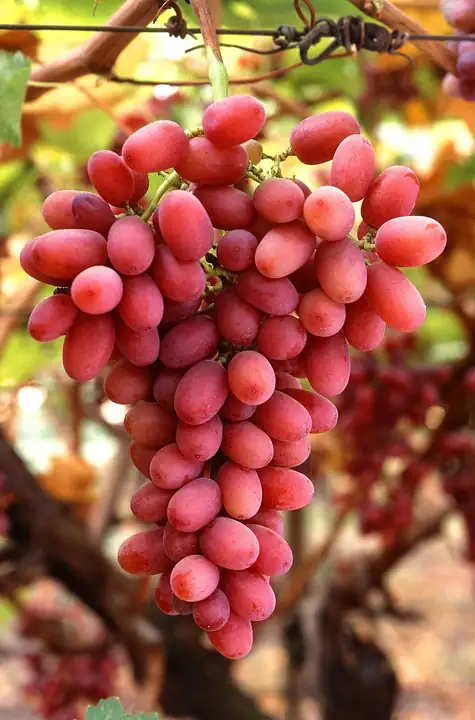
Grape
Vitis species and hybrids (American V. labrusca, European V. vinifera, muscadine V. rotundifolia) · Grape family (Vitaceae)
| Hardiness zones | 3 to 9 |
|---|---|
| Sun | full sun |
| Water | moderate |
| Life cycle | perennial |
| Frost | Hardy: takes frost |
| Soil pH | 5.5–6.5 |
| Spacing | 72 to 96 inches |
About Grape
Grapes are long-lived woody vines that climb by tendrils and fruit on shoots from last year's wood, so they are pruned hard every winter. Choosing the right type for your climate matters more than anything else.
Cold-hardy hybrids like the Frontenac series grow in zones 3-4 (University of Minnesota), American types are the hardiest and European types the least (Oregon State), and muscadines suit zones 7-9 in the humid South, since they are hurt by winter lows much below 10 F.
When to plant
Timing is counted from your average last spring frost (and first fall frost). Sow & Tell works out the actual dates for your ZIP code.
- Set out plants: from 4 weeks before to 2 weeks after the last frost
Plant bare-root vines in early spring as soon as the soil can be worked, and potted vines after frost danger. Expect a first crop in about the third year and full production in years five to six.
Soil
Well-drained soil; avoid heavy clay or a hardpan, and skip rich, damp ground, which grows leaves instead of fruit.
Grapes grow in a wide range of soil pH; clear perennial weeds and till well before planting (for muscadines, lime to about pH 6.5 as a soil test directs).
Feeding
- Early spring (around bud break) each year while vines are young: compost, manure, or a balanced fertilizer such as 16-16-16. Young vines or vines on poor soil may need about 1 oz of nitrogen per plant a year; follow a soil test.
- Muscadines, first year: after planting (late April-early May), repeated every 6 weeks until early July: balanced fertilizer such as 10-10-10. About 1/4 lb per vine, spread in an 18-inch circle around the vine but not touching the trunk.
Feed sparingly, since overfeeding causes more trouble than underfeeding; pick off clusters in the second year so young vines grow strong.
Harvest
Many grapes color before they are sweet, so taste berries from the tip of the cluster, the last part to ripen. Stems turn brown and seeds darken when ripe; grapes do not ripen after picking.
Grapes give one crop a year, picked by color and flavor in September-October in Minnesota. Fruit grows on new shoots from last year's canes, so prune hard each winter; light pruning gives lots of poor-quality fruit.
Varieties (64)
| Variety | Type | Days | Notes |
|---|---|---|---|
| Catawba | American | Medium red, seeded, slip-skin berries; an all-purpose grape for fresh eating, juice and wine. | |
| Concord | American | Strong, 'foxy' grape flavor; not very sweet. Large black, seeded, slip-skin berries. Very vigorous and hardy to about -15 to -20 F; prone to powdery mildew and ripens unevenly in warm climates. | |
| Delaware | American | Sweet, with almost no foxy taste. Small red, seeded berries in compact clusters; excellent for wine and juice. Prone to powdery mildew. | |
| Fredonia | American | Sweet and foxy. Blue-black, seeded, slip-skin berries; hardy to about -20 F. Good for juice. | |
| Niagara | American | Strong foxy flavor, not very sweet. Large green-white, seeded, slip-skin berries. Very vigorous and hardy to about -15 to -20 F; prone to powdery mildew. | |
| Steuben | American hybrid | Spicy. Large blue seeded berries; hardy, with some disease resistance. | |
| Ontario | American table grape | Mild foxy flavor. Seeded green slip-skin grape, productive on fertile soil. Cold hardy to about -20°F. | |
| Worden | American table grape | Strongly foxy and sweeter than Concord. Seeded blue-black slip-skin grape in large compact clusters; productive. Cold hardy to about -15 to -20°F. | |
| Bluebell | Cold-hardy American hybrid | Looks and tastes like Concord. Blue berries for juice and jelly. | |
| Swenson White | Cold-hardy grape | Juicy with a floral aroma. Yellow-green berries for wine and fresh eating. | |
| Edelweiss | Cold-hardy hybrid (table) | Very juicy, with a floral aroma and a mild foxy taste that grows stronger as it ripens. Yellow-green, seeded, slip-skin berries; hardy to about -30 F with better disease resistance than Niagara. Also makes sweet wine. | |
| Swenson Red | Cold-hardy hybrid (table) | Crisp, sweet and fruity, with hints of strawberry. Large, firm red berries; hardy to about -30 F. Vines grow slowly when young and set poorly in coastal fog. | |
| Frontenac | Cold-hardy hybrid (wine) | Small blue berries used for rosé, red and port-style wines. | |
| La Crescent | Cold-hardy hybrid (wine) | Apricot and honey aromas. Yellow-pink berries for white wine. | |
| Marquette | Cold-hardy hybrid (wine) | Blue-black wine grape that does very well in zone 4 and well in zone 3. | |
| Petite Jewel | Cold-hardy seedless table grape | Very fruity and spicy. Red seedless berries for fresh eating. | |
| Frontenac Blanc | Cold-hardy wine grape | A truly white-fruited form of Frontenac for light white wines. | |
| Frontenac Gris | Cold-hardy wine grape | Fruity aroma. Small pink berries used for white wine. | |
| St. Croix | Cold-hardy wine grape | Mostly grown for wine but also good for fresh eating. | |
| Flame Seedless | European (vinifera) table grape | Mild and sweet with a crisp bite. Red seedless berries. Not cold hardy (injury at about 0 to 10 F) and prone to powdery mildew. | |
| Marechal Foch | French-American hybrid wine grape | Pleasant and fruity, not foxy. Small to medium seeded blue-black berries, mainly for wine but edible fresh. Very cold hardy, to about -30°F. | |
| Sunbelt | Juice grape (University of Arkansas release) | Similar to Concord. A Concord-type juice grape whose berries ripen evenly. | |
| Darlene | Muscadine (black) | Excellent flavor and high sugar. Black fresh-market muscadine with female flowers; needs a self-fertile muscadine nearby. | |
| Ison | Muscadine (black) | Large black berries with a dry stem scar. Self-fertile (perfect flowers). | |
| Nesbitt | Muscadine (black) | Medium-large black berries for fresh eating; has some disease resistance. | |
| Noble | Muscadine (black) | Small black berries; the main red/black muscadine for juice and wine. Relatively cold tolerant with some disease resistance. | |
| Paulk | Muscadine (black) | Large to very large black berries with a dry stem scar. Self-fertile. | |
| Sugargate | Muscadine (black) | Very large black berries with a wet stem scar. Female flowers, so it needs a self-fertile muscadine nearby. | |
| Supreme | Muscadine (black) | Excellent quality and very sweet, with an edible skin. The largest black muscadine; ripens unevenly. | |
| Carlos | Muscadine (bronze) | Sweet, musky muscadine flavor. Small to medium bronze berries used mostly for juice and wine. Cold hardy enough for Virginia and has some disease resistance, but buds break early and can be hit by late frost. | |
| Fry | Muscadine (bronze) | Excellent quality and very sweet. Medium-large to large bronze berries; the most popular bronze for fresh eating. Susceptible to black rot. | |
| Hall | Muscadine (bronze) | Medium bronze berries with a dry stem scar. Self-fertile. | |
| Late Fry | Muscadine (bronze) | Very sweet, with an edible skin. Very large bronze berries with a dry stem scar, so they keep well; excellent disease resistance. | |
| Magnolia | Muscadine (bronze) | Small to medium bronze berries for juice and wine; relatively cold tolerant but ripens unevenly. | |
| Scuppernong | Muscadine (bronze) | Good flavor. An old bronze variety that is very cold hardy. | |
| Summit | Muscadine (bronze) | Very sweet and of very good quality. Medium-large bronze berries that ripen evenly and have a dry stem scar; vigorous and disease resistant. | |
| Sweet Jenny | Muscadine (bronze) | Very good flavor and high sugar. Very large bronze berries with a wet stem scar; good disease and cold tolerance. Female flowers, so plant a self-fertile muscadine nearby. | |
| Tara | Muscadine (bronze) | Good flavor. Medium-large bronze berries with a dry stem scar; good for fresh eating. | |
| Triumph | Muscadine (bronze) | Excellent flavor. Medium bronze berries with a reddish tint; good vigor and some disease resistance. | |
| Norton (Cynthiana) | Native American wine grape | Blue-black to deep purple native grape used for red wine. | |
| Concord Seedless | Seedless American grape | Tastes and feels much like Concord, with strong flavor (Cornell). Clusters and berries are much smaller than Concord's; medium vine vigor (Colorado State). Cornell says it makes excellent pies and preserves. | |
| RazzMatazz | Seedless muscadine | The first seedless muscadine; fruits over a long period. Self-fertile. | |
| Oh My! | Seedless muscadine (bronze) | Bronze seedless muscadine, larger than RazzMatazz. Self-fertile. | |
| Einset Seedless | Seedless table grape | Mild and fruity with a strawberry-like note. Medium red berries with slightly tough skin that keep very well fresh. Hardy to about -10°F. | |
| Interlaken | Seedless table grape | Sweet and aromatic, with a foxy note. Small, crisp, tender-skinned green berries in small compact clusters; good for raisins and reliable. Can be injured near -5°F. | |
| Perlette | Seedless table grape | Mild and aromatic. Medium, pale green seedless berries; spur pruned. | |
| Ruby Seedless | Seedless table grape | Sweet and crisp. Dark red seedless berries, good fresh or as raisins; spur pruned. Self-fruitful. | |
| Suffolk Red | Seedless table grape | Sweet with a mild foxy flavor. Medium berries in loose clusters, often more pink than red; fruit set can be uneven. Oregon State rates it for zone 5. | |
| Thompson Seedless | Seedless table grape | Very sweet. Green seedless grape; cane pruned. Self-fruitful. | |
| Canadice | Seedless table grape (American hybrid) | Sweet, with a medium foxy flavor. Small red seedless berries in tight clusters; high yielding and hardy to about -25 F when well pruned. Holds well on the vine. | |
| Glenora | Seedless table grape (American hybrid) | Mild, with a slight foxy undertone. Small blue seedless berries; hardy to about -25 F. | |
| Himrod | Seedless table grape (American hybrid) | Honey-like flavor. Small golden-green seedless berries in long, loose clusters; stems are brittle. Oregon State rates it moderately hardy (about -10 F). | |
| Jupiter | Seedless table grape (American hybrid) | Excellent flavor with a semi-crisp bite. Large blue seedless berries (may have seed traces) with skin that does not slip. | |
| Mars | Seedless table grape (American hybrid) | Sweet and juicy with a Concord-like flavor. Blue seedless berries; a productive, dependable vine that did well in Minnesota zone 4 trials. | |
| Reliance | Seedless table grape (American hybrid) | Sweet, fruity and foxy. Red, seedless, slip-skin berries that may color poorly and can crack. Very hardy (about -20 F). Keeps up to 3 months. | |
| Vanessa | Seedless table grape (American hybrid) | Mild and fruity. Firm, brick-red seedless berries that store well; hardy to about -20 F. | |
| Somerset Seedless | Seedless table grape (cold-hardy hybrid) | Juicy. Pink-red seedless berries; UMN calls it the hardiest seedless grape it lists. | |
| Faith | Seedless table grape (University of Arkansas release) | Slightly fruity to neutral. Blue seedless berries with a semi-crisp texture. | |
| Gratitude | Seedless table grape (University of Arkansas release) | Neutral. Green seedless berries with very crisp flesh. | |
| Hope | Seedless table grape (University of Arkansas release) | Fruity. Green seedless berries with soft texture in tight clusters; high production potential. | |
| Joy | Seedless table grape (University of Arkansas release) | Very fruity. Blue-black seedless berries with very soft texture and thin skin. | |
| Neptune | Seedless table grape (University of Arkansas release) | Mild and fruity. Large, oval, yellow-green berries with firm flesh and thick skin that resist cracking; yields are low. Cold hardy. | |
| Venus | Seedless table grape (University of Arkansas release) | Blue seedless grape. | |
| Lynden Blue | Table grape | Sweet. Large dark blue to black berries with some seeds. |
Pests to watch for
Japanese beetle, Spotted wing drosophila, Stink bugs, Root-knot nematodes, Leafhoppers, Eriophyid mites (rust, bud, blister and gall mites), Boxelder bugs, Opossum, Raccoon, Grape berry moth, Spotted lanternfly, Rose chafer, Green June beetle (fig-eater), Pocket gophers, Birds, Mealybugs
Diseases and problems
Powdery mildew, Downy mildew, Black rot, Botrytis bunch rot, Pierce's disease (Southeast), Crown gall, Herbicide injury, Frost and freeze injury, Tomato and tobacco ringspot
In the kitchen
Eaten fresh, dried as raisins, or made into juice, jelly and wine.
Keeping it: Refrigerate grapes in a perforated bag; they keep about one to two weeks but taste best within a few days.
Safety: Grape seed extract is generally well tolerated, but little is known about its safety in pregnancy, and some herbs interact with medicines (NCCIH).
Pets: The ASPCA warns that grapes and raisins can cause kidney damage in dogs (tartaric acid is the suspected cause); keep fallen fruit away from pets
Sources
- extension.oregonstate.edu
- extension.umn.edu
- extension.umd.edu
- plants.ces.ncsu.edu
- content.ces.ncsu.edu
- nccih.nih.gov
- aspca.org
- content.ces.ncsu.edu
Photo: Photo: Bob Nichols, USDA ARS, Public domain (USDA ARS), via Wikimedia Commons. Photo resized for the web.

Planting dates and advice are general guidance; check with your local Cooperative Extension office for your area.