
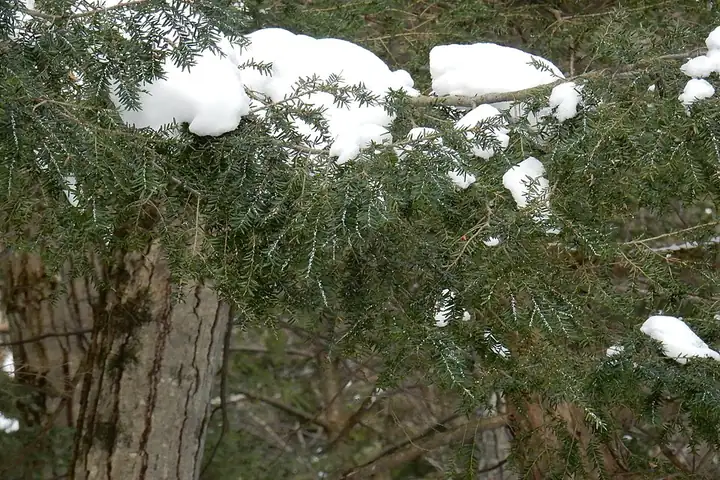
Hemlock woolly adelgid
Adelges tsugae
| Type | Insect |
|---|---|
| Pressure by region | High pressure: Northeast, Southeast |
About
A tiny aphid relative that hides under white, cottony wax at the base of hemlock needles and sucks sap. It is native to Japan and China and to the western US, where western hemlock mostly resists it, but in the East it badly harms and kills eastern and Carolina hemlocks (UMass, Penn State).
Spotting it
Damage
Feeding at the needle bases makes needles yellow and drop early, slows twig growth and thins the crown, and severe infestations cause dieback and death (Penn State). Already stressed trees can die in 3 to 5 years (UMass).
How to find it early
Check the undersides of twig tips, starting with lower branches, for white woolly tufts at the needle bases. They are easiest to see from late winter through early summer and again in fall (UMass, Penn State).
When
Feeds mostly from fall through spring; it is more active in cold weather (UMass).
Life cycle
In the East all adelgids are female and reproduce without mating. A spring generation develops in April and May, and the overwintering generation rests as tiny nymphs through summer, feeds from October through winter, and lays eggs in the wool from late winter into spring (UMass, Penn State).
What to do, gentlest first
Start at the top. Sprays are a last step; always read and follow the product label.
Skip the nitrogen and choose resistant hemlocks Prevent
Do not give infested hemlocks nitrogen fertilizer, which can feed the adelgids. Where it fits, plant resistant western, mountain or Japanese hemlock (UMass).
Predator beetle releases Natural enemies
Three predator beetles, Sasajiscymnus tsugae, Laricobius nigrinus and Scymnus sinuanodulus, have been widely released in the eastern US, and silver flies from the Pacific Northwest are being studied (UMass).
These are released by forest health programs; there are no known parasites of adelgids (UMass).
Horticultural oil or insecticidal soap Organic spray
On trees small enough to soak completely, spray horticultural oil in fall and spring when the weather allows (UMass). Penn State says late September through October is the best time to hit the overwintering females, with a mid- to late-June spray for young nymphs.
Sprays must cover every twig to work. Follow the label.
Systemic treatment for larger trees Conventional spray
Imidacloprid or dinotefuran can be applied as a soil drench (UMass). For large trees that can't be sprayed well, a licensed applicator can inject a systemic insecticide into the soil; early spring with good soil moisture works best, so water first in a dry spring (Penn State).
Both are highly toxic to bees (PNW 591). Follow the label.
Plants it goes after
Pressure by region
Penn State lists it as a pest from Maine to Georgia and Kentucky, and in Oregon and California, where it rarely does serious damage to western hemlocks. The guide has no hemlock page yet; hemlocks are its only hosts. Midwest and Alaska ratings are estimates.
| Northeast | High pressure |
|---|---|
| Southeast | High pressure |
| South Central | Not found here |
| Midwest | Low |
| Great Plains | Not found here |
| Mountain West | Not found here |
| Southwest | Not found here |
| Pacific Northwest | Low |
| California | Low |
| Alaska | Low |
| Hawaii | Not found here |
Ratings come from extension sources where available; some are estimates, as noted above.
Sources
Photo: Photo: R. A. Nonenmacher / Wikimedia Commons, CC BY-SA 4.0 (CC BY-SA 4.0). Photo resized for the web.

Planting dates and advice are general guidance; check with your local Cooperative Extension office for your area.