
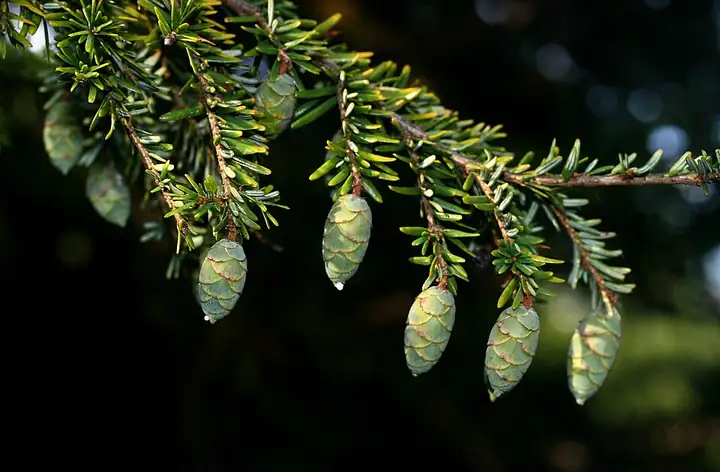
Eastern hemlock
Tsuga canadensis (eastern or Canada hemlock) and T. caroliniana (Carolina hemlock) · Pine family (Pinaceae)
| Hardiness zones | 3 to 7 |
|---|---|
| Sun | part shade |
| Water | high |
| Life cycle | perennial |
| Frost | Hardy: takes frost |
About Eastern hemlock
Eastern hemlock is a graceful, shade-loving evergreen with short, soft needles, drooping branch tips and little brown cones. It is native from Maine and the Great Lakes states south along the Appalachians to Georgia and Alabama, and Carolina hemlock grows wild only on rocky ridges and cliffs of the southern Appalachians (wildflower.org, NC State). Both are dying across much of the East from the hemlock woolly adelgid, an insect from Asia, so look under the twigs for its white, cottony tufts (Penn State, USDA NRCS). This evergreen tree is NOT poison hemlock (Conium maculatum), a deadly weed in the carrot family with lacy leaves and purple-spotted stems.
Eastern hemlock is hardy in zones 3-7 and Carolina hemlock in 6-7 (NC State). Both want cool summers and shelter from drying winds; heat, drought, pollution and city conditions are hard on them (NC State, Morton Arboretum).
When to plant
Timing is counted from your average last spring frost (and first fall frost). Sow & Tell works out the actual dates for your ZIP code.
Plant container-grown or balled-and-burlapped trees; container plants transplant best (USDA NRCS). Fall planting is ideal in the South (Clemson). Choose a cool spot out of strong wind, set the root ball 2-4 inches above grade in heavier soil, and stake young trees for 2-3 years because the roots are shallow (USDA NRCS). Hemlock takes shearing well and makes a dense hedge or screen, but it must be trimmed regularly to stay small (USDA NRCS).
Soil
Cool, moist, well-drained, acidic soil (pH below 6.0). It does poorly in soggy or poorly drained ground, long droughts, salt spray and exposed, windy spots (NC State, USDA NRCS, wildflower.org).
Test the soil first; hemlock wants acidic soil (pH below 6.0). Loosen a wide area and mix 10-20 percent compost into the native soil, or add peat moss or sand to open up heavy soil (Clemson, USDA NRCS, NC State).
Feeding
- Spring, after the tree is established, and only if a soil test or pale needles and weak growth show a need: slow-release nitrogen fertilizer with a ratio near 3-1-1 or 3-1-2 (3-0-1 or 3-0-2 if the soil test shows enough phosphorus). Spread it from just outside the trunk to the dripline and water it in. Clemson cites 2-4 lb of slow-release nitrogen per 1,000 sq ft per year, split into smaller feedings between budbreak and late summer; follow your soil test and skip it in a summer drought.
Water daily for the first 1-2 weeks, every 2-3 days until week 12, then weekly, giving about 1-1.5 gallons per inch of trunk width, until established (roughly 1.5 years per inch of trunk); only skip after more than an inch of rain (UMN). Drought is the biggest threat to hemlock, so water deeply in dry spells even after it is established (NRCS, NC State). Check the undersides of twigs for white woolly tufts of hemlock woolly adelgid; Penn State says late September through October is the best time to treat with a registered insecticide, following the label.
Varieties (4)
NC State and Morton Arboretum document these eastern hemlock forms; most are dwarf or weeping. Sources list no Carolina hemlock cultivars.
| Variety | Type | Days | Notes |
|---|---|---|---|
| Gentsch White | Dwarf (eastern hemlock) | Slow, dwarf shrub about 3-4.5 ft tall with silvery-white new needle tips. | |
| Jeddeloh | Dwarf (eastern hemlock) | Low mound 2-3 ft tall with a funnel-shaped dip in the center. | |
| Pendula | Weeping (eastern hemlock) | Weeping shrub about 2 ft tall and 5 ft wide in NC State's listing. | |
| Sargentii | Weeping (eastern hemlock) | Dense, weeping form 10-12 ft tall and 20-30 ft wide. |
Pests to watch for
Hemlock woolly adelgid, Scale insects, Twospotted spider mite, Eriophyid mites (rust, bud, blister and gall mites), Bagworm, Sawflies (garden sawflies), Spongy moth (formerly gypsy moth)
Diseases and problems
Needle blight, Canker, Rust, Root rot, Winter injury
In the kitchen
Safety: The hemlock tree (Tsuga) is not poisonous in the sources we used. Poison hemlock (Conium maculatum) is a different plant: a carrot-family weed in which every part is highly toxic and can kill people and livestock (NC State). Learn to tell the weed apart before handling any plant called hemlock.
Pets: Non-toxic to dogs, cats and horses (ASPCA lists both the hemlock tree, Tsuga species, and Carolina hemlock as non-toxic). Poison hemlock (Conium), a different plant, is toxic (ASPCA).
Sources
- plants.ces.ncsu.edu
- plants.ces.ncsu.edu
- wildflower.org
- plants.sc.egov.usda.gov
- mortonarb.org
- extension.psu.edu
- plants.ces.ncsu.edu
- aspca.org
- aspca.org
- aspca.org
- extension.rutgers.edu
- extension.rutgers.edu
- hgic.clemson.edu
- hgic.clemson.edu
- extension.umn.edu
Photo: Photo: liz west / Wikimedia Commons, CC BY 2.0 (CC BY 2.0). Photo resized for the web.

Planting dates and advice are general guidance; check with your local Cooperative Extension office for your area.