
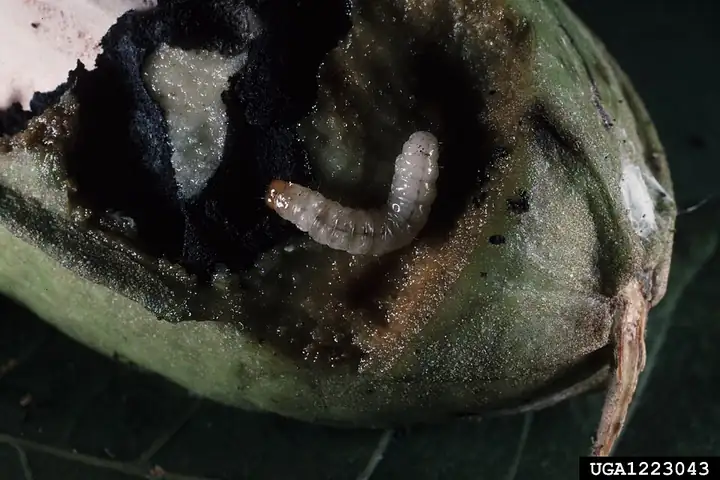
Hickory shuckworm
Cydia caryana
| Type | Insect |
|---|---|
| When | Moths from mid-April; the worst damage from midsummer to harvest. |
| Pressure by region | High pressure: Southeast, South Central |
About
A small dark moth whose cream-colored caterpillars feed in the green shucks of pecans and hickory nuts. Damaged nuts fill poorly or drop early (Texas A&M; Oklahoma State).
Spotting it
Damage
Summer caterpillars inside young nuts make them drop; fall caterpillars tunnel in the shucks, so kernels fill poorly and shucks stick to the shells instead of opening ('sticktights') (Texas A&M; Oklahoma State).
How to find it early
Look for single creamy-white egg smears on the shucks, early nut drop in summer, and shucks that won't open in fall (Texas A&M).
When
Moths from mid-April; the worst damage from midsummer to harvest.
Life cycle
It spends the winter in old shucks on the tree or ground and has several generations a year (three in Oklahoma); each caterpillar feeds in a shuck for about 15 to 20 days (Oklahoma State; Texas A&M).
What to do, gentlest first
Start at the top. Sprays are a last step; always read and follow the product label.
Clean up old shucks Prevent
Rake up and destroy old shucks and dropped nuts, where the pest spends the winter (Texas A&M).
Spinosad Organic spray
Only where it has been a problem before: spray when nuts reach half-shell hardening, and again 10 to 14 days later if needed (Texas A&M).
Big trees are hard to cover from the ground. Follow the label.
Plants it goes after
Pressure by region
Our sources cover Texas and Oklahoma only; the regional ratings are estimates based on where pecans and hickories grow.
| Northeast | Not found here |
|---|---|
| Southeast | High pressure |
| South Central | High pressure |
| Midwest | Moderate |
| Great Plains | Moderate |
| Mountain West | Not found here |
| Southwest | Moderate |
| Pacific Northwest | Not found here |
| California | Not found here |
| Alaska | Not found here |
| Hawaii | Not found here |
Ratings come from extension sources where available; some are estimates, as noted above.
Sources
Photo: Photo: Louis Tedders, USDA ARS / Wikimedia Commons, CC BY 3.0 US (CC BY 3.0 US). Photo resized for the web.

Planting dates and advice are general guidance; check with your local Cooperative Extension office for your area.