
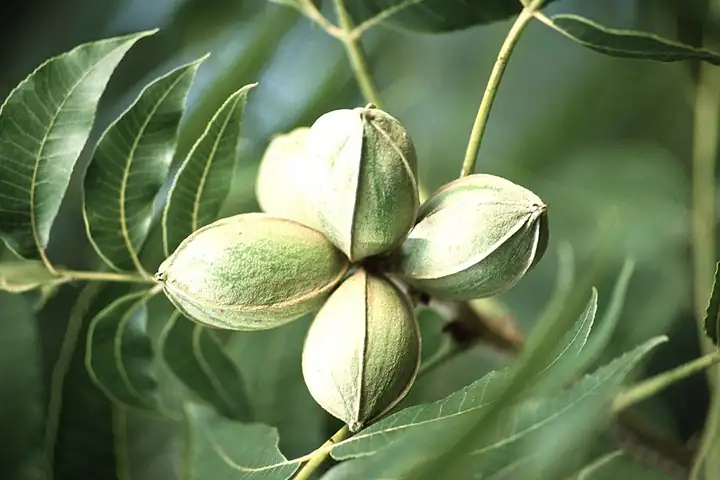
Pecan
Carya illinoinensis · Walnut family (Juglandaceae)
| Hardiness zones | 5 to 9 |
|---|---|
| Sun | full sun |
| Water | moderate |
| Life cycle | perennial |
| Frost | Hardy: takes frost |
| Soil pH | 6.0–6.5 |
| Spacing | 360 to 960 inches |
About Pecan
Pecan is a native nut tree that grows 70 to 100 feet tall, so a home tree needs a big yard, room away from the house and no power lines overhead. Grafted named varieties give the best nuts, and choosing a scab-resistant variety matters most in humid areas because big trees are too tall for a homeowner to spray.
NC State lists zones 5-9. In the North pick a northern variety whose nuts ripen at least a week before your usual first fall freeze (Kansas State), and avoid mountain sites, where late spring freezes cut yields (Clemson).
When to plant
Timing is counted from your average last spring frost (and first fall frost). Sow & Tell works out the actual dates for your ZIP code.
Plant dormant trees: bare-root trees in late fall or early winter in South Carolina (Clemson) or in March, as soon as the soil can be dug, in Kansas (Kansas State). Space trees 60 to 80 feet apart in home landscapes (Clemson; Kansas State allows 30 to 35 feet as a minimum). Grafted trees start bearing about 5 to 7 years after planting (Kansas State).
Soil
Deep, well-drained soil; avoid soggy ground, hardpan or stiff clay, and thin sand over a high water table (Clemson). Kansas State asks for at least 3 feet of loose topsoil on upland sites.
Test the soil before planting and keep pH at 6.0 to 6.5, adding lime in late fall if the test calls for it.
Feeding
- Right after planting (if you have no soil test): complete fertilizer such as 16-4-8 or 12-6-6. Spread about 1 lb of 16-4-8 (or 1.5 lb of 12-6-6) over about 25 square feet around the tree and water it in.
- June or July of the first year: complete fertilizer such as 16-4-8 or 12-6-6. Repeat the same amount as at planting.
- Each February from the second year on: complete fertilizer such as 16-4-8 or 12-6-6, guided by a soil test. About 4 lb of 16-4-8 (or 5 lb of 12-6-6) per inch of trunk diameter, kept at least 12 inches from the trunk; on bearing trees broadcast it under the canopy in mid to late February.
- June or July, only if young trees grew less than 2 to 4 feet: nitrogen fertilizer such as 34-0-0 or calcium nitrate (15.5-0-0). About 1 lb of 34-0-0 or 2 lb of calcium nitrate per inch of trunk diameter.
- February, for the first three years: zinc sulfate. About 1 lb per tree; after that, add zinc only when a soil test shows a shortage (3 to 5 lb under large trees).
Don't put fertilizer in the planting hole or let shrubs crowd the root zone; zinc shortage shows as small, bronzed leaves in rosettes and dead twig tips.
Harvest
Shucks start to split in late September or early October (Kansas State). Gather nuts as soon as they fall, or shake the tree once the first ones drop, and don't leave them lying on wet ground (Clemson; Kansas State).
One crop each fall, as shucks split from late September into October. Many varieties bear heavily one year and lightly the next; feeding by soil test, healthy leaves and water during August and September dry spells help nuts fill well.
Varieties (21)
| Variety | Type | Days | Notes |
|---|---|---|---|
| Caddo | Type I (protandrous) | Slender, golden kernels. About 67 nuts per pound and 54% kernel; bears young and steadily. Small, football-shaped nuts that crows steal easily; black aphids like it. | |
| Cape Fear | Type I (protandrous) | Large nuts of good quality; scab resistant and heavy-bearing even as a young tree. | |
| Cheyenne | Type I (protandrous) | On Texas A&M's list of improved varieties. | |
| Creek | Type I (protandrous) | Small nuts of average kernel quality; scab resistant and productive. | |
| Desirable | Type I (protandrous) | Large, well-filled nuts (about 45 per pound, 51% kernel) that shell well; crops steadily from year to year. | |
| Giles | Type I (protandrous) | Northern pecan; about 6.1 g per nut and 52% kernel. | |
| Major | Type I (protandrous) | Northern pecan; small nuts (about 5.6 g, 49% kernel) in Kansas tests. | |
| Oconee | Type I (protandrous) | Large nuts with good kernels; productive but poorly scab resistant. | |
| Pawnee | Type I (protandrous) | Light-colored kernels of excellent quality. Medium-large nuts (about 45-56 per pound, 54-56% kernel); good aphid resistance. Popular in western and northern pecan areas. | |
| Peruque | Type I (protandrous) | Northern pecan; small nuts (about 5.6 g) with a high kernel percentage (about 59%) in Kansas tests. | |
| Colby | Type II (protogynous) | Northern pecan; about 6.7 g per nut and 43% kernel in Kansas tests. | |
| Elliott | Type II (protogynous) | Plump, high-quality halves with a hickory-like flavor. Small, teardrop-shaped nuts (about 77 per pound, 51% kernel); highly scab resistant, which suits home orchards. | |
| Forkert | Type II (protogynous) | Large, high-quality nut with a thin shell. | |
| Gloria Grande | Type II (protogynous) | Large nuts with excellent kernels; highly scab resistant and steady once mature. | |
| Kanza | Type II (protogynous) | Small nuts (about 74 per pound, 52% kernel); excellent cold hardiness and, so far, excellent scab resistance. | |
| Kiowa | Type II (protogynous) | Large, high-quality nuts on a heavy-bearing tree. | |
| Lakota | Type II (protogynous) | USDA release from 2007; about 54 nuts per pound and 58% kernel; excellent scab resistance. | |
| Posey | Type II (protogynous) | Northern pecan; about 6.5 g per nut and 52% kernel in Kansas tests. | |
| Stuart | Type II (protogynous) | Large nuts with excellent kernels; long planted across the Southeast. | |
| Sumner | Type II (protogynous) | Large nuts (about 54 per pound); slow to start bearing and tends to alternate; a favorite of black pecan aphids. | |
| Wichita | Type II (protogynous) | On Texas A&M's list of improved varieties. |
Pests to watch for
Pecan weevil, Pecan nut casebearer, Hickory shuckworm, Aphids, Twospotted spider mite, Stink bugs, Fall webworm, Tree squirrels, Birds
Diseases and problems
Pecan scab, Powdery mildew, Zinc deficiency (rosette), Early nut drop
In the kitchen
Eaten as a snack, stirred into oatmeal, yogurt and salads, and baked into pecan pie, cookies, breads, cakes, pralines and candies (Oklahoma State; University of Arkansas).
Keeping it: Dry the nuts well, then keep them cool and sealed, away from strong-smelling foods they can soak up: in the shell they keep about 4 months at room temperature and about 18 months in the refrigerator, and in-shell or shelled nuts keep 2 years or more in the freezer (NMSU; Kansas State).
Safety: Pecans are tree nuts, one of the major food allergens named by the FDA; anyone with a tree-nut allergy should avoid them. Brittle limbs break in storms, so keep trees well away from houses and play areas (NC State; Clemson).
Pets: No ASPCA plant entry for pecan was found; the ASPCA lists the related bitter pecan (water hickory, Carya aquatica) as non-toxic to dogs, cats and horses. The ASPCA warns that nuts, pecans included, are high in fats that can cause vomiting, diarrhea and possibly pancreatitis in pets.
Sources
- plants.ces.ncsu.edu
- hgic.clemson.edu
- bookstore.ksre.ksu.edu
- aggie-horticulture.tamu.edu
- pecanbreeding.uga.edu
- extension.okstate.edu
- uaex.uada.edu
- fda.gov
- aspca.org
- aspca.org
- extensionentomology.tamu.edu
Photo: Photo: Jerry A. Payne, USDA ARS / Wikimedia Commons, Public domain. Photo resized for the web.

Planting dates and advice are general guidance; check with your local Cooperative Extension office for your area.