
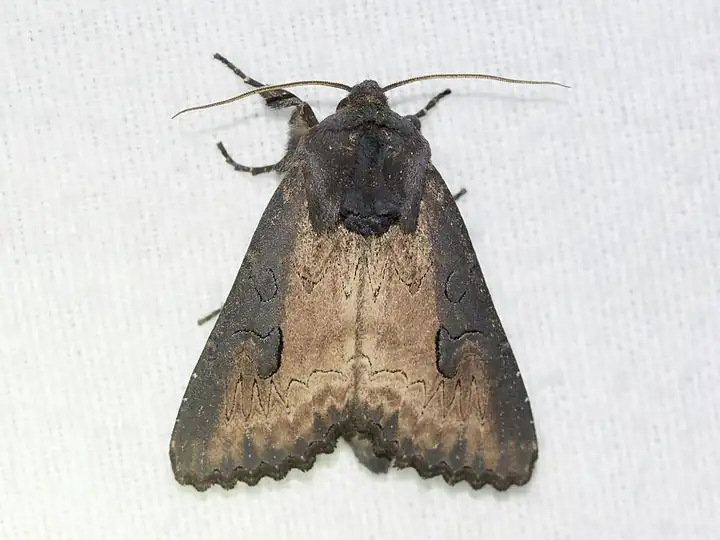
Iris borer
Macronoctua onusta
| Type | Insect |
|---|---|
| Pressure by region | Moderate: Northeast, Southeast, Midwest |
About
A pinkish caterpillar, up to about 2 inches long, that tunnels down iris leaves into the rhizomes. The adult is a moth with chocolate-brown front wings and a wingspan of up to 2 inches (UMN).
Spotting it
Damage
Leaves show pinprick holes, chewed edges and tan or water-soaked streaks, and their tips turn brown. Larger caterpillars hollow out rhizomes, which often get bacterial soft rot and turn slimy, soft and foul-smelling (UMN, Virginia Tech).
How to find it early
In spring, look for streaks and chewed edges on young iris leaves. In July, dig any plant with brown leaf tips or dying leaves and check the rhizome for caterpillars and rot (UMN).
When
Leaf feeding in spring, rhizome feeding in midsummer; moths fly in late summer and fall.
Life cycle
There is one generation a year. Eggs spend winter on old iris leaves and debris and hatch in spring; caterpillars reach the rhizomes by midsummer, pupate in the soil, and moths lay new eggs in late summer and fall (UMN, Virginia Tech).
What to do, gentlest first
Start at the top. Sprays are a last step; always read and follow the product label.
Clean up old leaves Prevent
Cut and remove old iris leaves and debris, where the eggs spend winter. Do it in fall after a hard frost, or in early spring before new growth starts (UMN, Virginia Tech).
Grow Siberian iris Prevent
UMN says Siberian iris tolerates iris borer better than other types.
Squeeze or remove caterpillars By hand
Pinch leaves along fresh streaks to crush the small caterpillars inside, or remove damaged leaves (UMN, Virginia Tech).
Dig and clean rhizomes By hand
Dig damaged plants, cut away tunneled or rotten parts, and throw out badly infested rhizomes. Virginia Tech suggests soaking cut rhizomes for about 10 minutes in 1 cup of household bleach per gallon of cool water, then letting them dry for several days before replanting.
Beneficial nematodes Natural enemies
Apply insect-killing nematodes (Steinernema or Heterorhabditis) to the soil during rain or with watering (UMN, Virginia Tech).
Spinosad on young leaves Organic spray
Spray when leaves are about 4 to 6 inches tall in spring, as the eggs are hatching and the caterpillars are still small. A second spray 10 to 14 days later may be needed (UMN).
Spinosad is toxic to bees for 3 hours to a day after spraying (PNW 591), so never spray open flowers or plants where bees are working. Some guides list imidacloprid; it is a neonicotinoid that harms pollinators, so skip it. Read and follow the label.
Plants it goes after
Pressure by region
Virginia Tech says it occurs across the eastern United States wherever iris grows, and Minnesota Extension covers it there. All ratings are estimates, including the low ratings for the West, Alaska and Hawaii.
| Northeast | Moderate |
|---|---|
| Southeast | Moderate |
| South Central | Low |
| Midwest | Moderate |
| Great Plains | Low |
| Mountain West | Low |
| Southwest | Low |
| Pacific Northwest | Low |
| California | Low |
| Alaska | Low |
| Hawaii | Low |
Ratings come from extension sources where available; some are estimates, as noted above.
Sources
Photo: Photo: Owen Strickland, CC BY 4.0, via Wikimedia Commons (CC BY 4.0). Photo resized for the web.

Planting dates and advice are general guidance; check with your local Cooperative Extension office for your area.